Last updated: 2026-07-20
File Becomes Part
The Quiet Industrial Truth About 3D Printing
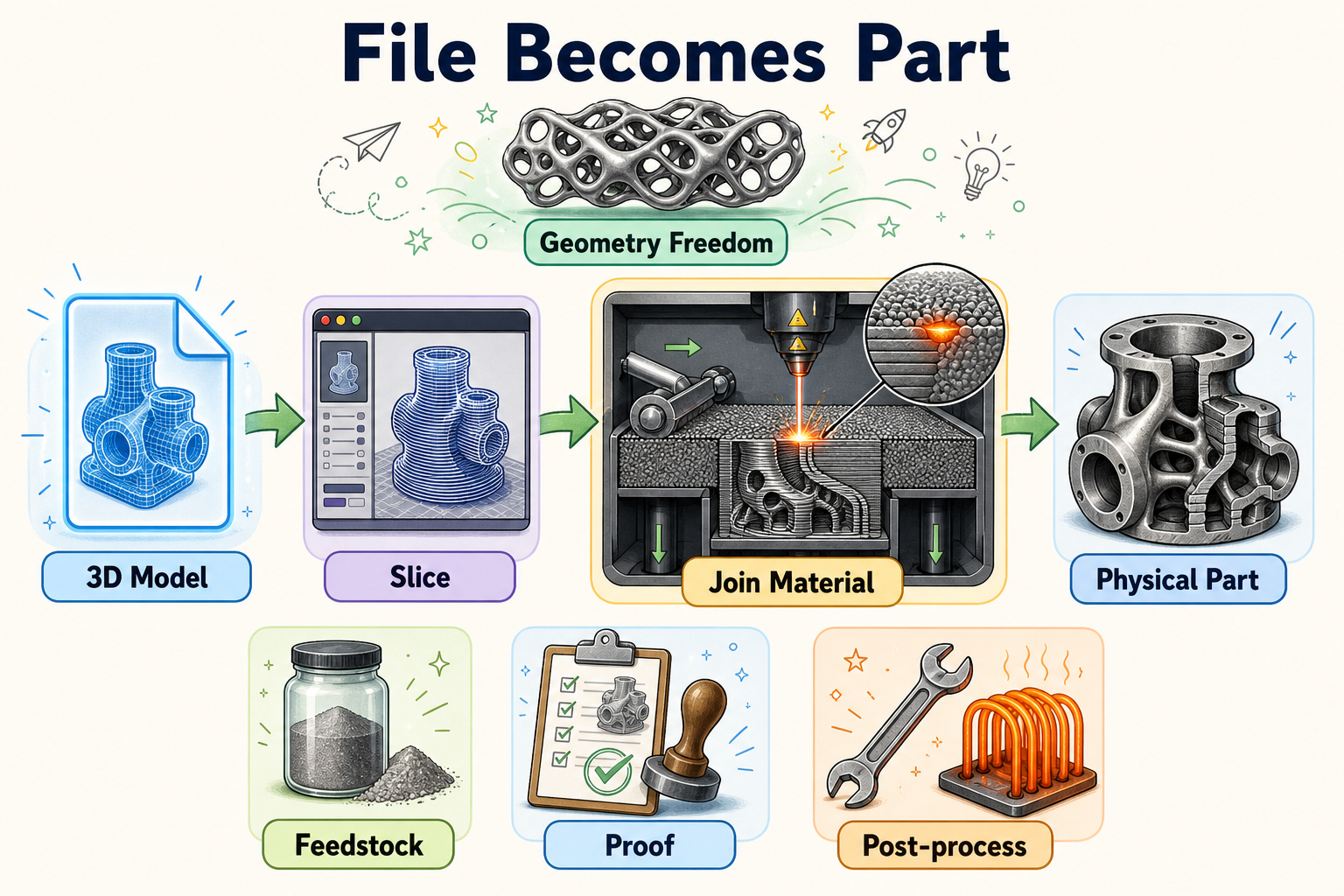
On a night in 1983, in a lab that still smelled of ultraviolet coatings, a solid object rose from a vat of liquid resin one hair-thin layer at a time. Charles “Chuck” Hull was not trying to abolish factories. He was trying to turn a drawing into a thing without waiting for a machine shop. That single act — file becomes part — still defines additive manufacturing. Everything loud that followed, from kitchen toy frogs to jet-engine nozzles to bankrupt pure-play empires, is a variation on that quiet mechanism.
This long-form essay covers the full research base on the current state of 3D printing: what the technology is, how the process families differ, why materials and qualification still rule, where money is actually made, which industries crossed into real production, why the home-factory dream stalled, how AI and defense policy are reshaping the field, and what a sophisticated skeptic still gets right in 2026.
Additive manufacturing makes geometry cheap and change cheap — until physics, powder, and proof put a price on every layer. The winners pay that price only where geometry, customization, uptime, or trusted readiness is worth it.
Read order follows the tech-tree of the field itself: invention, mechanism, process families, industrial proof, materials physics, economics, capital markets, consumer split, geopolitics, AI, contrarian limits, and decision rules. The appendix preserves the full research question map.
References
Research appendix (this site)
- Research appendix home
- Research index
- 01 · What AM is
- 02 · Process landscape
- 03 · Materials and qualification
- 04 · Market and economics
- 05 · Industrial adoption
- 06 · AI × AM
- 07 · Consumer vs industrial
- 08 · Geopolitics and Canada
- 09 · Contrarian limits
- 10 · Outlook
- Research references
- Question ledger
Selected primary sources (full list in research references)
- GE Aerospace — 30,000 Additive Fuel Nozzles
- Made in Alabama — 100,000th nozzle
- ISO/ASTM 52900 vocabulary
- NIST SP 1176 — AM costs
- TCT — NDAA AM restrictions
- 3D Printing Industry — Canada DIS and AM
- VoxelMatters — Stratasys acquires Markforged
- 3D Systems — Our Story
Chapters
Go deeper in the source dossier
The full OOM research package — definitions, process landscape, market tables, GE case evidence, geopolitics, AI convergence, contrarian scan, and the master question ledger — lives here as a structured appendix.
Pick a real place. Use what this essay made possible. You lead.