Last updated: 2026-07-20
7. When the Spreadsheet Says Print
There is no single official census of “all additive manufacturing.” Analyst houses draw different borders around hardware, materials, software, and services; around industrial systems versus desktop machines; around metal only versus everything that extrudes or cures. That is why responsible 2025–2026 figures disagree without anyone necessarily lying.
Trade citations of Wohlers Report 2026 put the global additive ecosystem near $24.2 billion in 2025, up about 10.9 percent year on year, with services stressed as a maturity signal. Narrower cuts circulate near $12.5 billion with a path toward roughly $20 billion by 2030. MarketsandMarkets-style bands around $16.4 billion in 2026 growing toward the low thirties by 2032 at something like eleven to twelve percent compound growth appear in secondary coverage. AM Research quarterly cuts have shown polymer-plus-metal production-oriented revenue around $4.35 billion in a single quarter of 2026 with low-teens growth. Metal-only commentary sometimes sits in a $6–7 billion class. U.S. defense additive budget requests in secondary reports land near $3.3 billion for fiscal 2026 — a demand pulse, not a commercial market size.
The decision-useful reading is blunt. Additive is a low-double-digit-billion global industry growing roughly high single to low double digits annually. It is neither dead nor a moonshot hypercurve. Ask every salesman which perimeter his number includes.
Trend analysis has to be equally blunt. Full-ecosystem revenue behaves like a maturing industrial S-curve segment, not like transistor density. Machine capability — more lasers, faster desktops, better monitoring — moves in stepwise jumps with plateaus. Share of global manufacturing value-add remains tiny, historically framed as well under one percent. Thermal physics, powder cost, post-processing labor, and multi-year certification half-lives break naive exponential stories. Paradigms that could re-steepen the curve include reliable high-volume metal binder routes, radically cheaper powder, autonomous post-processing cells, and first-time-right process control that collapses scrap.
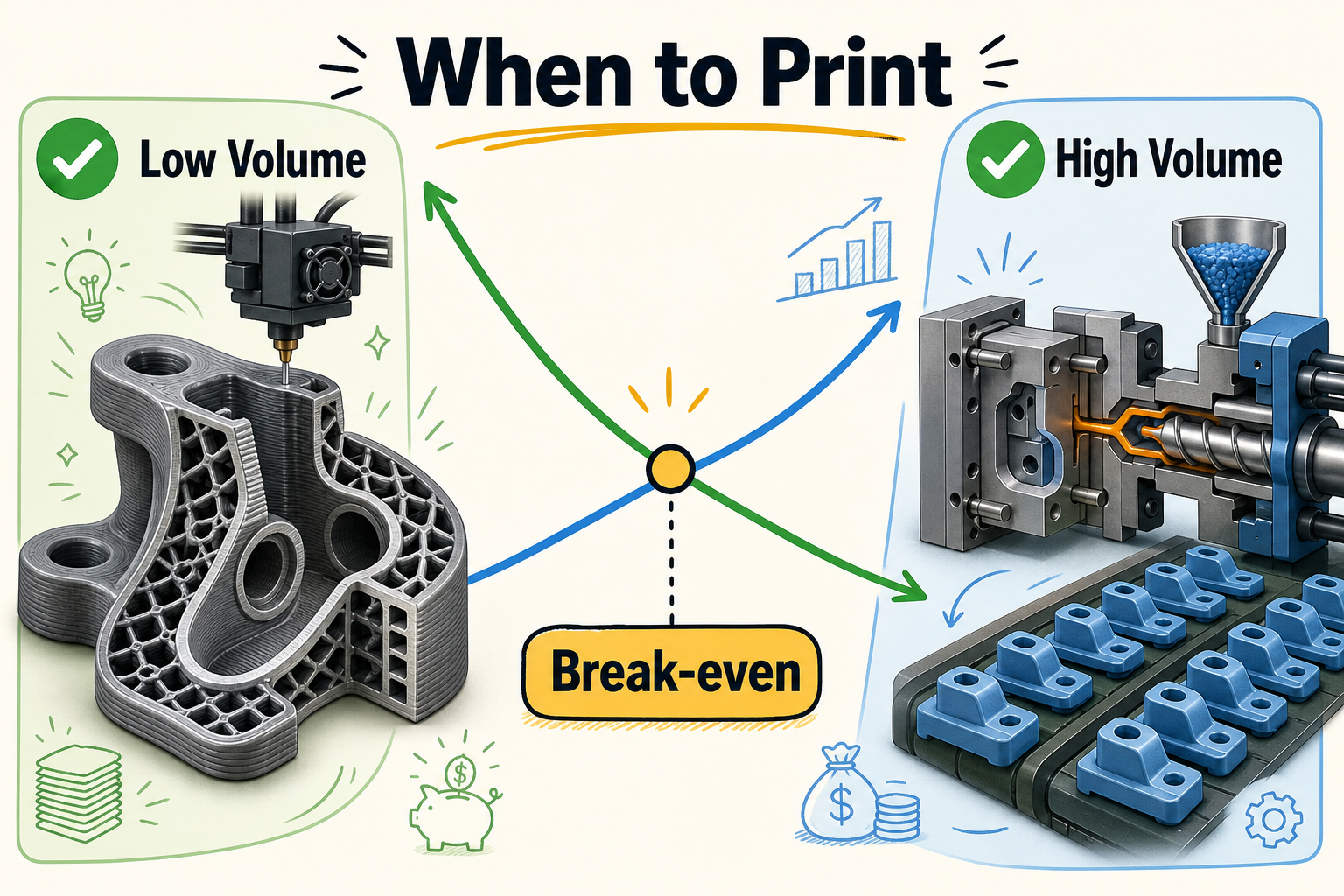
Classical break-even logic still holds with shifting constants. Very low volume, high complexity, and fast change favor additive. High-volume simple parts still belong to molding and stamping once tools are amortized. Published polymer examples often look competitive into hundreds or low thousands of units depending on geometry. Metal break-evens are often far lower in unit count unless the design requires additive channels and consolidation or the alternative is a painful multi-piece assembly. Total cost must count tooling avoidance, inventory and obsolescence, buy-to-fly scrap versus billet machining, qualification overhead, post-processing yield, and downtime avoided when a spare can be produced on demand. Aircraft spares remain the canonical case where the printed unit looks expensive and the spreadsheet still smiles.
Hardware, materials, software, and services are not one business. Trade coverage of Wohlers-style findings stresses services outpacing hardware as the industry sells outcomes and capacity. Materials are recurring revenue with teeth. Software encodes scarce process knowledge and shows up as a fast-growing slice in AI-in-AM market cuts. Captive industrial users often capture the real value inside engines and implants rather than inside equipment equities.
The spreadsheet is cold enough to be useful. Capital markets, for a few loud years, preferred heat. That is the next chapter.