Last updated: 2026-07-20
1. The Night the Solid Appeared
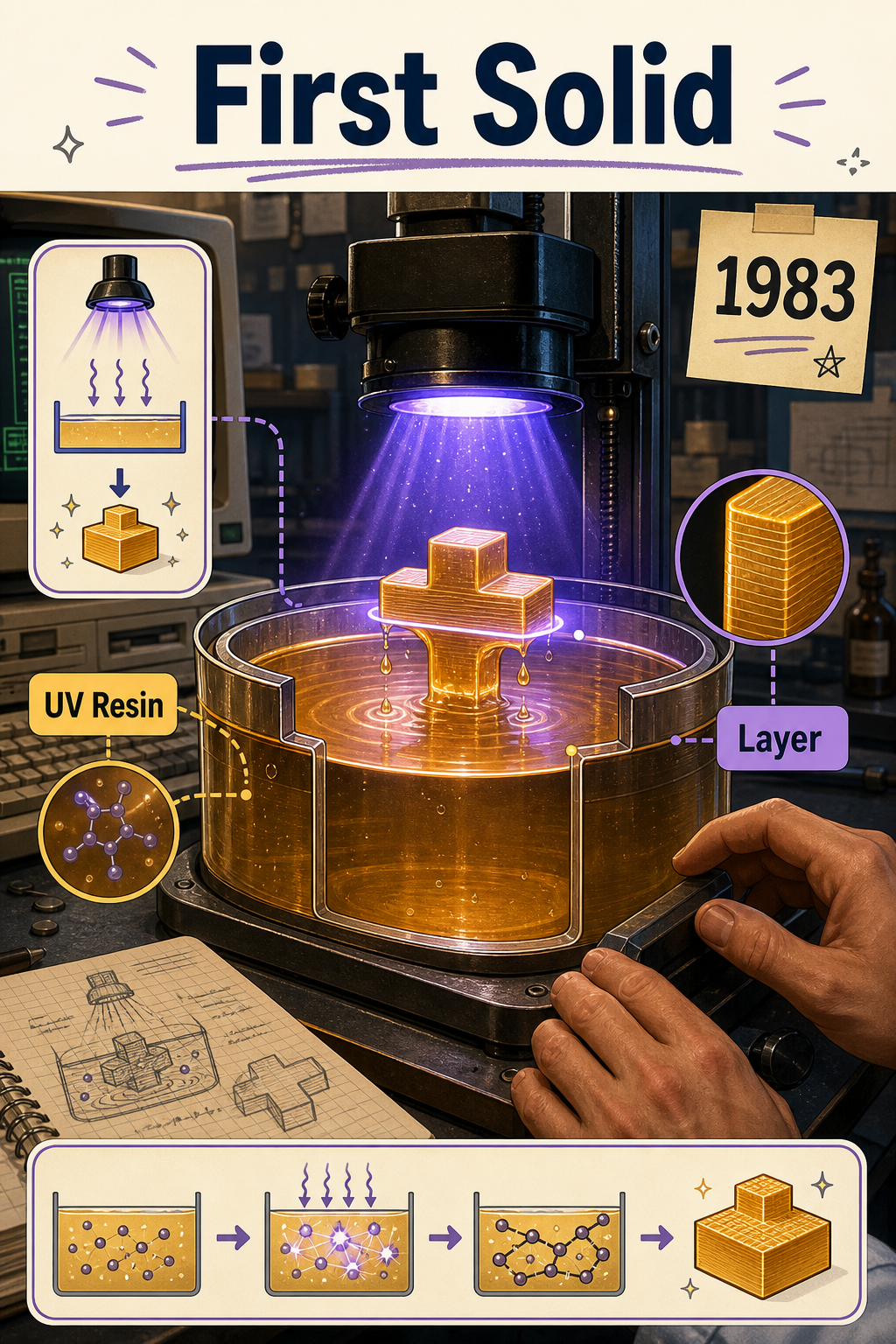
On November 10, 1983, Charles “Chuck” Hull watched a small solid object finish rising from a vat of liquid resin. He worked with ultraviolet light that hardened tabletop coatings. That night he bent the same physics toward a different job: building a three-dimensional shape by curing one thin layer, then another, then another.
He did not invent the idea that light can stiffen a polymer. He invented a system that took a digital description of a solid and turned it into stacked, solidified cross-sections. He later named the method stereolithography — “stereo” for solid, three-dimensional form; “lithography” for writing with light. In August 1984 he filed the patent. In 1986 the patent issued and he co-founded 3D Systems. In 1987 the company shipped the SLA-1, the first commercial machine of its kind.
The scene matters because it contains the whole industry in miniature. Hull’s problem was not a shortage of factories. His problem was time and translation. A design lived in drawings. A prototype lived weeks or months later, after someone cut or molded it. Stereolithography collapsed that gap for a class of shapes that resin and light could handle.
Every later argument about 3D printing is an argument about how far that collapse can travel.
Can the same logic move from brittle prototype resin to titanium that flies? From a single demo part to a hundred thousand identical tips with flight hours behind them? From a lab curiosity to a defense-industrial asset you are allowed to plug into a classified network? The answers are uneven, which is why the popular story of 3D printing keeps oscillating between miracle and dud.
Hull’s night did not abolish machining. It opened a portal. On one side of the portal sit bits: CAD models, scan data, build files. On the other side sit atoms: powders, resins, wires, cured polymers, fused metal. Sensors and software spend their lives turning atoms into bits. Additive manufacturing spends its life turning designed bits back into atoms.
That portal is the technology. Everything else is a fight over materials, proof, and price.
The next question is the one Hull’s first solid object forces into the open: what, exactly, is the machine doing when a file becomes a part?