Last updated: 2026-07-20
5. The Walnut That Flew
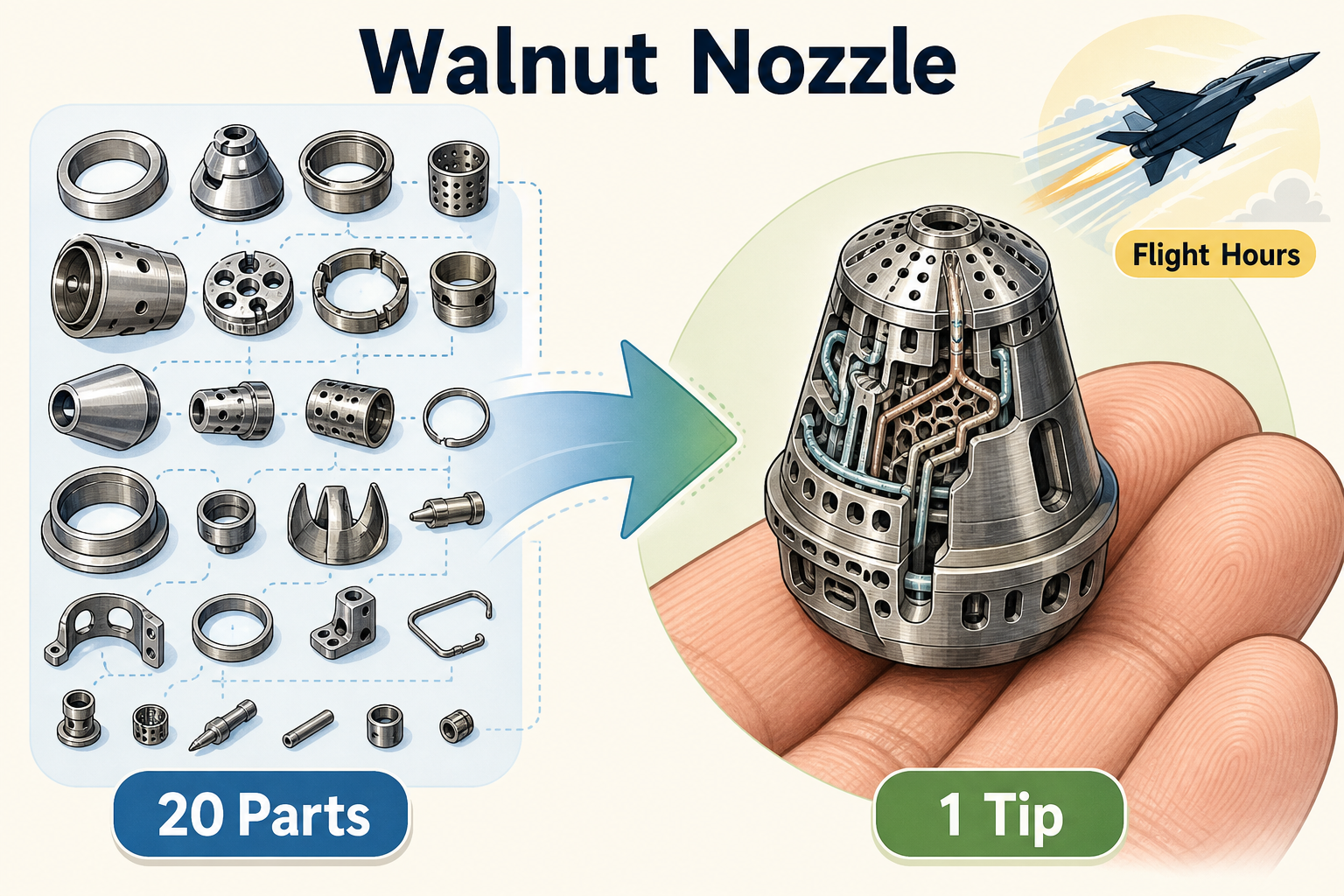
Mohammad Ehteshami remembered trying to cast the fuel nozzle geometry eight times. Every attempt failed. The tip was a maze of small features meant to meter and mix fuel and air in a LEAP engine combustor. Conventional thinking assembled it from many pieces — more than twenty in the accounts that settled into industry lore — welded and brazed into a whole. Joints meant weight, cost, and places to fail.
GE Aviation engineers in the Cincinnati orbit already knew a local shop that did something strange with metal powder and lasers. Greg Morris, with Wendell Morris and Bill Noack, had built Morris Technologies into a place that could grow metal parts from computer files. GE had been working with them for years. When the nozzle file arrived under secrecy, Morris’s team did not cast it. They printed it.
The first printed tip did what the castings had not. It collapsed the assembly into one piece. Public GE reporting later put the weight reduction near twenty-five percent and durability around five times the prior design. Nineteen additive tips would sit in each LEAP engine. LEAP itself, a CFM joint venture with Safran, was sold on fuel burn improvement on the order of fifteen percent versus the previous generation — a system claim, not a nozzle-only miracle, but the nozzle was no longer a science poster. It was hardware.
GE bought Morris Technologies in 2012. The harder drama moved to Auburn, Alabama, where the company built a factory around additive production rather than around tours. In October 2018 the plant marked the thirty-thousandth fuel nozzle tip grown there. In August 2021 it shipped the hundred-thousandth. By then LEAP engines had piled up years of flight hours. The point of the milestones was not novelty. The point was rate, yield, and a cost curve that had to bend while airlines took airplanes.
This is what industrial additive looks like when it is real. Not a single heroic print. A production system: powder practice, parameter control, post-processing, inspection, and the unglamorous discipline of making the next tip as trustworthy as the last.
The paired story — waiting in a later chapter — is what happens when capital markets fall in love with “additive platforms” that never find an Auburn. The nozzle teaches the positive case with Sinatra-Test force: if additive can live forever in a LEAP combustor path, it can live in other brutal environments. It does not teach that every bracket on earth should be printed.
Medical and dental learned a rhyming lesson without jet fuel. When every unit is already patient-specific, tooling never amortizes, and digital dentistry already exists, additive stops being exotic and becomes workflow. Energy companies learned another rhyme: when a spare’s absence stops a turbine or a line, print cost is a rounding error next to downtime. Automotive learned the boundary the hard way. Fixtures and jigs print beautifully. High-volume structural body parts still meet a bouncer named cost-per-part and rate.
Ehteshami’s failed castings and Morris’s first good tip are the scene. Auburn’s hundred thousandth ship is the proof. Between them sits the real subject of modern additive manufacturing: not whether a machine can grow a shape, but whether an organization can grow a shape that regulators, fatigue curves, and chief engineers will repeatedly accept.
Shapes accept no applause. They accept microstructure. That is the next chapter’s weather.