Last updated: 2026-07-20
4. Seven Ways to Join
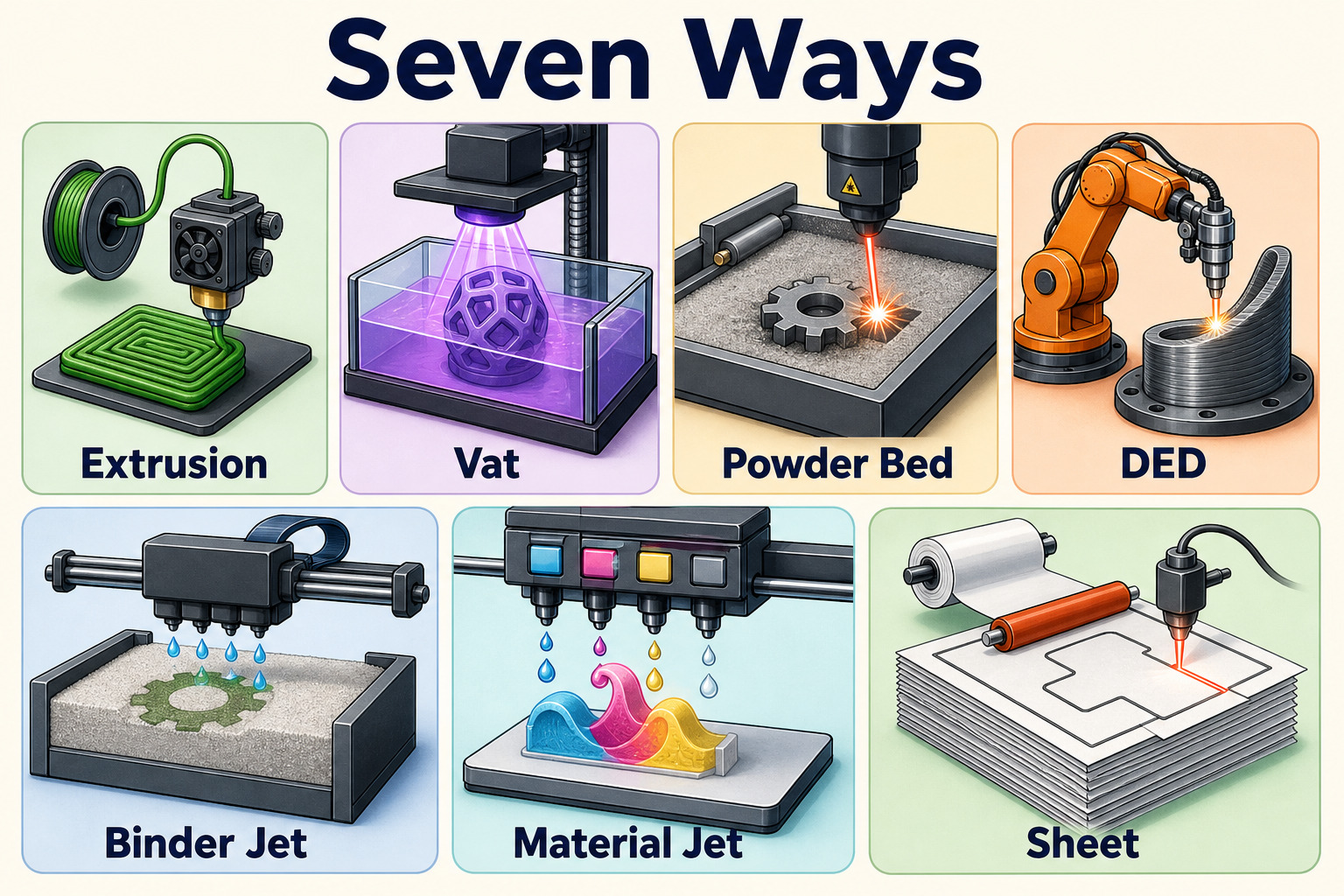
Brand names multiply like weeds. The standards backbone does not. ISO/ASTM 52900 sorts additive manufacturing into seven process categories. Buyers who learn the categories stop buying poetry.
Material extrusion pushes solid feedstock through a nozzle. Thermoplastics, filled polymers, continuous fiber, and some metal-bound filaments live here. The honest industrial jobs are jigs, fixtures, factory tooling, high-temperature polymer parts, and continuous-fiber structures. Commodity trinket printing is a different economy wearing the same nozzle shape.
Vat photopolymerization cures liquid resin with light. Dental models, surgical guides, hearing-aid shells, and high-detail prototypes dominate because every unit is already a custom geometry and surface fidelity pays.
Powder bed fusion spreads powder and fuses selected regions with a laser or electron beam. Metal laser powder bed fusion — marketed under a soup of names like SLM, DMLS, LPBF — is the aerospace and implant workhorse when feature resolution and growing allowables matter. Polymer powder systems produce durable end-use plastics without the anisotropic weak bonds of cheap filament parts. Electron-beam metal systems run hot in vacuum and suit certain titanium workflows.
Directed energy deposition aims energy and metal feedstock at a surface as the material arrives. It behaves less like a “printer” and more like robotic welding with a path plan. Wire-arc builds large structures quickly with rough surfaces. Laser powder deposition clads and adds features. Hybrid cells pair deposition with CNC finishing. Factories that treat DED as “bigger powder bed” fail. Factories that treat it as digitally controlled weld deposition plus machining succeed.
Binder jetting prints binder into a powder bed at inkjet-like speeds, then sinters or infiltrates the green part. The pitch is rate and cost at higher volumes. The bruise is distortion, density scatter, mechanical property variation, and the long road to structural allowables. Sand binder jetting for foundry cores is mature in a way structural automotive metal still is not.
Material jetting deposits droplets and cures them — high-detail multi-material models and patterns. Sheet lamination bonds sheets. Both matter in niches; neither carries the center of industrial gravity in 2026.
Industrial value is not evenly distributed across the seven. Powder bed fusion, industrial extrusion, dental vat processes, and DED repair/large metal carry most of the serious production stories. Binder jetting remains the permanent candidate for metal volume. Hybrid additive-plus-subtractive cells are increasingly the real factory architecture: add where geometry demands it, cut where tolerance and surface demand it.
Procurement should decode brand soup by category and material class first. Build volume, rate, post-processing lag, parameter sets, monitoring, software lock-in, and — for defense — machine and software provenance matter more than the trademark on the trade-show booth.
The map of processes is a map of compromises. The next chapter leaves the taxonomy and enters a factory in Alabama, where one compromise became a hundred thousand flying parts.