Last updated: 2026-07-20
3. The Frog in the Kitchen
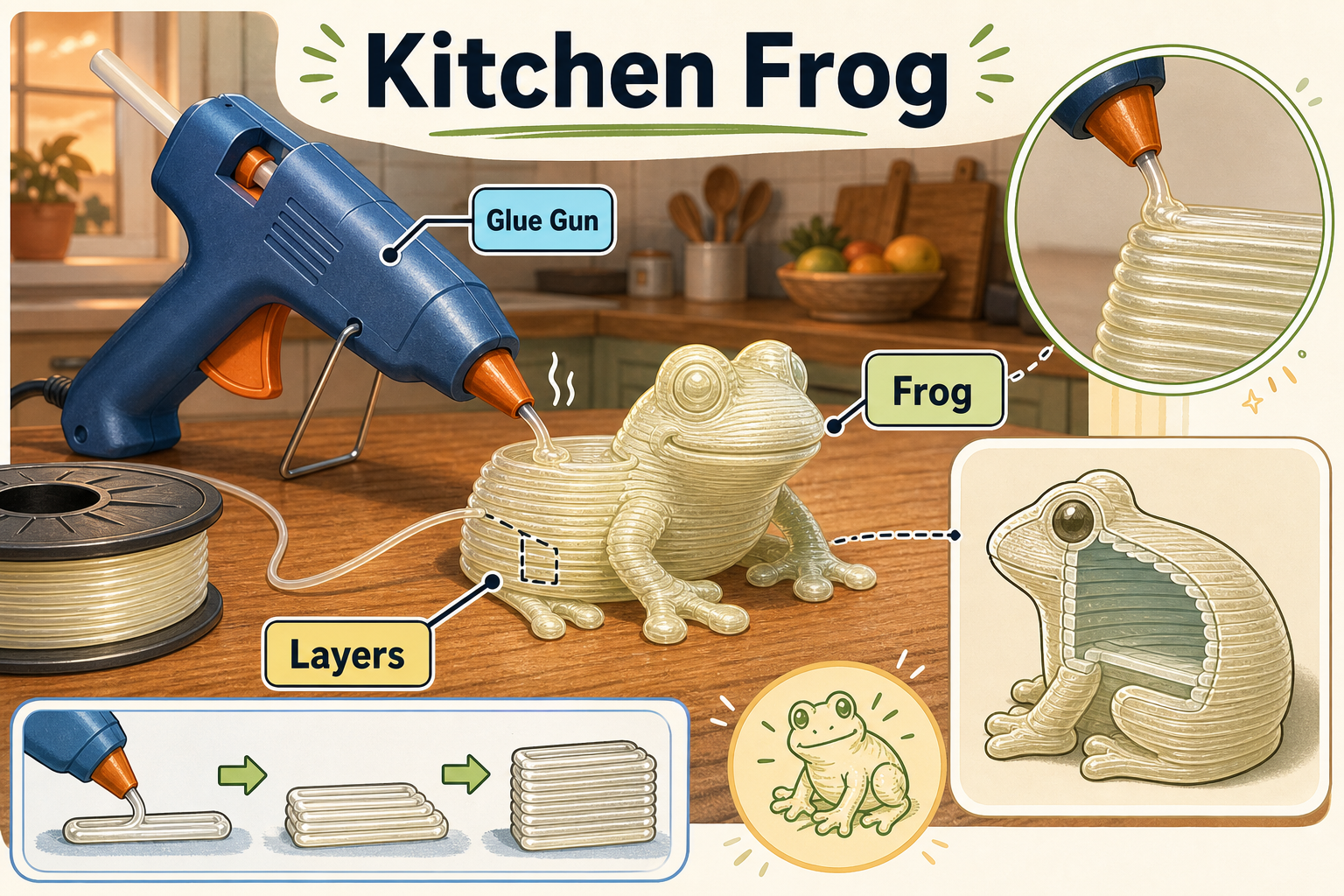
Scott Crump wanted a toy frog for his daughter. The story has been told so often inside the industry that it risks becoming wallpaper. It should not. In the late 1980s he loaded a hot glue gun with a mix of polyethylene and candle wax and built the little animal by hand, layer by layer. The act looked domestic. The insight was industrial.
Crump’s frustration was the same species as Hull’s: the distance from blueprint to prototype was too long. Automating the glue-gun motion — temperature-controlled liquefier, spooled filament, a machine that could draw in plastic the way a plotter draws in ink — produced fused deposition modeling, later trademarked as FDM and known more generically as material extrusion. He and Lisa Crump founded Stratasys. The early dream was an office prototyping machine, not a revolution in global manufacturing.
Material extrusion made additive tangible to millions of people who would never see a metal powder bed. Filament is understandable. A nozzle drawing plastic is understandable. When patents aged and Chinese manufacturing scaled high-speed desktop machines in the 2020s, extrusion became a consumer and prosumer wave strong enough to pressure legacy brands. That wave mattered. It still does not mean a kitchen replaces a supply chain.
Stereolithography proved that a computer could grow a solid from a vat. Extrusion proved that a computer could grow a solid from a spool. Each breakthrough created a new bottleneck. Resin systems needed better materials and cleaner handling. Filament systems needed strength, temperature resistance, reliability, and — much later — enough speed that the machine stopped feeling like a hobby that owned your weekend. Neither process, by itself, answered metal, flight, or implant law.
The frog is a creativity plot with teeth. A father makes a toy; a company follows; decades later continuous carbon fiber systems claim structural brackets, and Stratasys agrees in May 2026 to buy Markforged from Nano Dimension for about $42.5 million after Markforged did roughly $70 million in 2025 revenue. The kitchen experiment became an industrial product class. Public markets still had to learn that a product class is not the same thing as an equity destiny.
If light-cured resin and hot filament were the first two major trunks of the tree, the canopy that money and regulators care about now is wider — and more violently specialized. The next chapter maps the seven ways the industry learned to join.