Last updated: 2026-07-20
2. File Becomes Part
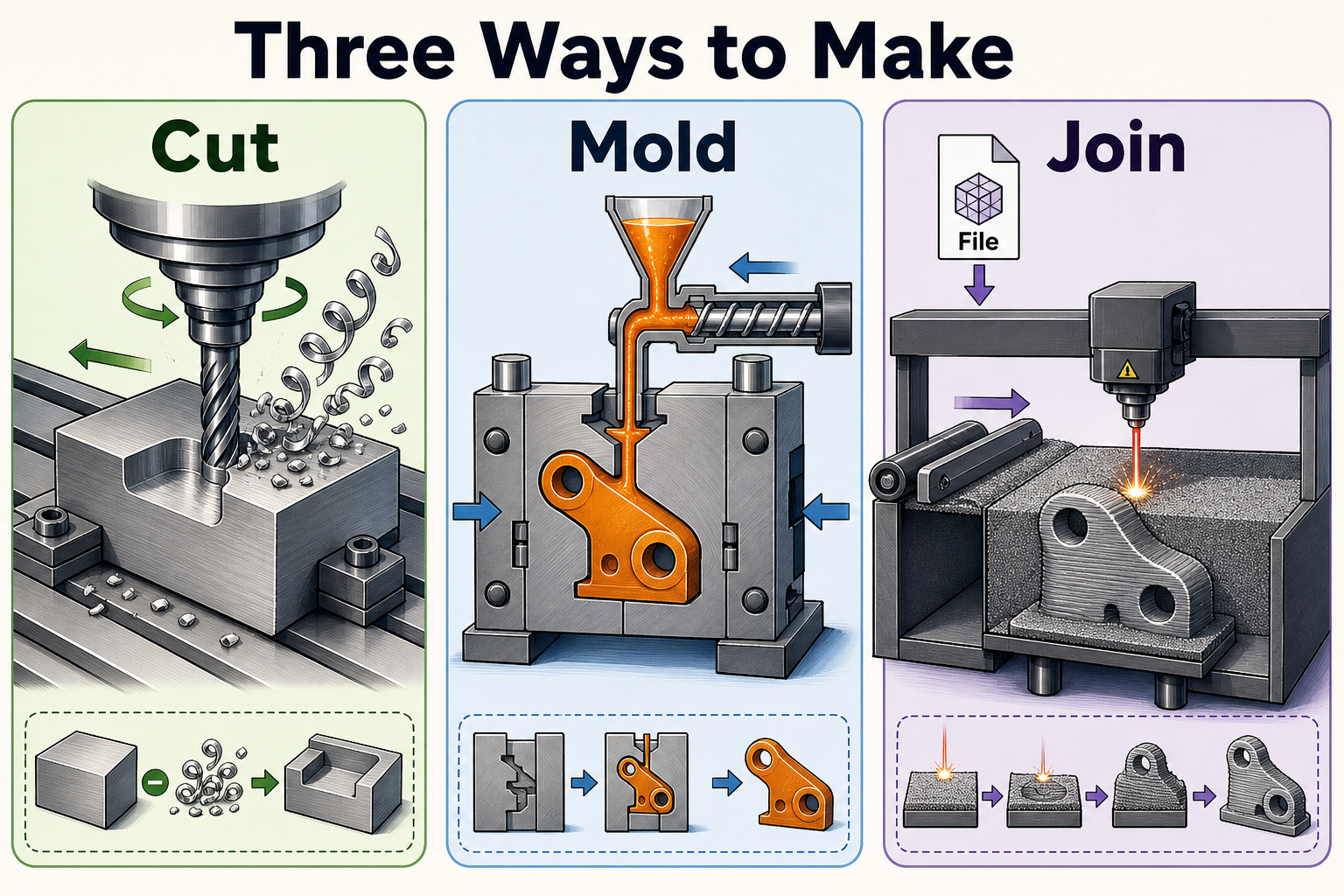
Additive manufacturing is a family of processes that build objects from three-dimensional model data by joining material, usually layer upon layer. That is not a slogan. It is the definition international standards bodies wrote down so engineers and regulators would stop arguing past each other with brand names.
The mechanism is simple enough to say in one breath and deep enough to organize an industry. A computer holds a solid model. Software slices the model into layers and toolpaths. A machine deposits, fuses, binds, or cures material only where the model says solid. Subtractive machining starts from a billet and removes what is not wanted. Formative processes — injection molding, casting, forging — reshape bulk material with tooling that encodes the shape in steel. Additive manufacturing encodes the shape primarily in data. Change the file and, within process limits, you change the part.
This is why “digital manufacturing” is both useful and dangerous as a phrase. It is useful because the design is software-shaped. It is dangerous because atoms do not obey compiler flags. Heat, residual stress, porosity, surface roughness, and powder chemistry still decide whether the printed object is a triumph or a liability.
Under this mechanism, some things become relatively abundant. Geometric complexity that would bankrupt a tool shop becomes printable. Early design iteration no longer waits on a mold. Variant count can rise without a matching pile of dies. In the best cases, a qualified build file can sit in a digital inventory while physical shelves shrink.
Other things stay scarce. Qualified process–material pairs with allowables a flight office will accept. Stable metal powder with tight chemistry. Post-processing capacity: support removal, heat treatment, hot isostatic pressing, machining, inspection. People who can design for the process and run a powder cell without turning the shop into a hazard. Trust artifacts — build logs, powder genealogy, calibration history — that make a part auditable.
Technology, in the useful sense of the word, takes something scarce and makes it abundant. Additive manufacturing made shape-from-data abundant. It has not made certified structural metal at commodity molding prices abundant. That gap is the industrial story of the last decade.
A non-technical decision-maker does not need a materials science degree to spot an additive problem. Ask whether the geometry is hard for conventional processes. Ask whether volume is low to medium or tooling amortization hurts. Ask whether value lives in weight, lead time, or uptime more than in pennies per identical unit. Ask whether the team can live with the surfaces and materials additive actually delivers. Ask whether there is a path to inspect and qualify the part for its real duty cycle. If most answers are no, the printer is a prototype aid. If several are yes, additive is a candidate route — not a slogan.
Desktop hobby printing and flight-critical metal production share this mechanism. They diverge on materials, evidence, and consequences. Conflating them produces the two classic mistakes of the 2010s: treating a library plastic trinket as the dawn of home factories, or dismissing industrial additive because a warped phone case looked silly.
The portal from bits to atoms is real. The next chapter is about the second major door through that portal — opened not in a coatings lab, but in a kitchen, with a glue gun and a toy frog.