Last updated: 2026-07-20
6. The Expensive Dust
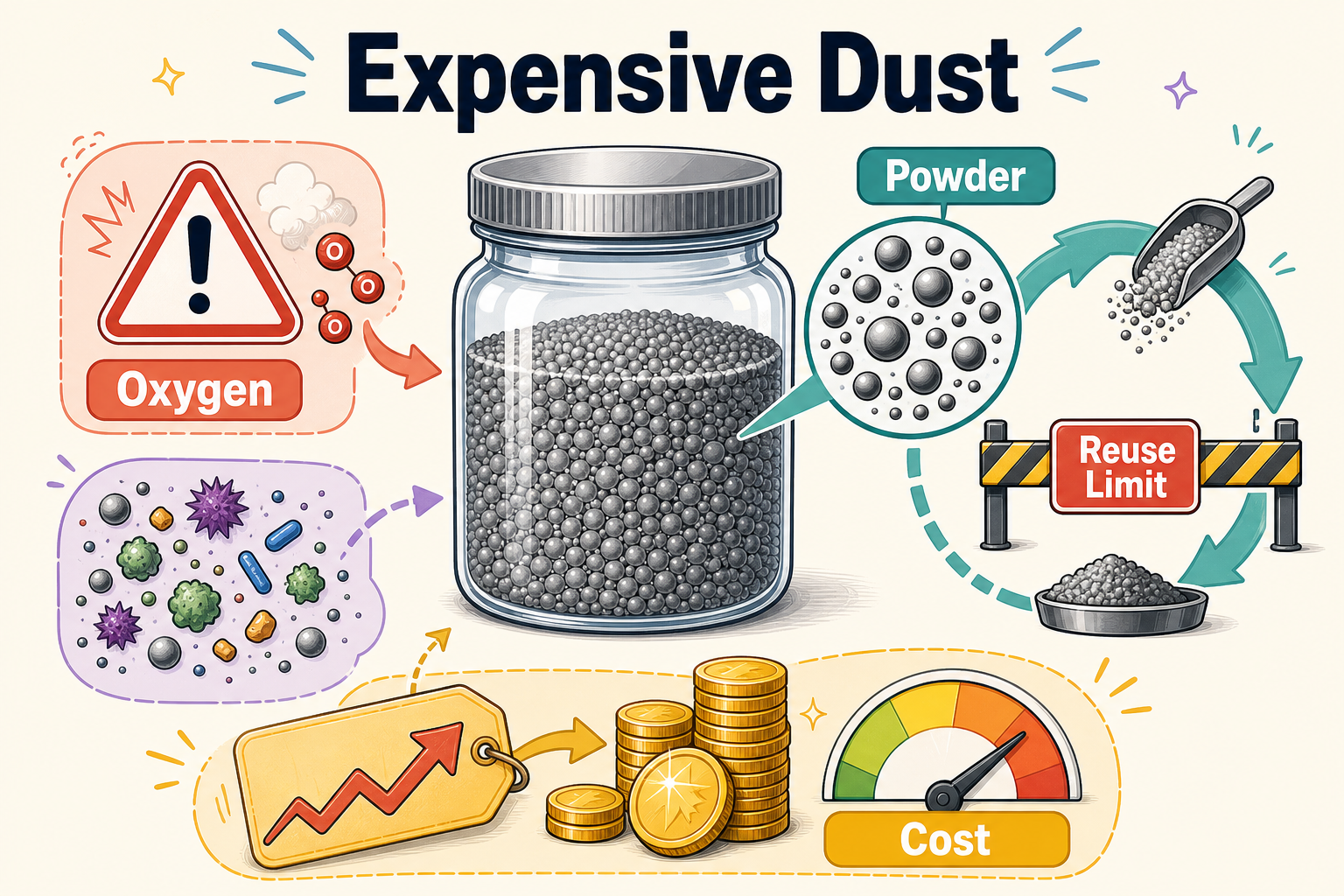
Metal additive feedstock is not bar stock with a different invoice. Gas-atomized powders need controlled particle size, chemistry, flow, and cleanliness. Every time powder cycles through a machine it can pick up oxygen, spatter, and history. Specifications limit reuse. Virgin powder price plus reclaim losses dominate cost models with a persistence that shop-floor optimism rarely survives.
NIST’s cost work and the literature that followed put numbers under what operators already felt. Material share of part cost is often large. Alloy choice is therefore an economic act, not only a metallurgical one. Designs that remove volume — lattices, thinner walls where allowed — attack the bill directly. Powder recycling is a quality system, not janitorial work. High-volume users eventually stare at vertical integration or long powder contracts the way airlines stare at fuel.
Polymers have their own ladder. Commodity PLA and PETG teach students and fill non-critical fixtures. Engineering nylons, filled grades, and powder-bed polymer systems carry real end-use loads. Photopolymer resins own dental models and guides. High-temperature PEI and PEEK families appear where aerospace and medical justify the invoice. Ceramics and multi-material graded structures remain specialized. Bioprinting with cells and hydrogels is a different life-altering ambition with different regulators; scoring “AM maturity” by organ headlines is a category error.
Layerwise joining leaves fingerprints. Properties can differ parallel versus perpendicular to the build. Steep thermal gradients leave residual stress that warps parts and cracks superalloys. Lack-of-fusion porosity, keyholing, and gas porosity damage fatigue life. Partially melted particles roughen surfaces until machining or finishing intervenes. Good design for additive does not deny this physics. It orients stress, adds machining stock on datum faces, specifies hot isostatic pressing and heat treatment where fatigue matters, and places supports where humans and tools can remove them.
Qualification is the product customers actually buy when the duty cycle is brutal. Process qualification asks whether a machine, powder class, parameter set, and post-process route can repeatedly make material inside a specification. Material allowables tell engineers what strengths and fatigue curves they may use. Part qualification asks whether this geometry, with this inspection plan, meets the safety case. In-situ cameras and machine-learning defect flags help scrap and learning. In 2026 they still assist non-destructive testing and mechanical coupons in high-criticality work; they do not replace a quality system.
Post-processing is often most of the calendar: supports, stress relief, HIP, heat treat, machining, surface treatment, inspection. A quote that sells “print time” and hides that chain is a lie of omission.
The audit pack is genealogy. CAD revision, build-file hash, machine identity and calibration, powder lot and reuse generation, operator, environment, anomalies, travelers, NDT, final dimensions. That pack is the additive cousin of a mill certificate, except more parameters can go wrong. Digitization raises the value of the qualified parameter set itself. Old forecasts of hundred-billion-dollar consumer IP apocalypse did not arrive on schedule. Industrial file and parameter leakage is the sharper knife.
Once the dust has a price and the proof has a price, the spreadsheet finally gets a vote. The next chapter is about when that vote says print.