Last updated: 2026-07-20
8. The Rollup That Came Apart
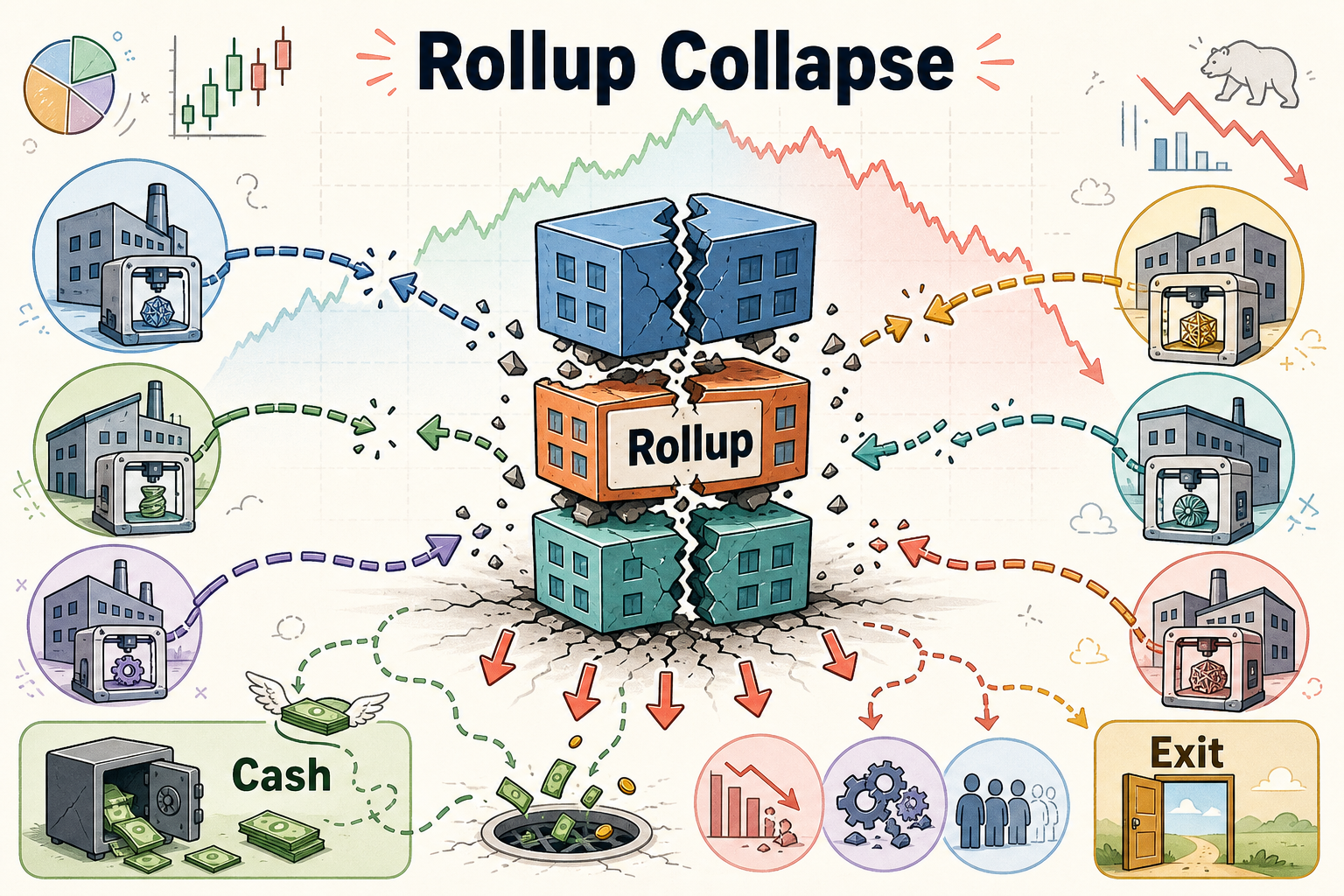
For a stretch of the 2020s it was possible to believe that additive manufacturing’s main plot was a public-market platform war. Stratasys and Desktop Metal tried to combine and failed. Nano Dimension, a company whose original identity sat in additively manufactured electronics, moved to buy Desktop Metal in a deal on the order of $179 million and closed in April 2025 after Delaware litigation forced the finish line into view. Desktop Metal’s independent board was in bankruptcy reorganization by July 2025. Core assets, including lines associated with ExOne and EnvisionTEC, sold in September 2025 toward defense- and energy-focused buyers under the Arc Impact name in trade press. Nano also bought Markforged for about $116 million in 2025, then agreed in May 2026 to sell Markforged — metal binder-jet carve-outs aside — to Stratasys for about $42.5 million. Markforged’s 2025 revenue sat near $70 million in the same reporting.
Read that sequence twice. Machines that print continuous fiber and bind metal powder are real. Dental clinics and aerospace plants keep printing. What failed was the idea that financial consolidation could substitute for unit economics, disciplined cash, and production anchors.
This is the capital-markets twin of the Auburn story. GE needed a nozzle and built a factory. The rollup era needed a story and built a maze of deals. When rates rose and industrial sales cycles stayed long, the maze had nothing to eat.
The lesson is easy to misuse. Misuse one: “additive is fake.” False — the LEAP tip and the clear aligner workflow disagree. Misuse two: “the next pure-play with a bigger slide deck fixes the industry.” Also false. Captive value inside products often outruns equipment equity narratives. Materials, software, and accredited services can be cleaner exposures than a fifth-place metal box vendor. Defense eligibility is becoming a binary filter on some revenue streams, not a marketing footnote.
Corporate structure is now part of the technology story because buyers live in the wreckage. A machine with orphans for service networks is a different asset than a machine with a living application base. Stratasys buying Markforged cheaply is a bet on continuous-fiber capability and channel after the fantasy multiples died. That is industrial logic. It is not romance.
Romance had already spent itself on the consumer myth. The next chapter returns to the living room that was supposed to become a factory and did not.