Last updated: 2026-07-20
Materials, properties, and qualification
Materials that actually ship
❓ Which materials are production-ready in 2026, and which remain science projects?
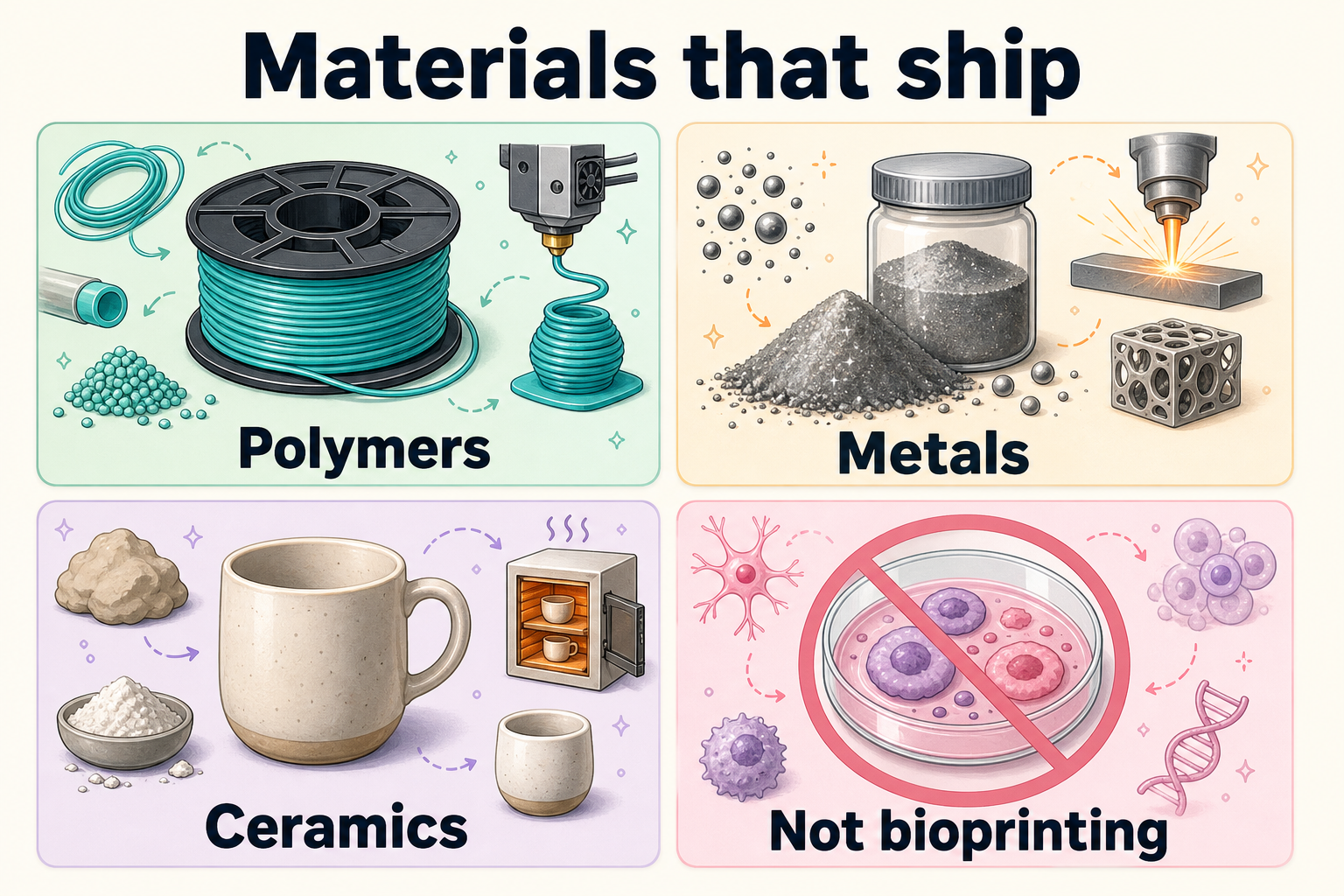
Polymers (production-common): PLA/PETG/ABS-class for non-critical and tooling; nylon and glass/carbon-filled nylons for functional polymer parts; photopolymer resins for dental models, surgical guides, hearing-aid shells; selective laser sintering / multi-jet fusion style nylons for end-use polymer production; high-temp PEI/PEEK families where aerospace and medical justify cost.
Metals (qualified niches): Titanium alloys (implants, aero structures), nickel superalloys (hot section-adjacent and energy), stainless and tool steels (tooling, industrial), aluminum alloys (brackets, heat exchangers with care), copper and copper alloys (thermal/electrical—harder optically for some lasers but strategically hot).
Ceramics and multi-material: Real in specialized medical, foundry, and electronics contexts; not a general factory replacement.
Not the same bucket: Bioprinting (cells, hydrogels) is a related LAC with different regulation and failure modes. Do not score “AM maturity” by bioprinting headlines.
Why powder economics dominate metal AM
❓ Why do material costs crush so many metal business cases?
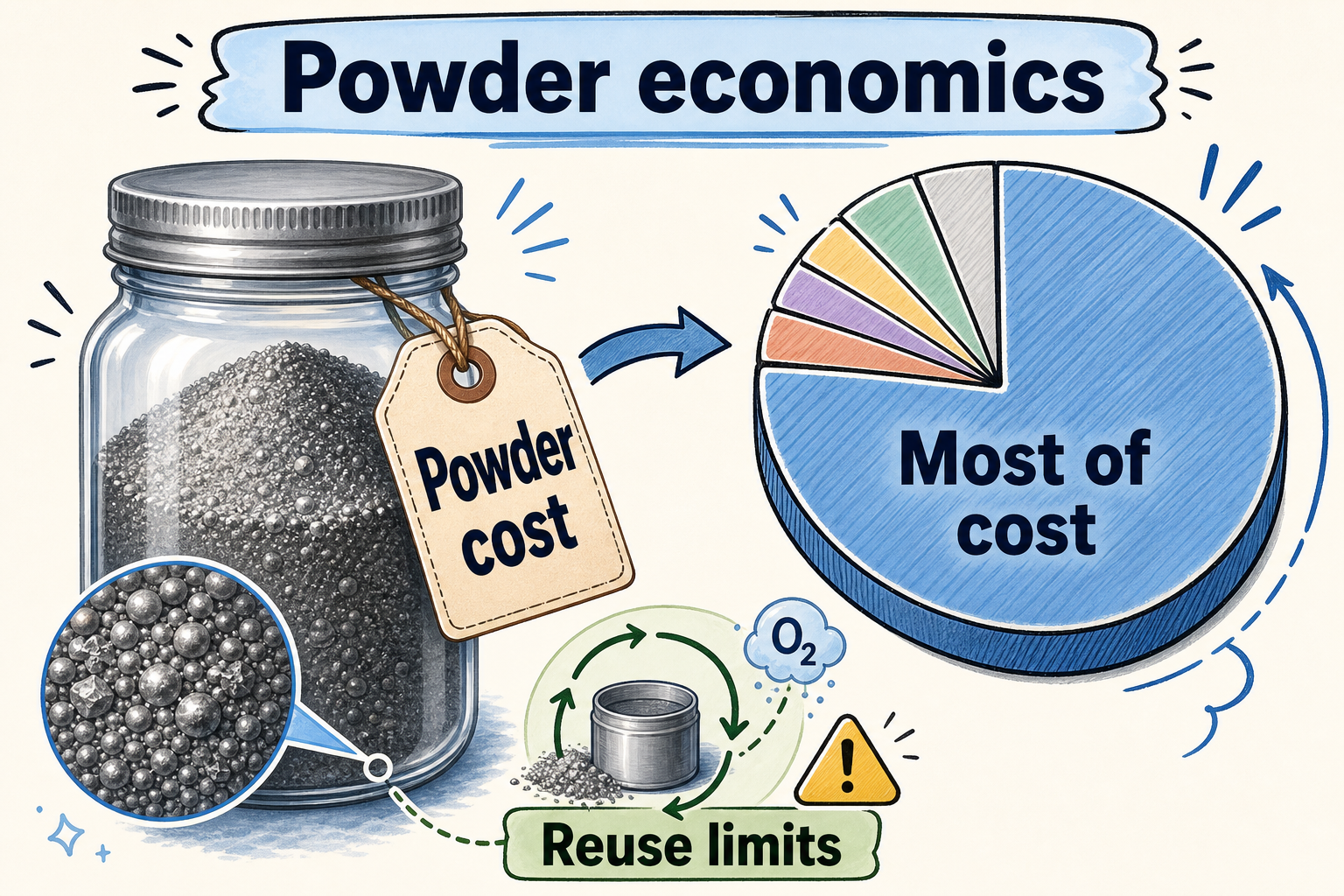
Metal AM feedstock is not bar stock. Gas-atomized powders need controlled particle size distribution, chemistry, flow, and low contamination. Open powder reuse is limited by oxygen pickup, spatter, and specification rules. Virgin powder price plus reclaim losses often dominate cost models—NIST and subsequent cost literature have flagged material share as a major fraction of part cost for years.
Implications:
- Alloy choice is an economic choice, not only a metallurgical one.
- Designs that minimize volume (lattices, thin walls where allowed) attack cost directly.
- Powder recycling policy is a quality system, not a janitorial afterthought.
- Vertical integration into powder (or long-term powder contracts) is a strategic lever for high-volume users.
Property reality: anisotropy and defects
❓ What material physics still caps AM parts?
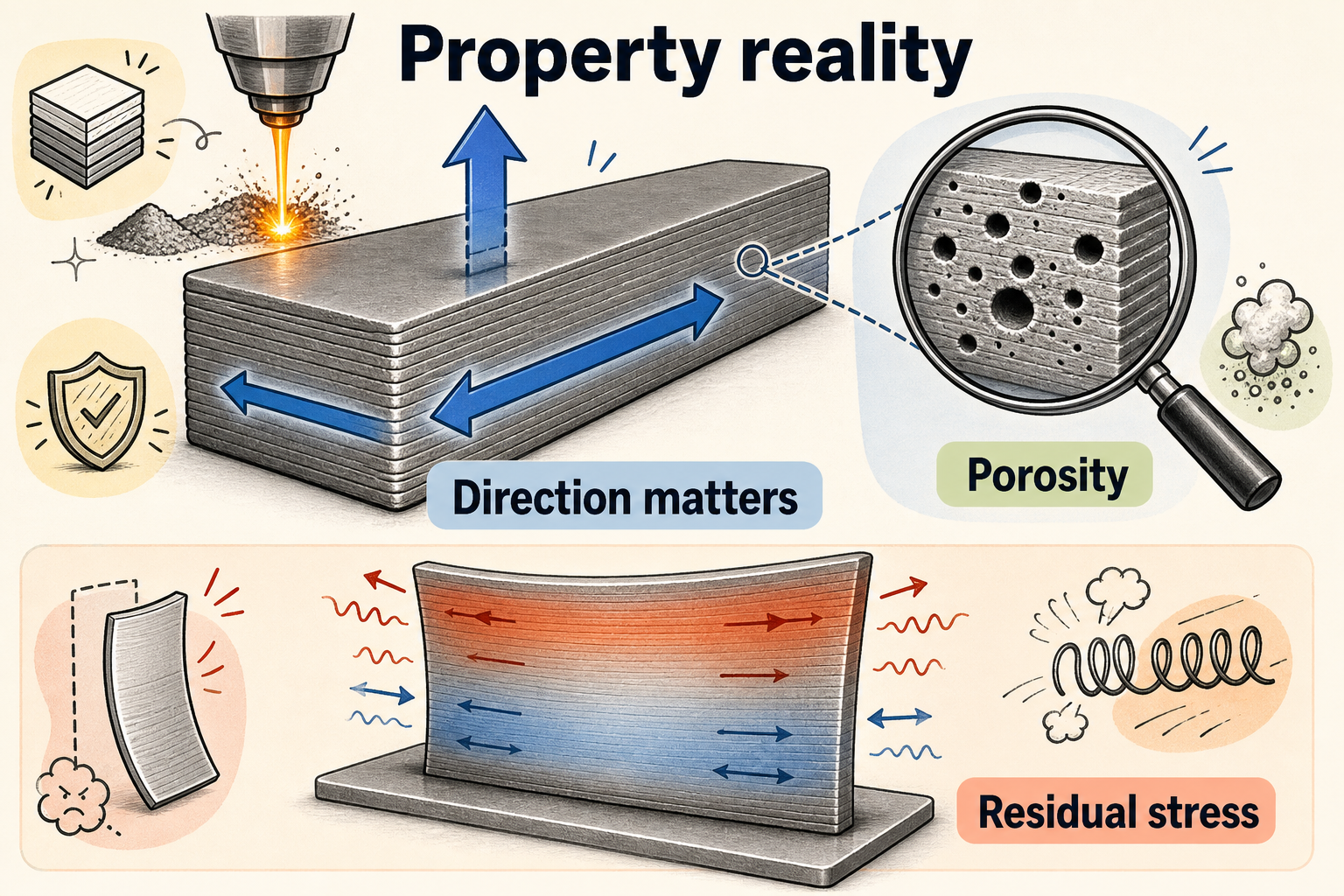
Layer-wise joining creates preferred directions. Mechanical properties can differ parallel vs perpendicular to build direction. Residual stress from steep thermal gradients warps parts and can crack superalloys. Lack-of-fusion porosity, keyholing, and gas porosity degrade fatigue life. Surface roughness from partially melted particles hurts fatigue and fluid flow unless finished.
Good DfAM does not “ignore” these; it designs around the process:
- Orient critical stresses favorably.
- Add material for machining stock on datum faces.
- Specify HIP and heat treatment where fatigue matters.
- Place supports where removal is possible and distortion is controlled.
Hard-to-vary explanation: Heat input and solidification path determine microstructure; microstructure plus defects determine allowables; allowables determine whether a lighter lattice is a triumph or a liability. Software cannot wish away solidification physics.
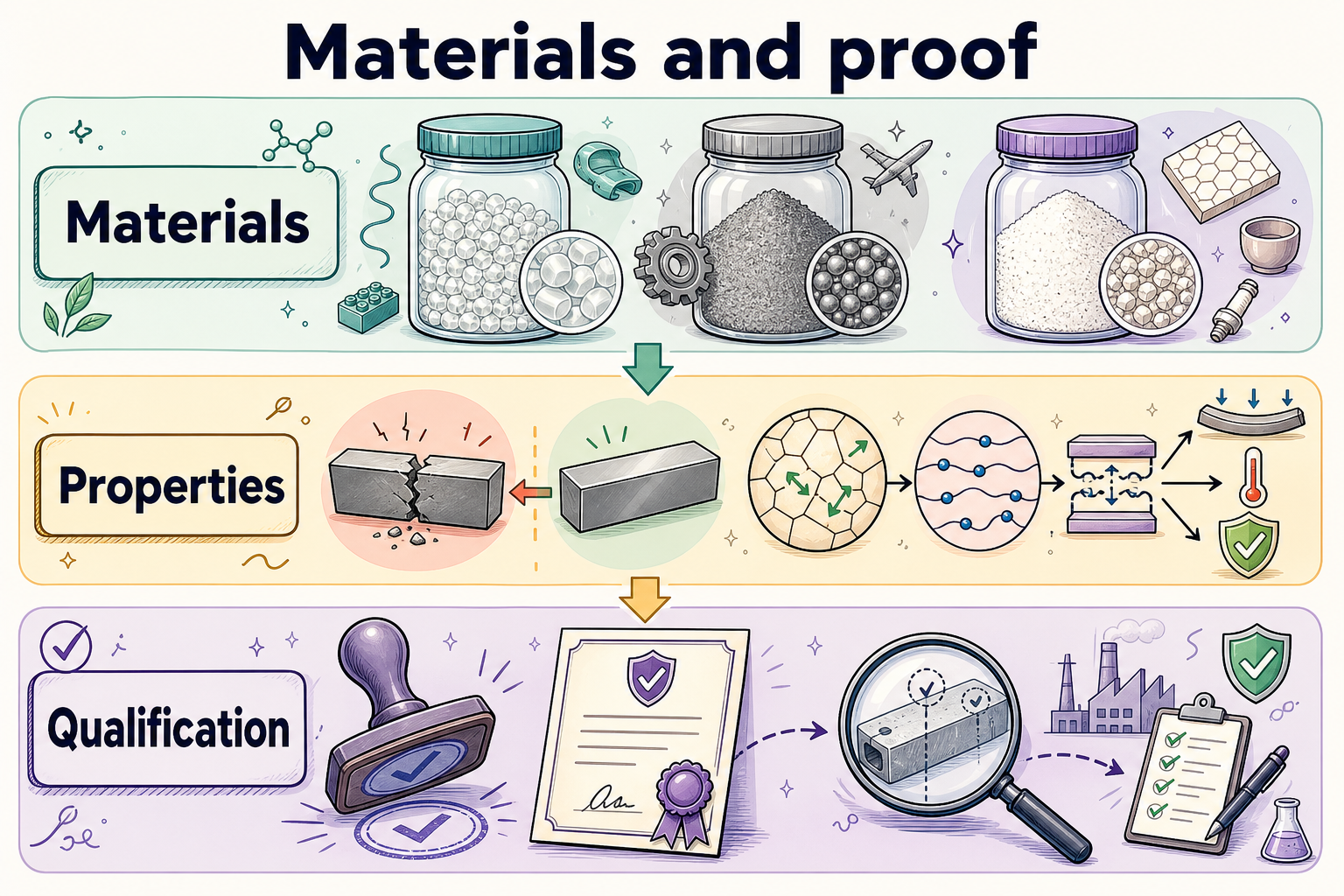
Qualification is the real product

❓ What makes an AM part good enough for flight, implant, or nuclear service?
Three nested gates:
- Process qualification — Can this machine, powder lot class, parameter set, and post-process route repeatedly produce material within a specification?
- Material allowables — What design strengths, fatigue curves, and knockdowns may engineers use?
- Part qualification — Does this geometry, with this inspection plan, meet the application’s safety case?
Standards scaffolding includes the ISO/ASTM 529xx family (vocabulary, principles, process categories, and growing process/quality documents), aerospace material and process specs, medical device quality systems and device-specific pathways, and customer-specific special processes (e.g., Nadcap-style oversight in aero supply chains).
In-situ monitoring (melt pool cameras, acoustic sensors, layer imaging) and machine-learning defect flags are evidence assistants, not automatic substitutes for mechanical testing and NDT in high-criticality parts—as of 2026. They reduce scrap and speed learning; they do not delete the need for a quality system.
Post-processing is often most of calendar time: support removal, stress relief, HIP, heat treat, machining, surface treatment, inspection. A “print time” quote that ignores this chain is a lie of omission.
Audit trail and IP
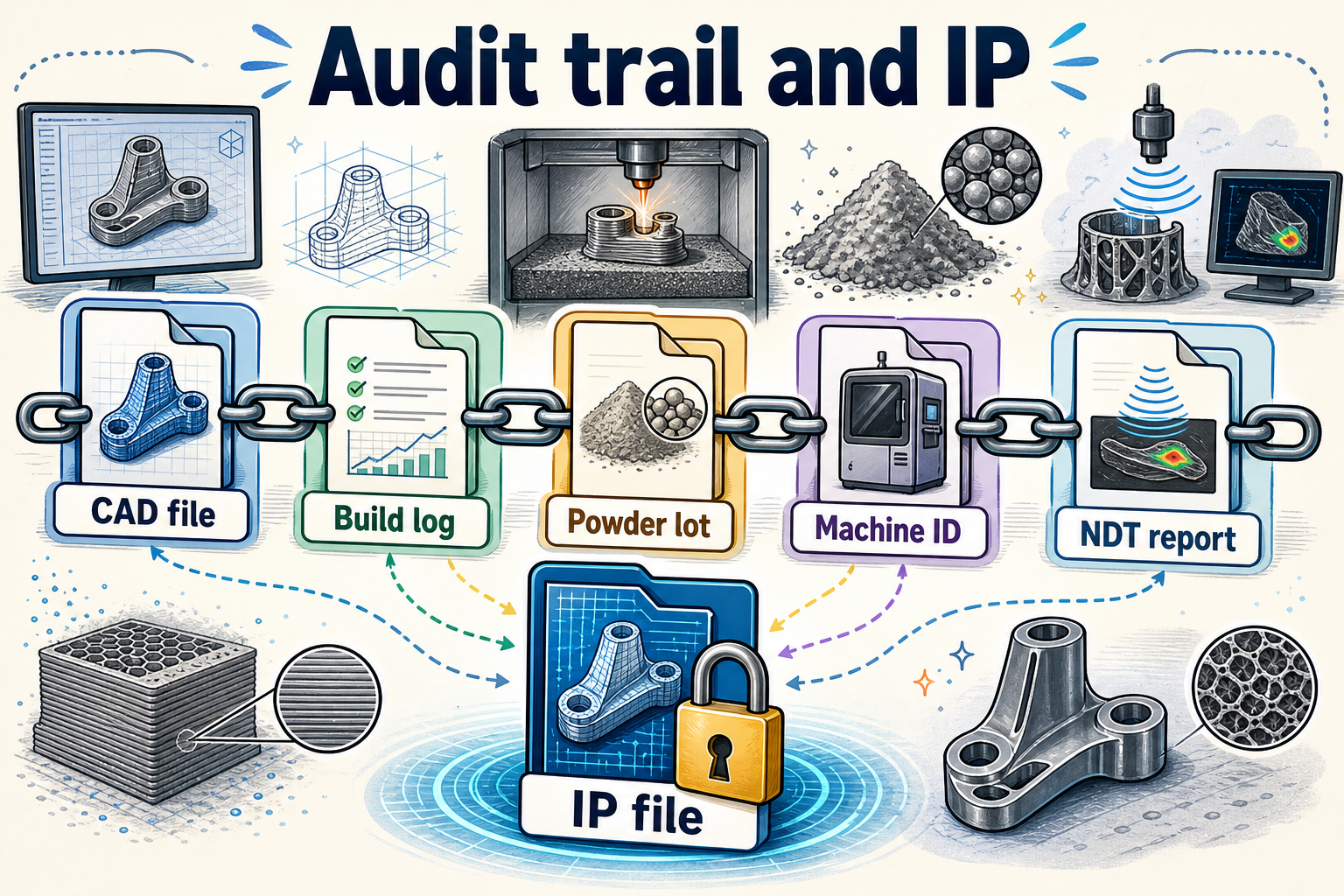
❓ What evidence pack does a regulated buyer need, and how does IP change?
A serious buyer wants genealogy: CAD revision, build file hash, machine ID and calibration state, powder lot and reuse generation, operator and shift, environmental logs, in-situ anomalies, post-process travelers, NDT results, and final dimensional report. That pack is the AM equivalent of a forging’s mill cert—except more parameters can go wrong.
Digitization raises IP stakes: the valuable artifact may be the qualified parameter set and build file, not only the STEP model. Conversely, old Gartner-era fears of “$100B annual IP loss from home printing” did not materialize as predicted; industrial IP theft and parameter leakage are the sharper risks.