Last updated: 2026-07-20
What additive manufacturing is
The core definition
❓ What is additive manufacturing, and what hard-to-vary mechanism distinguishes it from cutting, casting, and molding?
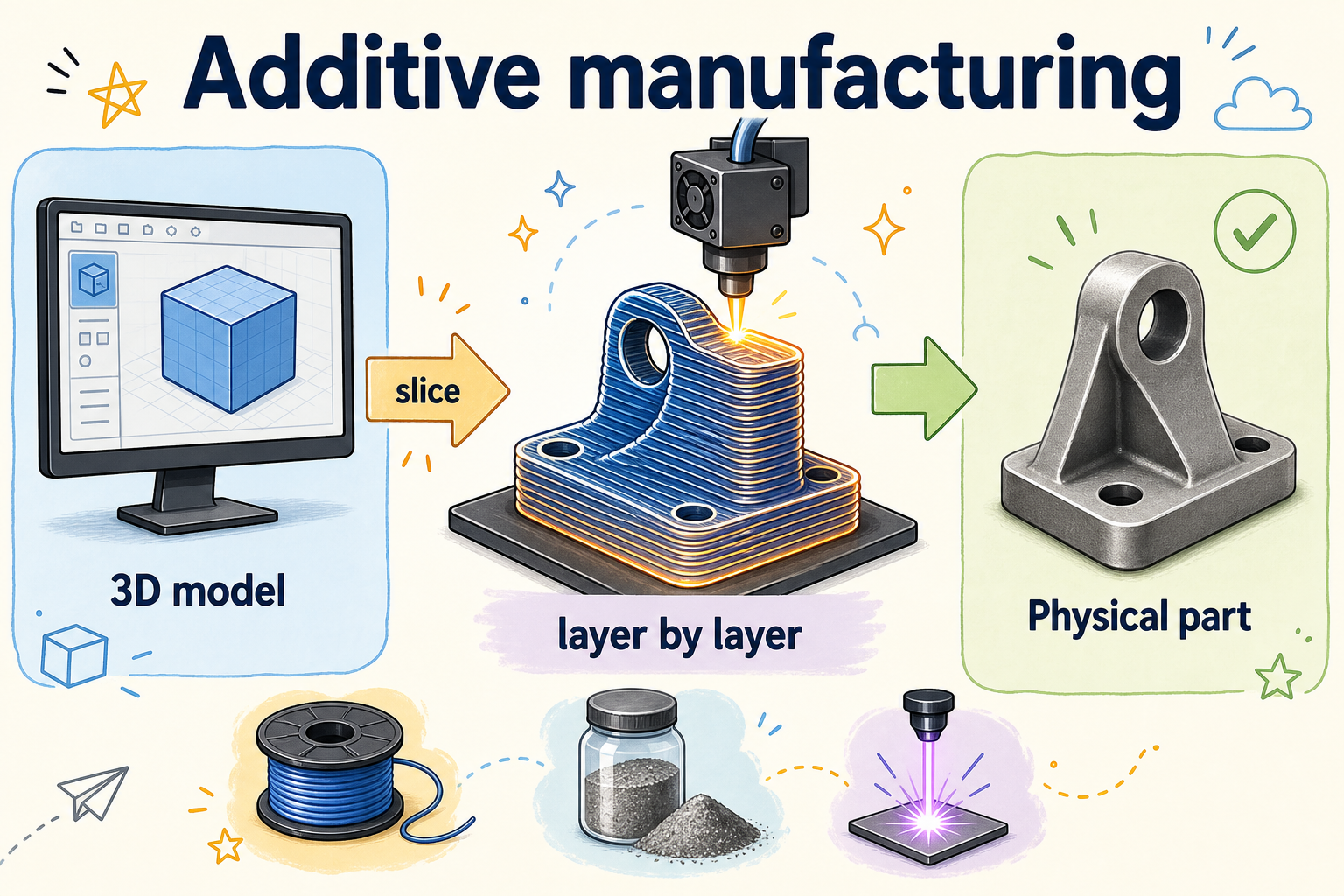
Additive manufacturing (AM) is a family of processes that build physical objects from a digital three-dimensional model by joining material, usually layer upon layer, rather than by removing material or forcing it into a mold. The international vocabulary standard ISO/ASTM 52900 codifies that definition so engineers, regulators, and buyers share one language instead of marketing synonyms. “3D printing” is the popular name for the same idea; in industrial and standards contexts, AM is preferred because it covers factory-scale metal systems as well as desktop plastic printers.
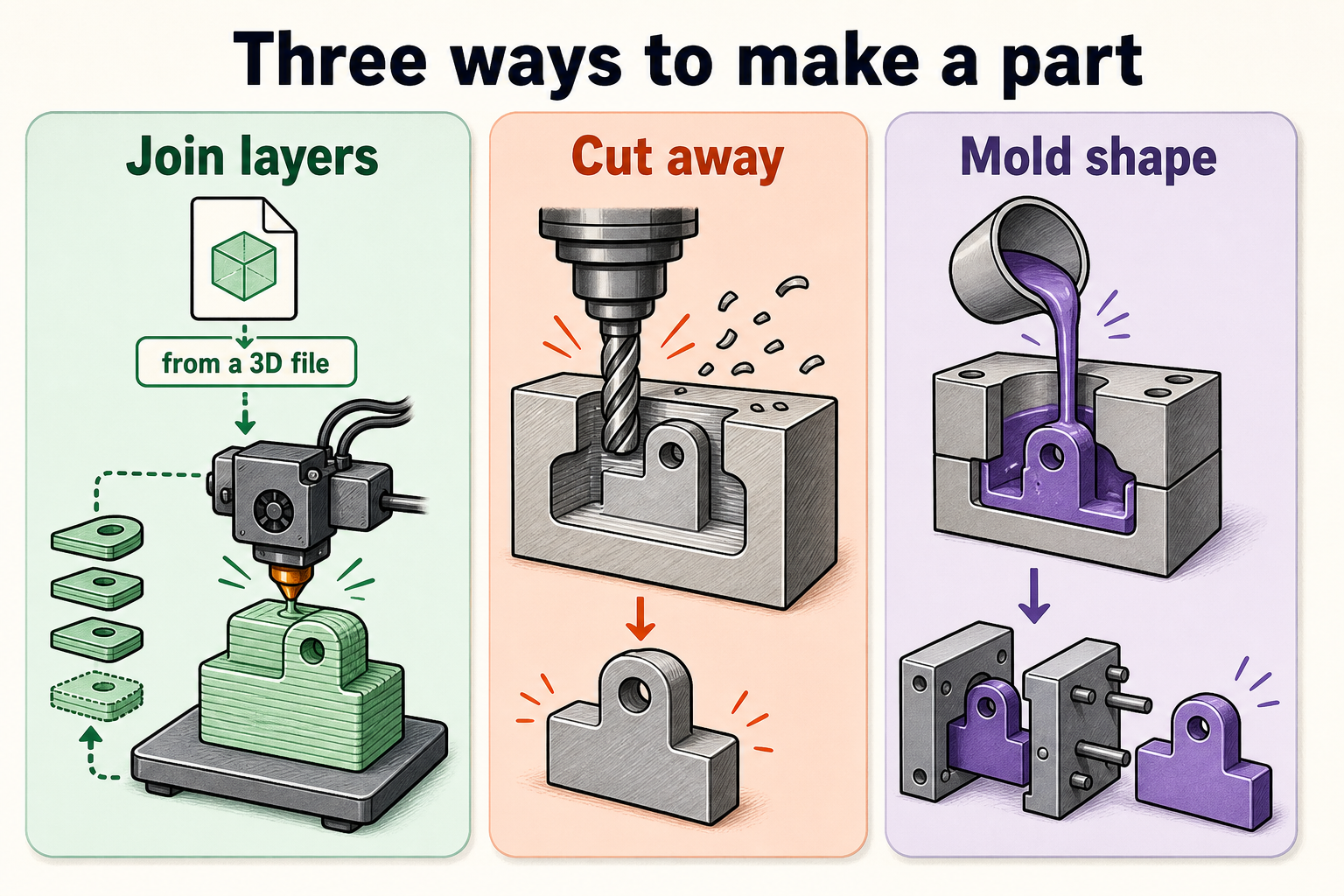
The hard-to-vary mechanism is information-driven material placement. A computer holds a solid model (almost always derived from CAD or from a scan). Software slices that model into layers and toolpaths. A machine then deposits, fuses, binds, or cures material only where the model says “solid.” Subtractive machining starts from a billet and cuts away what is not wanted. Formative processes (injection molding, casting, forging) reshape bulk material with tooling that encodes the shape in steel. AM encodes the shape primarily in data, so changing the part often means changing a file, not cutting a new die.
Different from: CNC is also digital and precise, but it still removes material and is constrained by tool access and fixturing. Molding is superb at volume once the tool exists, but the tool is expensive and slow to change. AM’s distinctive claim is not “better always”; it is “geometry and change are cheap relative to tooling-based routes.”
Hard-to-vary test: If you remove “from 3D model data” or “joining material where the model requires,” you no longer have AM—you have craft sculpture or bulk forming. If you claim AM always replaces factories, you have varied the claim into something the mechanism does not support.
Refutability: The framing fails if most industrial value from “AM” machines turns out to depend on non-additive steps (forging blanks, machining nearly all surfaces) without the digital layer-wise join mattering. It also fails if identical economics are achievable with conventional processes without digital geometry freedom.
Reach example: The same mechanism that lets a hospital print a patient-specific surgical guide from a CT scan is the mechanism that lets a satellite team print a topology-optimized bracket from a load case—both are “file → qualified join process → part.”
Criticism note: Calling AM “digital manufacturing” can smuggle in the false idea that atoms behave like bits. Material physics, heat, residual stress, and certification still dominate.
What becomes abundant and what stays scarce
❓ What becomes abundant under AM, and what remains scarce even in 2026?
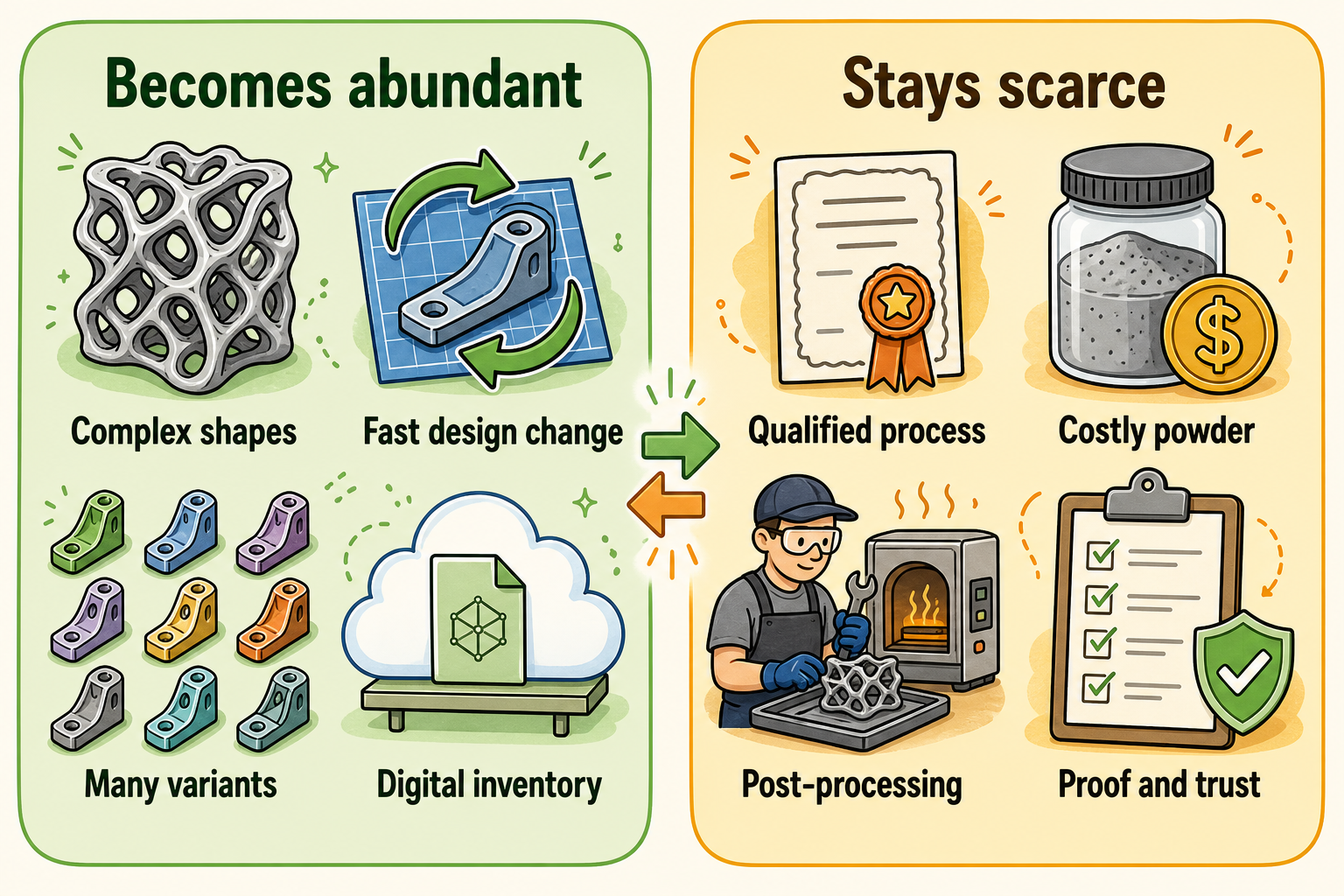
AM makes several things relatively abundant:
- Geometric complexity that would be unaffordable or impossible with a single piece of tooling (internal channels, lattices, consolidated assemblies).
- Design iteration speed early in a product’s life, when molds and hard tooling have not yet been ordered.
- Variant count — many similar parts without a matching number of tools.
- Digital inventory — store a qualified build file and material spec instead of a physical spare on a shelf (when qualification allows).
What stays scarce:
- Qualified process–material pairs with allowables a regulator or flight office will accept.
- Stable, cheap feedstock (especially metal powders with tight chemistry and morphology).
- Post-processing capacity (support removal, heat treatment, hot isostatic pressing, machining, inspection).
- People who can design for AM (DfAM) and run a powder or resin cell safely and repeatably.
- Trust artifacts: build logs, powder genealogy, machine calibration history, non-destructive test evidence.
Technology, in the OOM sense, takes something scarce and makes it abundant. AM has made shape-from-data abundant. It has not made certified structural metal at commodity injection-molding prices abundant. That gap is the entire industrial story of the last decade.
EmTech placement: bits to atoms
❓ Where does 3D printing sit among emerging technologies?
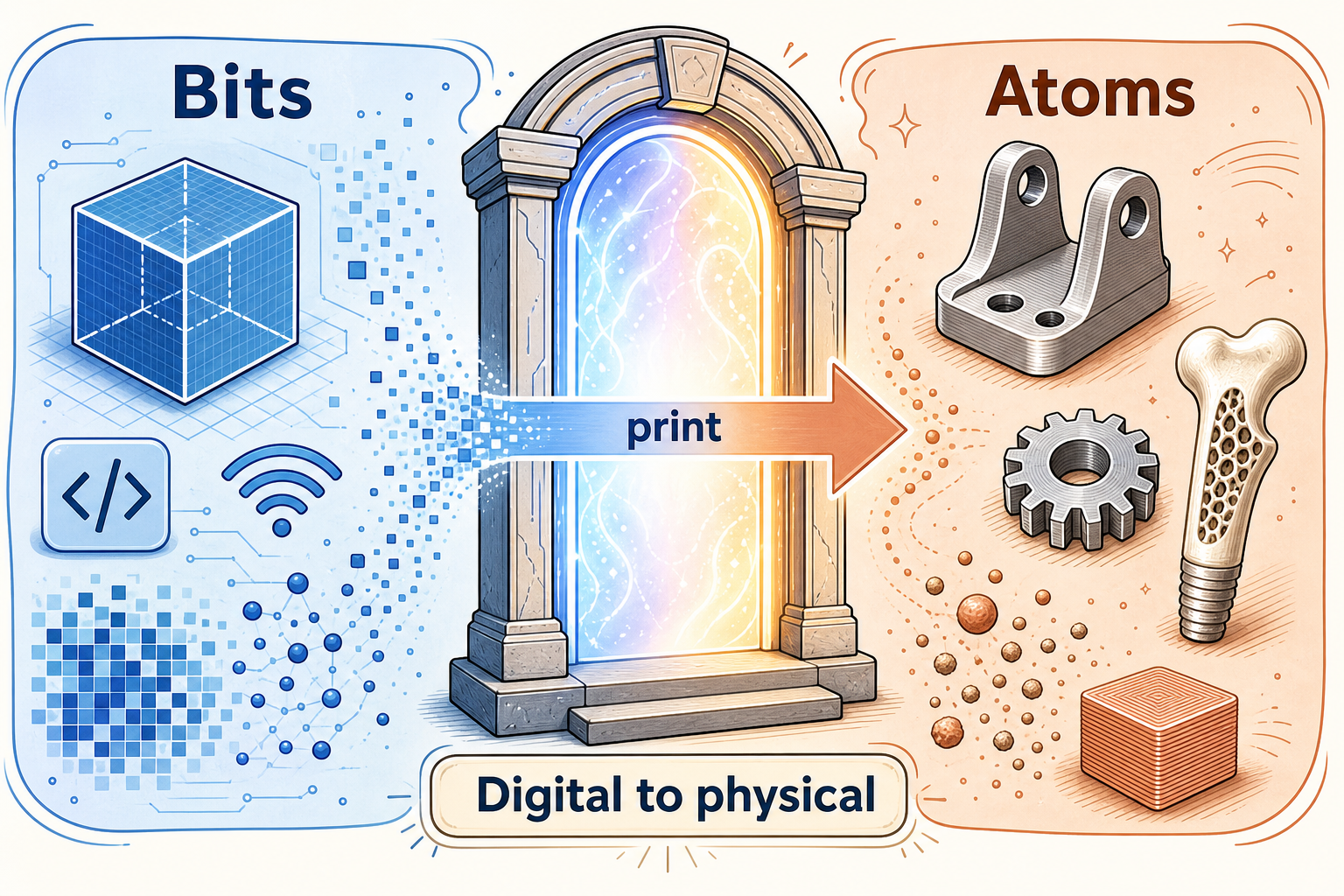
In the OOM taxonomy, 3D Printing is a named EmTech and a portal from the digital world to the physical world. Sensors and IoT move measurements from atoms to bits. AM moves designed geometry from bits to atoms. Robotics embodies automation in machines that move; AI automates information work; AM automates a slice of fabrication.
That portal framing prevents two common mistakes:
- Treating desktop hobby printing and flight-critical metal AM as unrelated hobbies—they share the mechanism, diverge on qualification and materials.
- Treating AM as pure software. Without energy delivery, feedstock science, and metrology, the file never becomes a trustworthy part.
Historically the tree looks like: CAD solid modeling → stereolithography (1980s, Chuck Hull / 3D Systems) → FDM patents and Stratasys → metal powder bed systems → aerospace qualification campaigns → multi-laser and larger build volumes → software/AI build prep and monitoring → hybrid cells with CNC and robotics. Each step solved a previous limit and created a new bottleneck (first resins, then materials, then speed, then qualification, then cost at volume, now security and workforce).
Everyday decision test
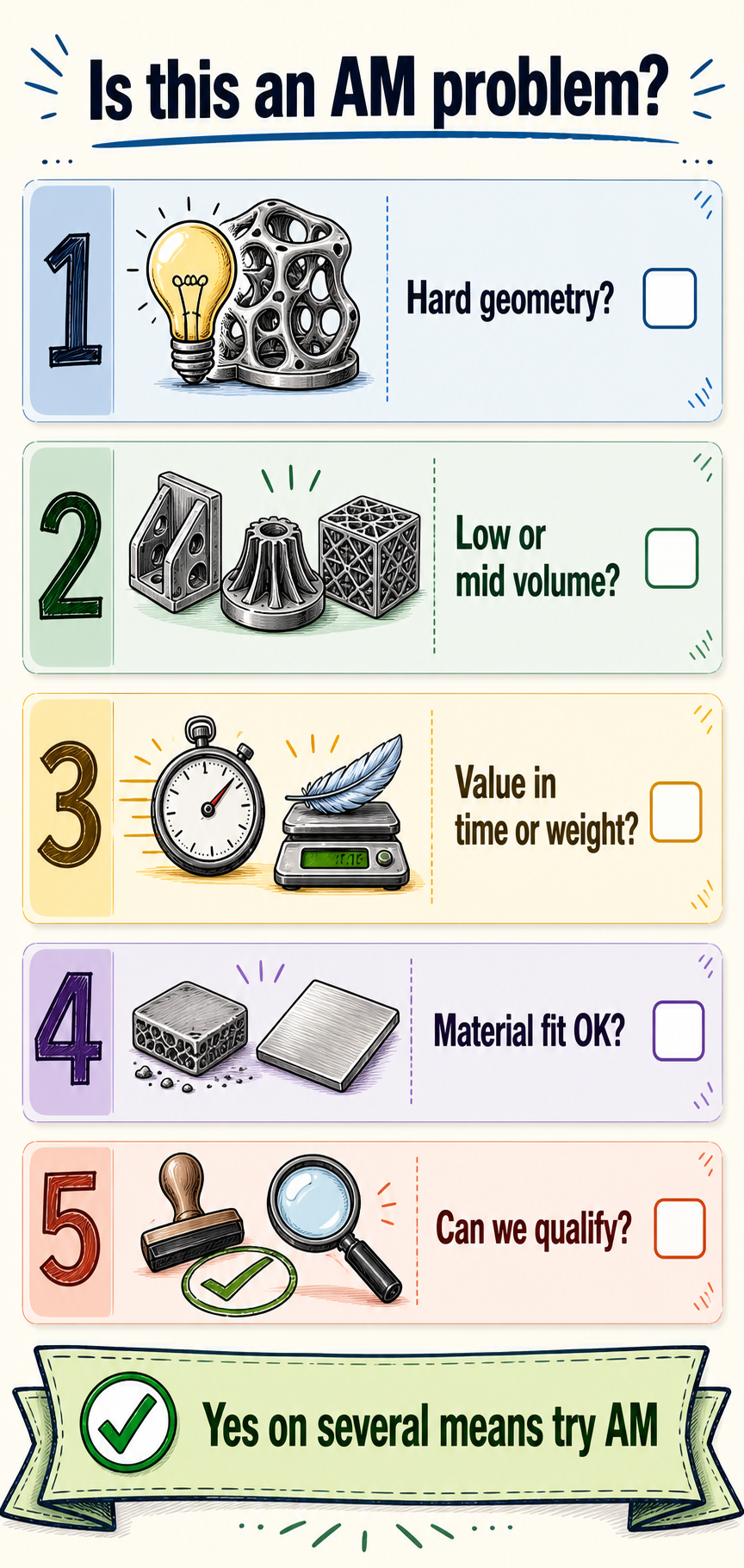
❓ How should a non-technical decision-maker decide whether a problem is an AM problem?
Ask five questions:
- Is the geometry hard for conventional processes (internal features, part consolidation, customization per unit)?
- Is volume low-to-medium or is tooling amortization painful (spares, short product life, many SKUs)?
- Does the value live in weight, lead time, or uptime more than in pennies per identical unit?
- Can we accept the material and surface system AM actually delivers, including post-processing?
- Is there a path to qualify and inspect the part for its real duty cycle?
If most answers are no, AM is a prototype aid, not a production strategy. If several are yes, AM is a candidate manufacturing route—not a slogan.