Last updated: 2026-07-20
Process landscape
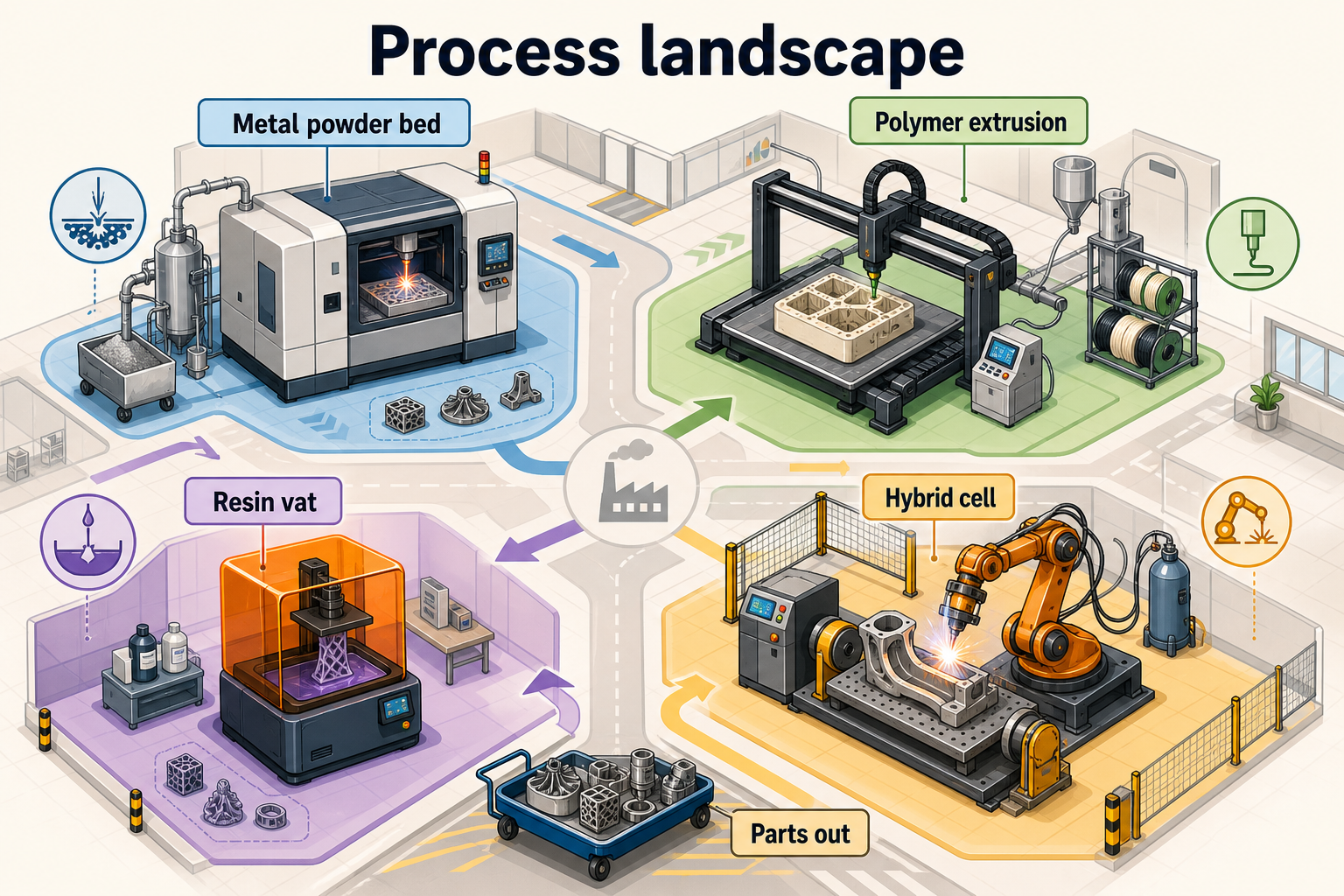
The seven ISO/ASTM categories
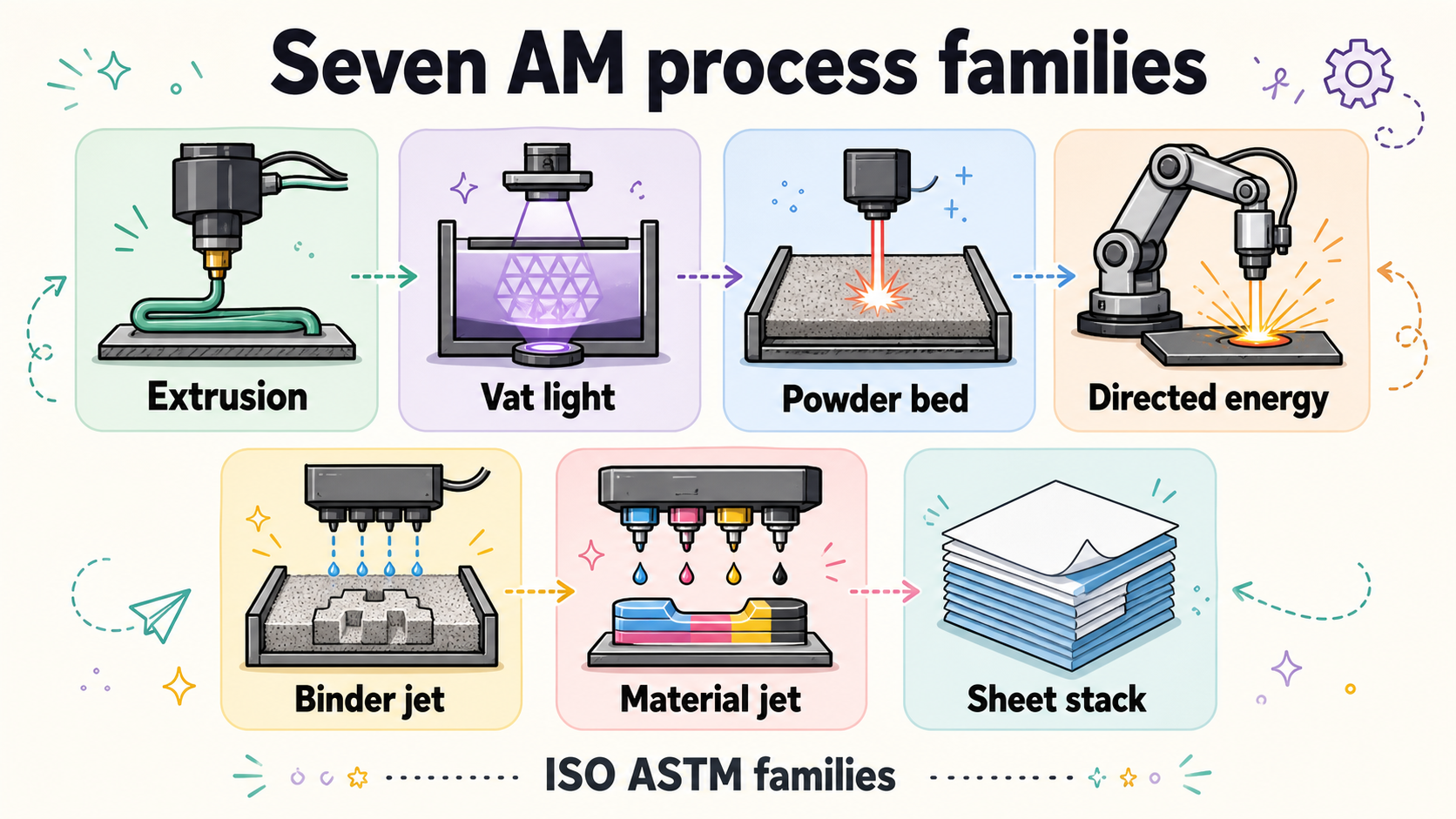
❓ What are the seven process categories, and which ones drive industrial value in 2025–2026?
ISO/ASTM 52900 groups AM into seven process categories. Brand names proliferate; the categories stay stable. Decision-makers should map vendor claims onto this backbone.
| Category | Plain mechanism | Typical materials | 2026 industrial role |
|---|---|---|---|
| Material extrusion | Solid feedstock pushed through a nozzle; solidifies on the bed | Thermoplastics, filled polymers, continuous fiber, some metal-bound filaments | Tooling, jigs, fixtures, composite-like structures, field/spares polymers |
| Vat photopolymerization | Light cures liquid resin in a vat | Photopolymers | Dental, hearing aids, high-detail models, some tooling inserts |
| Powder bed fusion (PBF) | Energy beam fuses regions of a powder bed layer by layer | Metals (laser/EBM), polymers (laser/MJF-class) | Aerospace, medical implants, high-value production polymers |
| Directed energy deposition (DED) | Focused energy melts feedstock as it is deposited (powder or wire) | Metals | Repair, large features, cladding, hybrid near-net shapes |
| Binder jetting | Printhead deposits binder onto powder; later sintering/infiltration | Metals, sand, ceramics | Speed/volume potential; sand cores mature; metal still qualification-sensitive |
| Material jetting | Droplets of material deposited and cured | Photopolymers, some waxes | High-detail multi-material prototypes, investment patterns |
| Sheet lamination | Sheets cut and bonded | Paper, metal foil, polymers | Niche; limited relative share |
Industrial value concentration in 2025–2026 is not even. Metal and polymer powder bed fusion, material extrusion (including continuous fiber), vat processes in dental/medical, and DED for repair/large metal carry most of the serious production stories. Binder jetting is the perpetual “next volume metal” candidate. Material jetting and sheet lamination matter in niches.
Powder bed fusion: the qualified workhorse
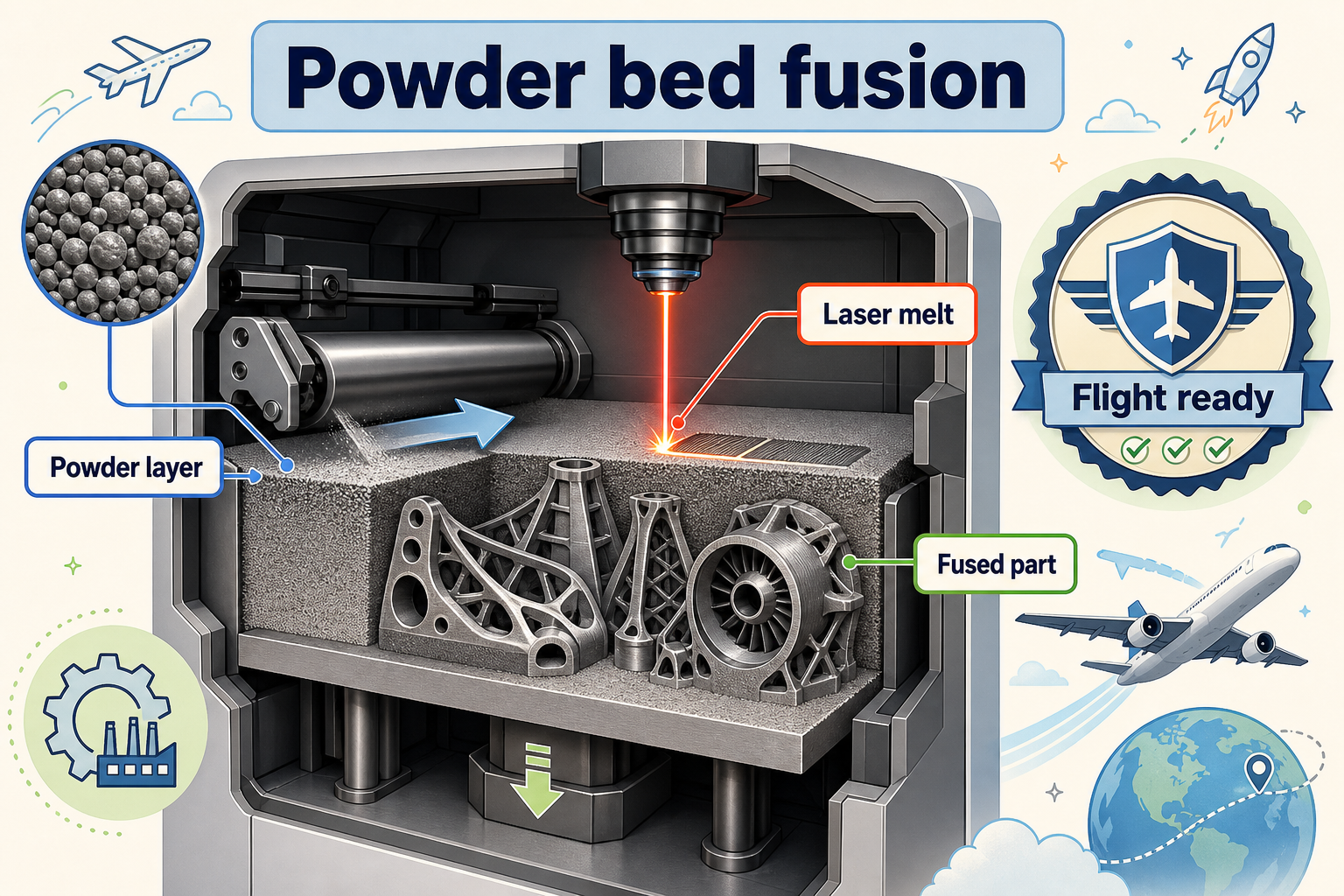
❓ Why is powder bed fusion the aerospace and implant default?
In metal laser PBF (often marketed as SLM, DMLS, LPBF), a recoater spreads a thin powder layer; one or more lasers melt the cross-section; the bed drops; repeat. Electron-beam PBF runs in vacuum at high temperature and suits certain titanium workflows.
PBF wins qualified work because:
- Feature resolution and surface quality are better than most DED.
- A large body of process parameters, heat treatments, and mechanical allowables already exists for key alloys (Ti-6Al-4V, nickel superalloys, some steels and aluminums).
- Complex internal cooling channels and topology-optimized solids are native.
PBF loses when:
- Parts are very large (build box and cost scale poorly).
- Deposition rate cannot hit the required cost per kilogram.
- Powder handling, inert gas, and support removal dominate operations.
Multi-laser machines and larger chambers are the industry’s answer to rate—not a different physics.
Directed energy deposition and hybrids
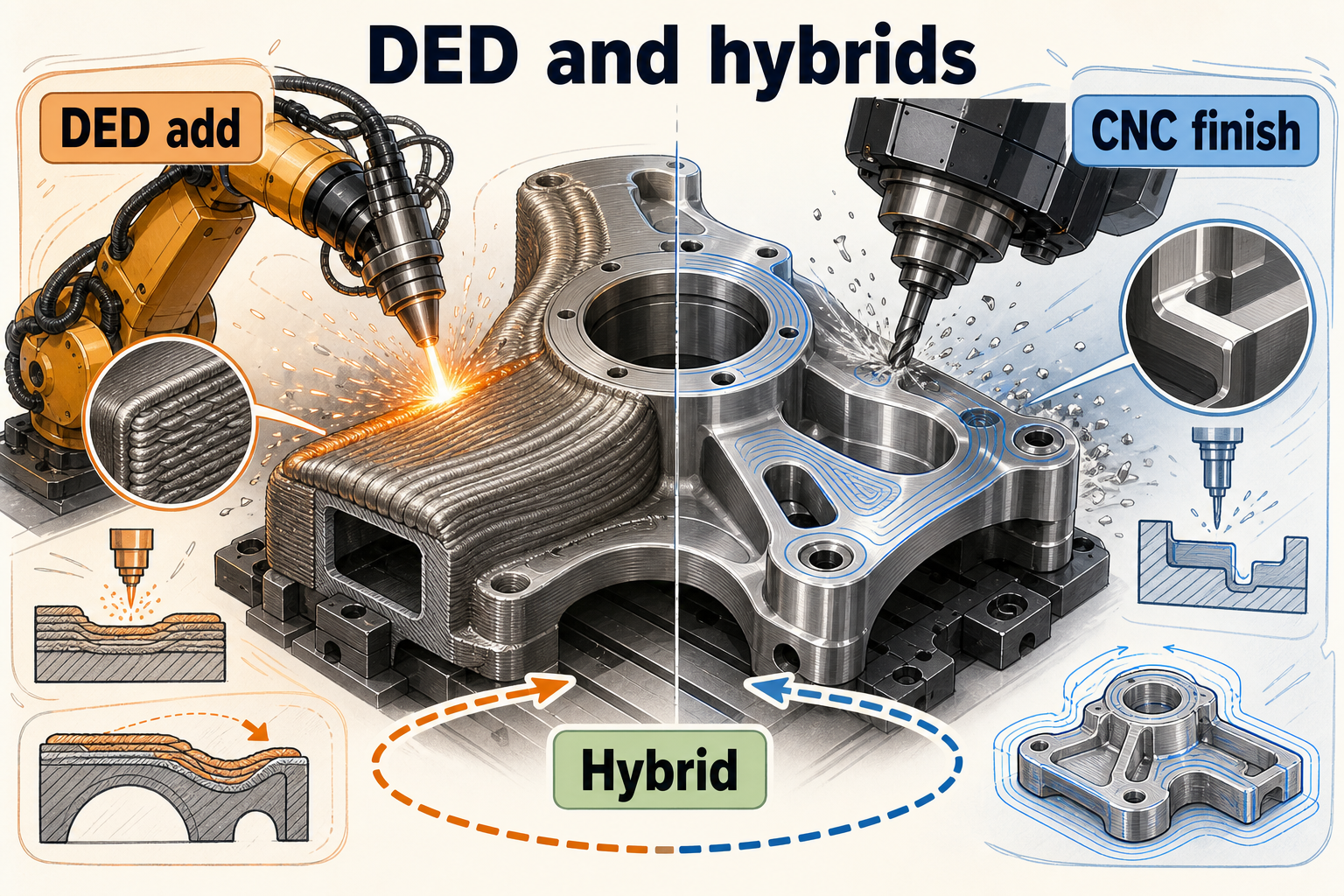
❓ Is DED a production process or a repair specialty?
DED points energy and feedstock at a surface—closer to robotic welding with path control than to a powder “printer.” Wire-arc AM (WAAM) builds large structures quickly with rough surfaces. Laser powder DED clads and adds features.
DED’s honest home is repair, feature addition, large near-net shapes, and hybrid cells where a CNC machine finishes critical surfaces. Comparing mid-size metal parts, literature often finds DED faster and cheaper per deposited kilogram than PBF, with worse as-built surface and geometric precision. Factories that treat DED as “PBF but bigger” fail; factories that treat it as digitally controlled weld deposition + machining succeed.
Hybrid AM + 5-axis CNC is increasingly the real “factory architecture”: add where geometry demands it, cut where tolerance and surface demand it.
Binder jetting’s promise and bruise
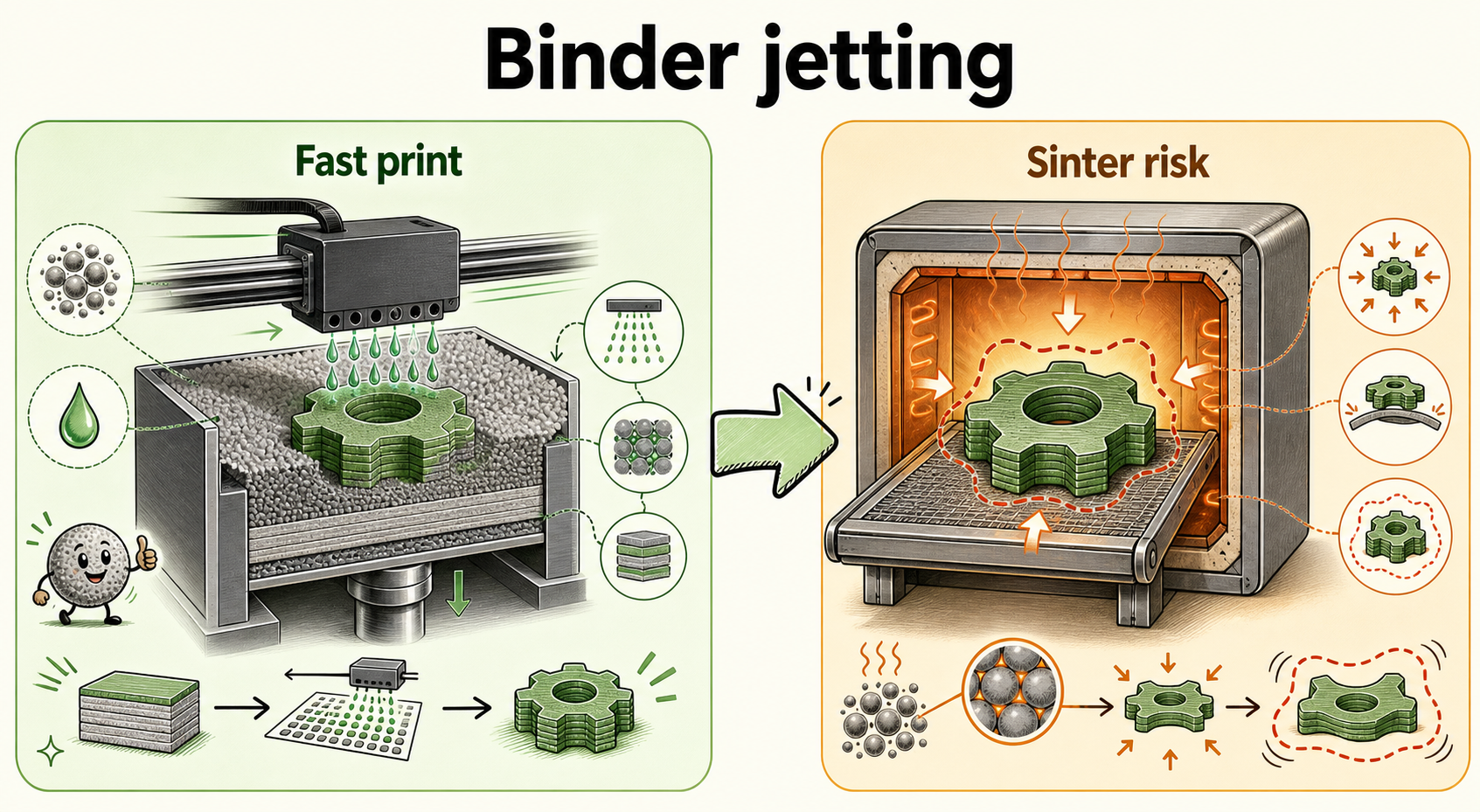
❓ Is metal binder jetting ready to replace laser PBF at volume?
Binder jetting prints binder into a powder bed at inkjet speeds, then sinters the green part—more like metal injection molding’s thermal densification than like melting each voxel with a laser. The pitch is speed and cost at higher volumes, especially automotive-relevant geometries.
The bruise is sintering distortion, density, mechanical property scatter, and qualification time. Industry analyses (including AMPOWER-style comparisons) have long expected binder jetting’s main impact in higher-volume markets while warning that aerospace and implant buyers will stay on melt-based PBF until properties and process control match their risk tolerance. Corporate turmoil around Desktop Metal / ExOne lines in 2025 (acquisition, bankruptcy of core assets, carve-outs) is not proof the physics failed—but it is proof that scaling the business of binder jet metal is harder than scaling the slide deck.
Material extrusion: underestimated industrial workhorse
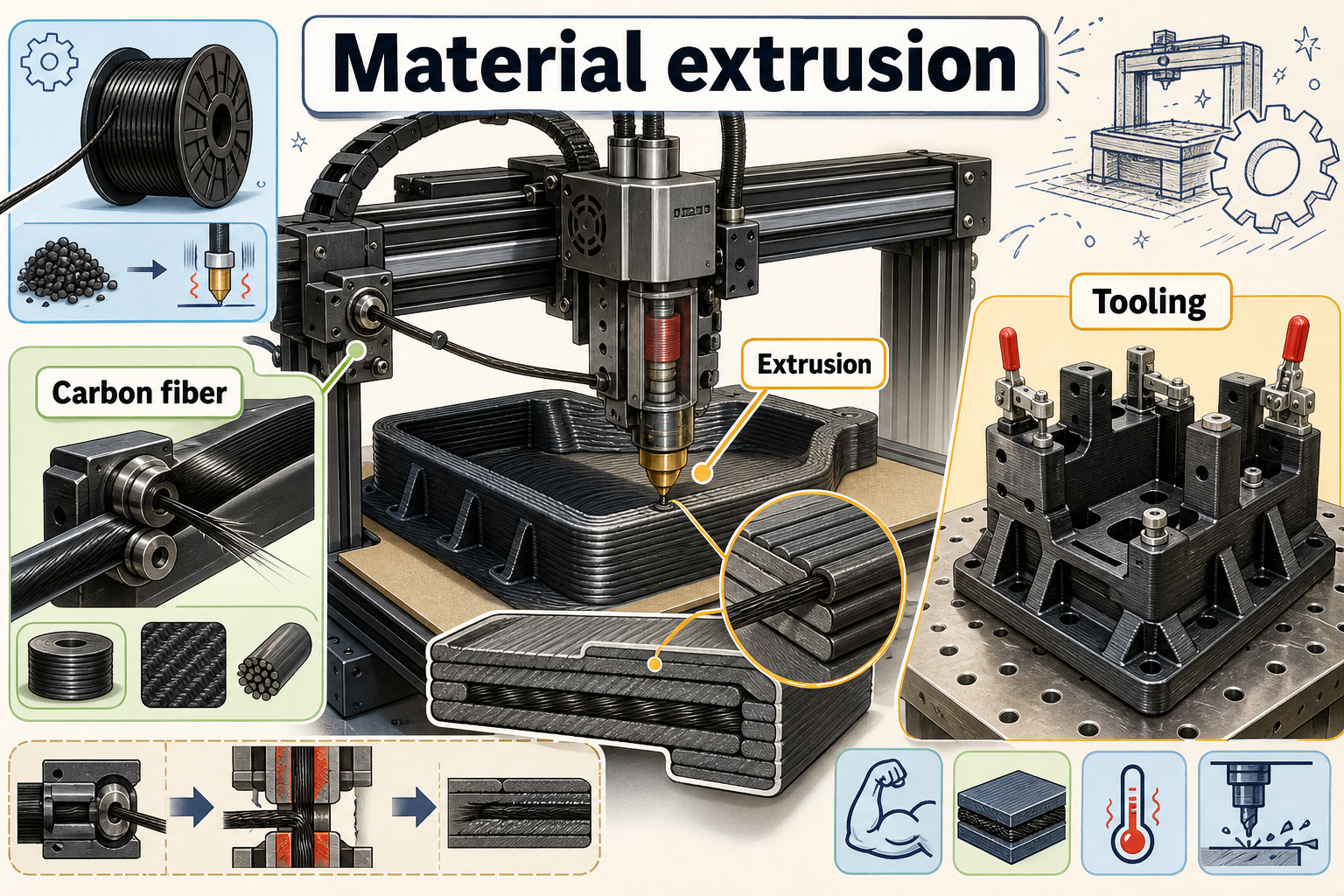
❓ Where does “filament printing” still matter professionally?
Commodity FFF for trinkets is a consumer story. Industrial material extrusion matters for:
- Jigs, fixtures, and factory tooling that would otherwise be machined from aluminum.
- High-temperature polymers for aerospace interiors and under-hood prototypes.
- Continuous carbon fiber systems (e.g., Markforged lineage) that produce polymer-matrix parts with directional strength for brackets, tooling, and some end-use structures.
Stratasys’s agreement (announced May 2026) to buy Markforged from Nano Dimension for about $42.5 million—after Markforged did roughly $70 million revenue in 2025—shows both the strategic value of continuous fiber extrusion and how brutally public markets repriced “industrial FFF” pure-plays. Stratasys is buying capability and channel, not paying 2021 multiples.
Mapping brand soup to decisions
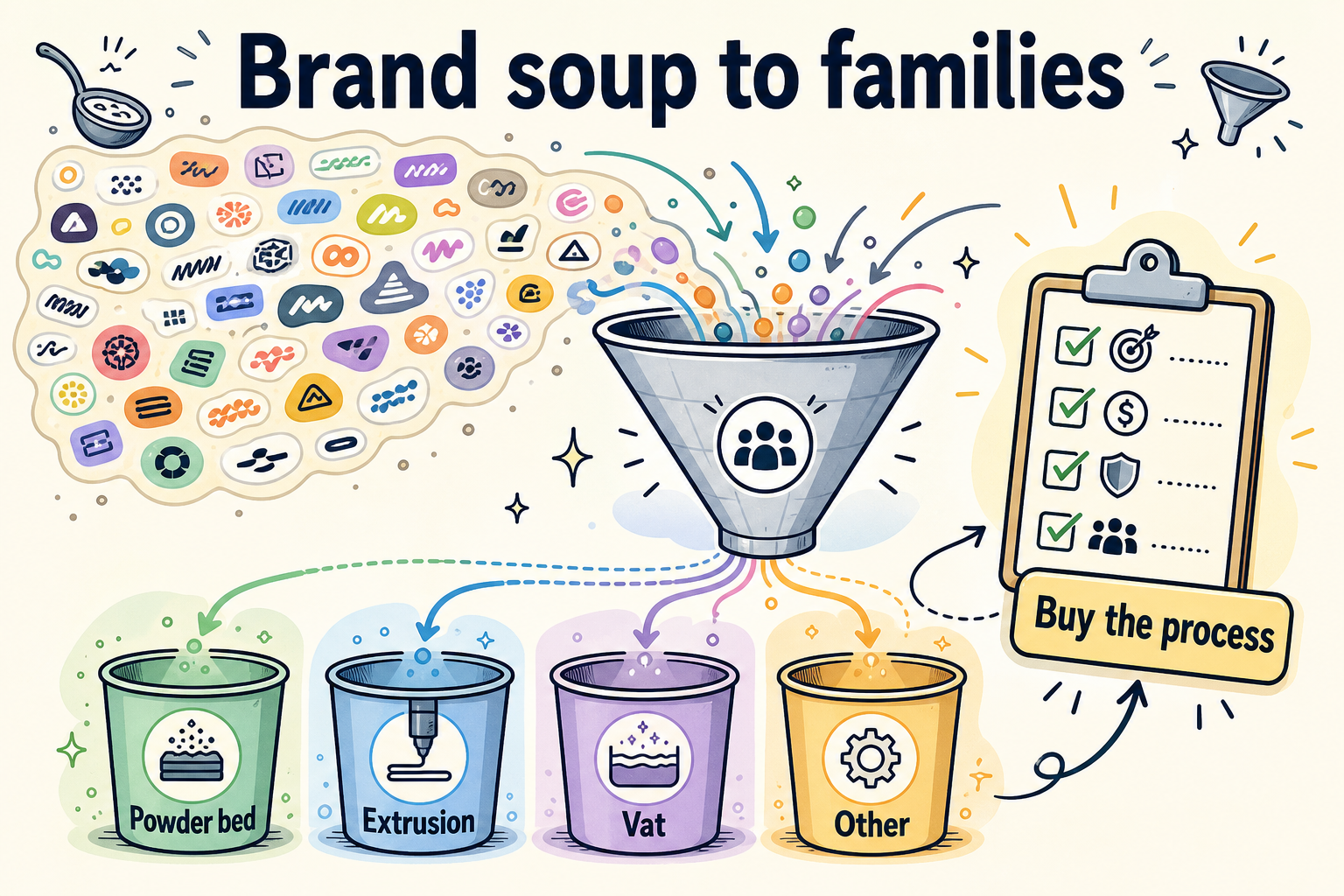
❓ How should buyers decode SLM, DMLS, EBM, MJF, PolyJet, SAF, FDM?
Treat brand names as PTCs under LTCs:
- LTC examples: Metal Laser Powder Bed Fusion System; Polymer Powder Bed System; Industrial Material Extrusion System; Vat Photopolymerization System; Metal Binder Jetting System; Directed Energy Deposition Cell.
- PTC examples: a specific EOS, SLM Solutions, Velo3D, HP, Stratasys, or GE Additive machine generation.
Procurement questions that matter more than brand poetry:
- Which ISO category and material class?
- What build volume, rate, and lag in post-processing?
- What parameter sets and allowables exist for our alloy and standard?
- What monitoring, software lock-in, and service footprint?
- For defense buyers: where was the machine, software, and network stack developed and who can reach it? (See geopolitics section.)