Last updated: 2026-07-19
3D Printing (Additive Manufacturing) — Current State Research
Executive abstract
Additive manufacturing (AM)—popularly called 3D printing—builds physical parts from digital 3D models by joining material, usually layer by layer (ISO/ASTM 52900). The hard-to-vary mechanism is information-driven material placement: geometry and change live primarily in files, not in hard tooling. That makes complex shapes, late customization, and digital inventories newly practical. It does not make certified metal parts at injection-molding economics automatic. By mid-2026 the industry is a low-double-digit-billion-dollar global ecosystem growing roughly high-single to low-double digits per year (scope-dependent figures from Wohlers-class and other trackers cluster around that band), with services and production outcomes mattering more than box-shipping hype. Serial industrial proof is strongest in aerospace (GE LEAP fuel nozzle tips past 100k units), medical/dental customization, energy spares, and factory tooling—not in “every home a factory.” Metal powder bed fusion remains the qualified workhorse; binder jetting and hybrids court volume; continuous-fiber extrusion fills structural polymer niches. AI × AM is real for generative design and monitoring, uneven for closed-loop process control. Defence industrial policy (US FY2026 NDAA restrictions on covered-nation AM systems; Canada’s 2026 Defence Industrial Strategy) now shapes trusted supply as much as pure cost curves. Contrarian truth still stands: pure-play equity rollups destroyed capital; post-processing, powder, qualification, and workforce remain bottlenecks; AM is a surgical tool in the manufacturing tray, not a replacement for the tray.
Confirmed vs second-hand: Process definitions and GE nozzle milestones rest on primary/standards and company reporting. Market dollar totals often arrive via trade citation of paywalled reports—labeled as such in section 04 and references. Corporate M&A figures use company/trade primary reporting (Nano Dimension, Stratasys/Markforged May 2026).
Core mechanism (one paragraph)
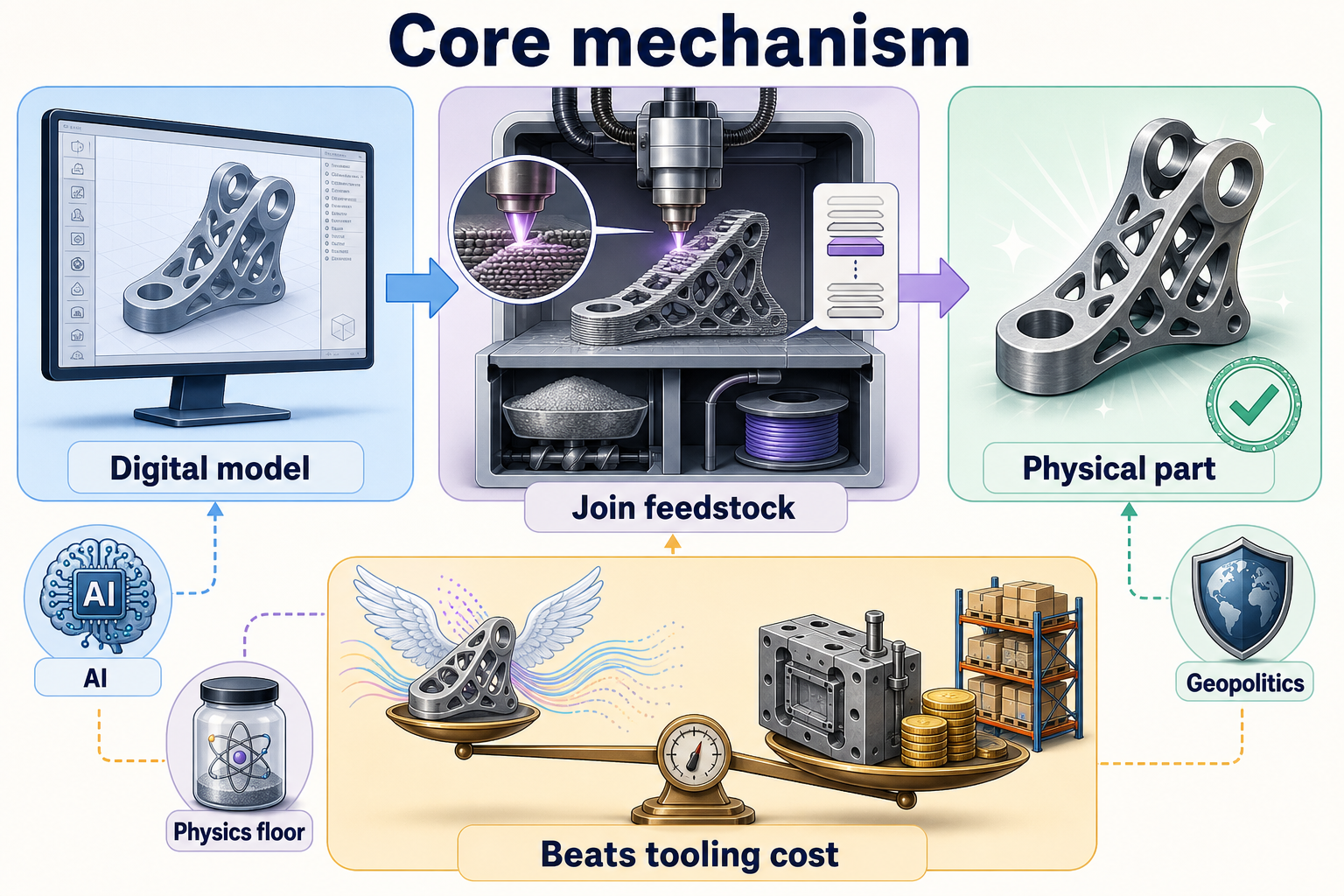
AM converts a solid digital model into a physical object by controlled joining of feedstock where the model requires material. Value appears when the cost of that freedom—and of certifying the resulting microstructure—beats the cost of tooling, machining access limits, multi-piece assemblies, or physical inventory. AI improves search and control inside that loop; geopolitics constrains which machines and networks may serve critical buyers; physics and powder set the floor.
Short answers
| Question | Short answer |
|---|---|
| What is it? | Join material from 3D model data, usually layerwise (ISO/ASTM 52900). |
| Is it exponential like chips? | No—maturing industrial S-curve ~10% ecosystem growth; stepwise machine gains. |
| Where does it win? | Complex geometry, low-mid volume, spares, medical custom, tooling, defence readiness. |
| Where does it lose? | High-volume simple parts vs molding/stamping on unit cost. |
| Biggest 2026 external driver? | Defence trusted capacity + qualification economics. |
| Biggest internal bottleneck? | Powder + post-process + certification, not CAD. |
Report structure
| File | Contents |
|---|---|
| 01-what-is-am | Definition, abundance/scarcity, EmTech portal, decision test |
| 02-process-landscape | Seven categories, PBF/DED/binder/extrusion |
| 03-materials-and-qualification | Materials, defects, qualification, audit trail |
| 04-market-and-economics | Market size, trend class, break-even, pure-play saga |
| 05-industrial-adoption | Aero, medical, auto, energy; GE story seed |
| 06-ai-convergence | Weak vs strong AI × AM |
| 07-consumer-vs-industrial-split | Hype failure and prosumer wave |
| 08-geopolitics-standards-canada | NDAA, Canadian DIS, secure digital thread |
| 09-contrarian-limits | Skeptic case integrated |
| 10-outlook-and-strategic-positions | Bottlenecks, decision rules, LTCs |
| references | Sources and quality notes |
| question-ledger | Master primary/secondary/rabbit-hole map (~85+ questions) |