Last updated: 2026-07-20
Industrial adoption
Where production is real
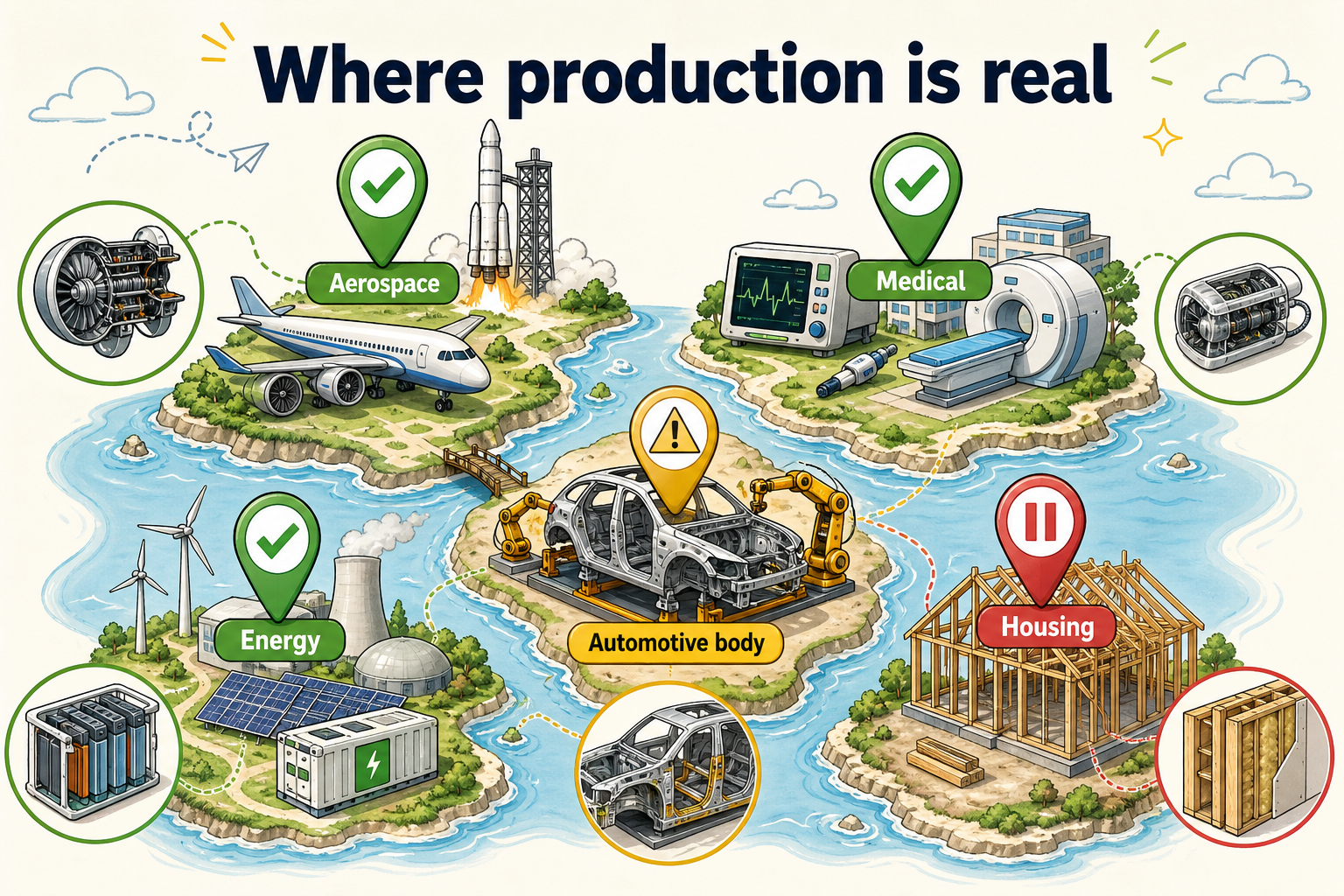
❓ Where has AM crossed from prototype theater into qualified production?
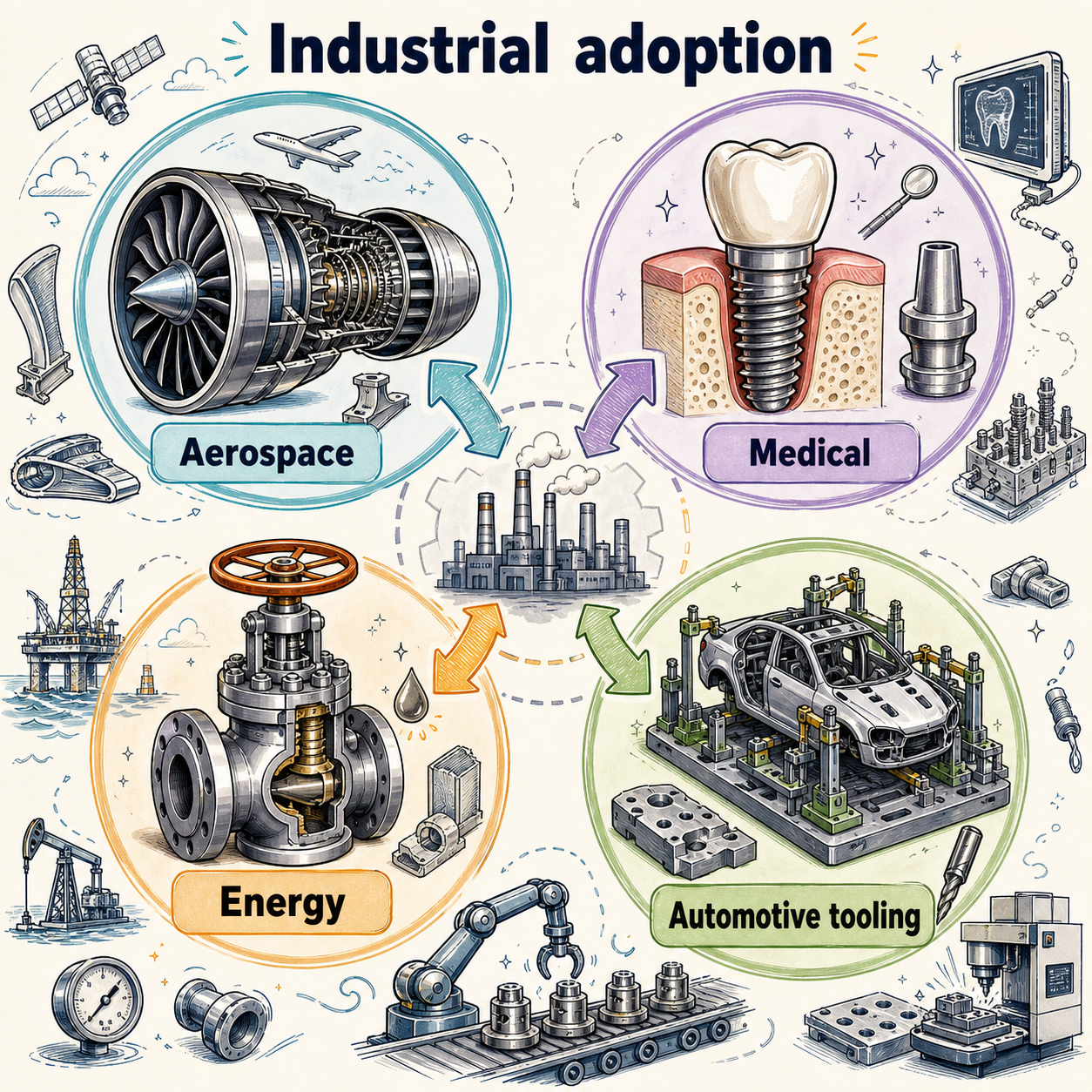
Aerospace and defense
The flagship serial story remains GE’s LEAP fuel nozzle tip: multiple parts consolidated into one additive piece, about 25% lighter, reported as ~5× more durable than the prior design, produced at scale in Auburn, Alabama. Public milestones: 30,000th nozzle tip around 2018; 100,000th shipped 2021. Each LEAP engine uses multiple additive nozzles; the point is not novelty—it is years of flight hours on a production additive part.
Beyond nozzles: brackets, heat exchangers, satellite structures, rocket engine components, and tooling populate programs across primes and New Space. Defense interest is not only performance; it is readiness—print or locally manufacture spares when logistics tails break.
Medical and dental
Patient-specific implants, osteotomy guides, dental models, clear-aligner thermoforming patterns, and hearing-aid shells were early economic wins: every unit is already custom, conventional tooling never amortized, and clinicians accept digital workflows. Regulation is heavy, but the customization fit is natural.
Energy and industrial equipment
Turbomachinery, oil and gas, and power-generation spares use AM for complex geometries and obsolescent parts. The business case often looks like aerospace spares: downtime costs dwarf print costs.
Automotive
Honest split:
- Strong: fixtures, jigs, assembly aids, prototype functional parts, some aftermarket and motorsport, limited end-use polymer/metal in specialized components.
- Still hard: high-volume structural body and powertrain parts at mass-market cost and rate. Binder jetting and high-speed polymer systems keep pitching at this wall; qualification and cost-per-part remain the bouncer.
Construction and large-format
Concrete printing and large polymer extrusion produce dramatic demos and some real projects. Building codes, labor models, insurance, and finish work still dominate whether “printed house” is housing policy or PR.
Electronics (AME)
Additively manufactured electronics attracted capital (Nano Dimension’s original identity). The later corporate unbundling—including selling AME assets in restructuring narratives—is a caution that category excitement ≠ durable standalone economics.
Operating model: what separates pilots from plants
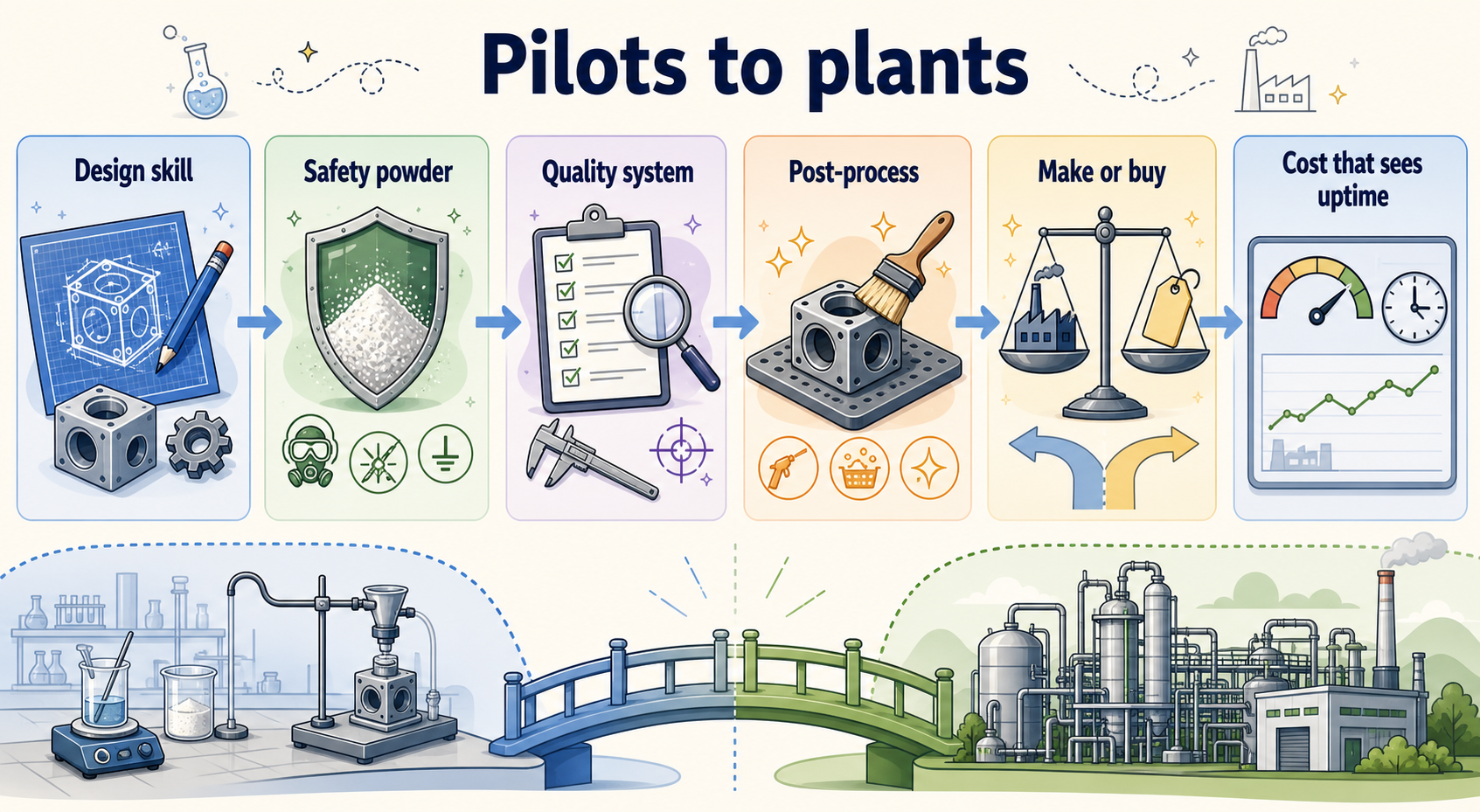
❓ What must change inside a company for AM to stick?
- Design rights and DfAM skill — If design stays “machine a billet,” AM only makes expensive billets layerwise.
- Powder/resin EHS and facilities — Inert gas, explosion risk for some powders, chemical handling for resins.
- Quality system integration — MES, travelers, NDT, nonconformance loops.
- Post-processing capacity — Often the true bottleneck resource.
- Make/buy network — Qualified service bureaus plus internal cells for sensitive IP or surge.
- Cost accounting that sees inventory and uptime — Unit-cost-only dashboards kill good AM cases.
Story seed: the walnut-sized nozzle
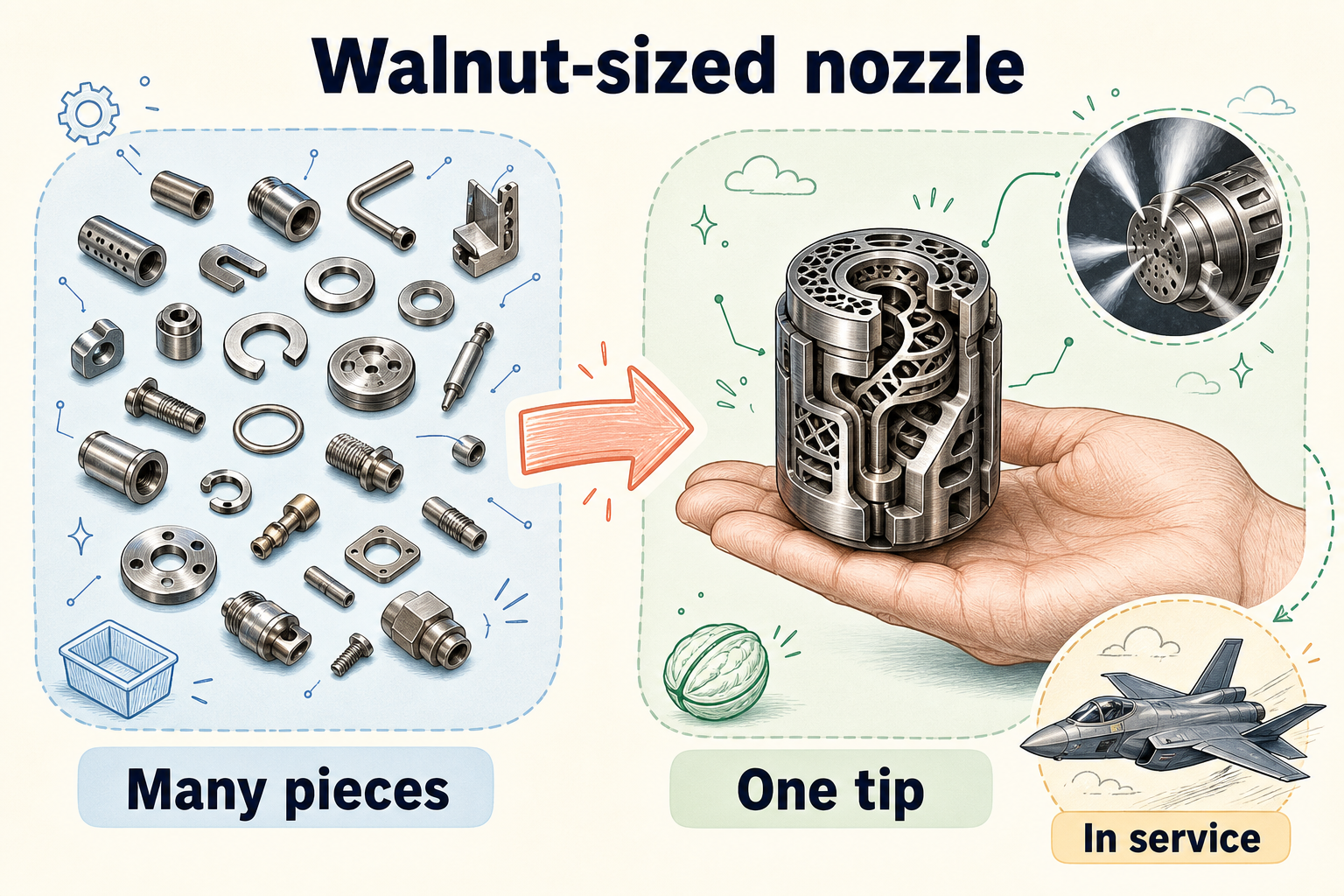
❓ What single concrete moment best explains industrial AM?
In the early 2010s, GE Aviation engineers faced a fuel nozzle assembled from many brazed pieces—heavy, failure-prone at joints, expensive to make. Additive redesign collapsed the assembly into a single printed tip with internal features casting could not easily offer. The drama is not the first print; it is the Auburn production system that had to hit rate, yield, and cost curves while airlines took delivery of LEAP-powered aircraft. When the plant later celebrated tens of thousands, then a hundred thousand tips, AM stopped being a lab tour and became manufacturing.
The paired contrarian story is equity markets cheering “AM platforms” that never found an equivalent production anchor.