Last updated: 2026-07-20
10. Machines You Are Allowed to Trust
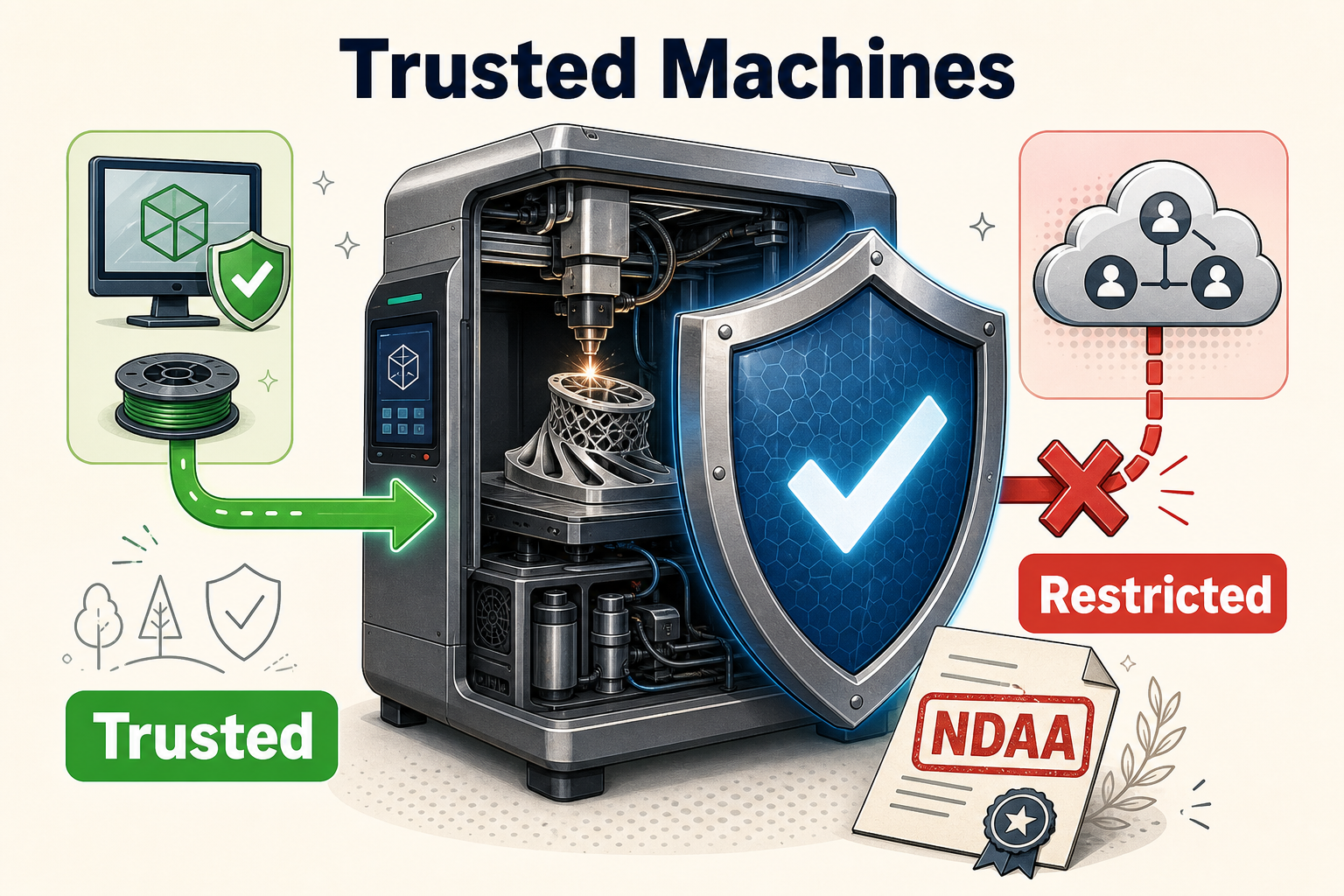
Additive manufacturing is now written into defense industrial language as capacity, not gadgetry.
In December 2025, the United States’ National Defense Authorization Act for fiscal 2026 was signed with provisions that restrict Department of Defense procurement and operation of certain additive machines manufactured in, networked through, or software-tied to covered nations including China, Russia, Iran, and North Korea. Specialized press and law-firm briefings emphasize ownership and control tests, software control, data sovereignty, qualification, and scale. Implementation is phased. Final assembly geography alone is not the whole story. Secondary reporting also cites multi-billion-dollar class increases in U.S. defense additive budget requests for fiscal 2026. Even when line items move in appropriations, the signal is steady: readiness and trusted supply pull metal additive.
Vendors with Chinese origin or dual-connected industrial printers watch a defense addressable market shrink in the United States. Allied vendors and cleaner software stacks gain structural preference. Service networks must document machine provenance end to end.
Canada’s Defence Industrial Strategy communications in February and March 2026, as reported in federal and trade channels, oriented toward domestic production, resilience, and higher Canadian content in acquisitions — including coverage that cites targets directing a large majority, on the order of seventy percent, of defence acquisitions toward Canadian companies. Additive shows up as enabling capacity for domestic spares and repair, lightweight structures, and sovereign digital manufacturing know-how aligned with allied standards. Build-Partner-Buy logic applies: not every machine must be invented in Canada, but trusted capacity, data control, and qualified processes must be reachable under Canadian and allied rules. For Canadian lenders and capital allocators, additive appears as industrial-policy-adjacent capital expenditure and export-control complexity — not as a mall gadget fad.
Standards are trade infrastructure. ISO/ASTM 52900-class documents and the growing 529xx series give powder, machines, and parts a common language across suppliers. Without them every prime reinvents process specs and small firms cannot enter. Standards move slowly on purpose. In safety industries that slowness is a feature. On hype timelines it feels like sabotage.
Trusted additive operationally means provenance of machine, firmware, and cloud links; access control on build files and parameter sets; air-gapped or carefully bounded shop networks where required; powder supply integrity; audit-ready build records. Yesterday’s convenience feature — always-on vendor cloud monitoring — is today’s procurement risk.
Allied networks can, in principle, share digital spare libraries the way they share logistics doctrine. In practice, classification, liability, and qualification still travel slower than files. The strategic picture is still clear enough: the machine you may not plug in is becoming as important as the machine you can afford.
If defense makes trust a hard gate, software is trying to soften every other gate. The next chapter asks how far super intelligence actually reaches into the melt pool.