Last updated: 2026-07-20
11. Software Meets the Melt Pool
Super intelligence and additive manufacturing now meet in every keynote. The serious question is weaker and sharper: is the meeting a handshake or a fusion?
Weak convergence is common and useful. Generative design proposes a lattice bracket; an engineer prints it on an existing powder-bed machine. Each technology helps the project. Neither rewrites the other’s limits every week.
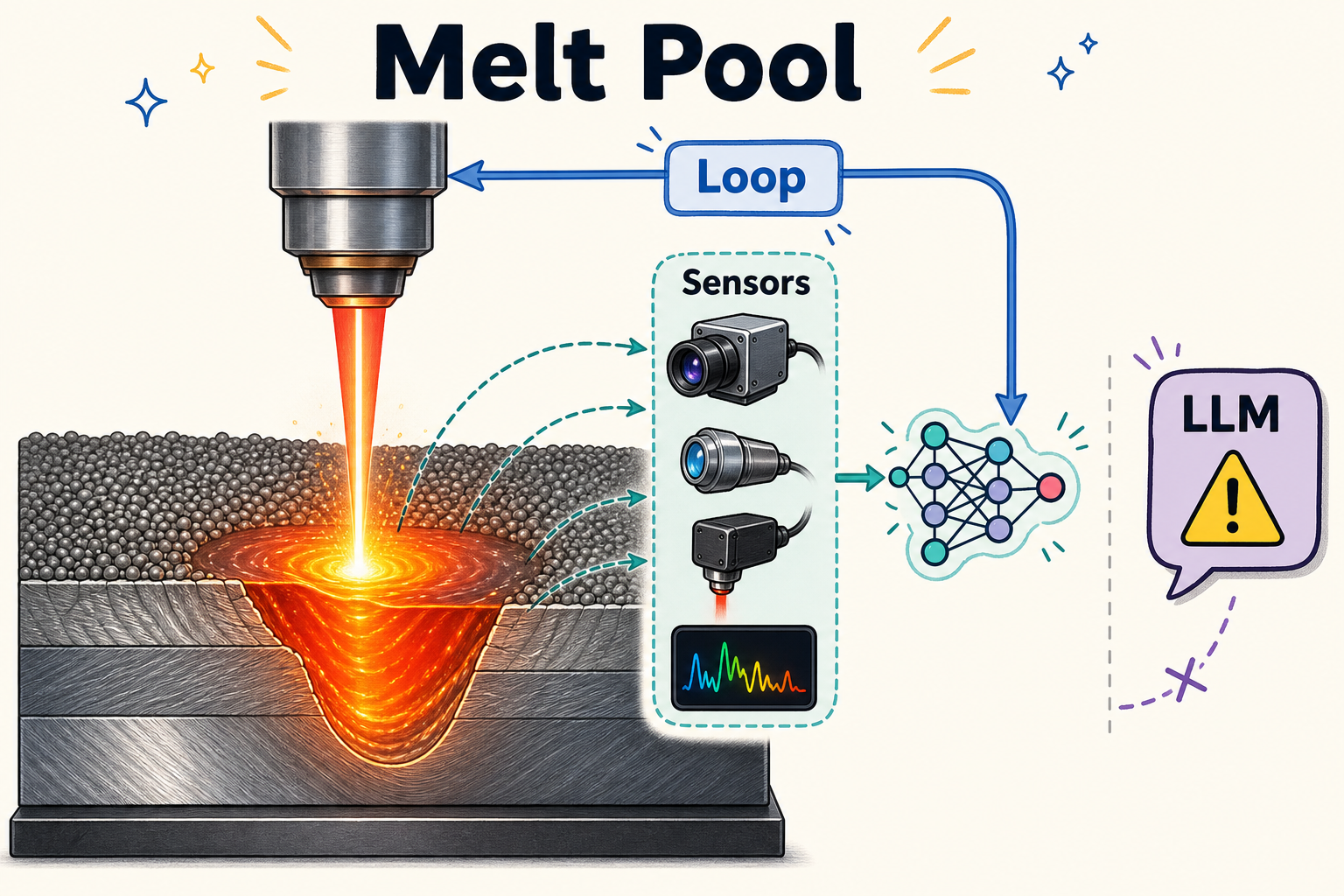
Strong convergence is emerging and uneven. Models close the loop on melt pools, learn parameter sets that widen alloy windows, and synthesize rare failure images so defect detectors can train. Here software changes what additive can reliably make.
Industrial reality in 2026 is mostly weak-to-moderate convergence with pockets of strong process AI. Buyers who keep their wallets attach separate labels: design AI, build-prep automation, in-process control.
Topology optimization and generative design explore geometries under loads and constraints. Additive uniquely produces many of the shapes that fall out. Professional tools include AM-aware implicit modeling, established optimization suites, accessible CAD generative features, and build-prep platforms that advertise faster supports and orientation. Materialise’s 2025 Magics coverage is one visible marker of a broader race to compress prep time. Limits remain adult: bad load cases produce pretty failures; fatigue and certification still need tests; organic shapes that cannot be supported, inspected, or cleaned are not free gifts. Generative design searches a space. Additive expands the manufacturable set of that space. Neither deletes validation.
In-process monitoring and machine-learning classifiers flag anomalies layer by layer, cut scrap, and focus inspection. On high-end metal systems they are becoming table stakes. Digital twins of residual stress and distortion help orientation and supports; accuracy still varies by alloy and geometry. Large language models retrieve playbooks, draft work instructions, and tutor juniors. Their special risk is confident wrong metallurgy. Treat them as interfaces over controlled knowledge bases, not as engineers of record.
A 2026 review framing of generative AI for additive sorts the field into generative design, process planning and control, data augmentation, and knowledge acquisition. That taxonomy is already more useful than the phrase “AI-powered manufacturing.”
Talent remains scarce. Automated orientation and supports compress technician hours. Generative tools help non-specialists propose candidates. Responsibility for structural integrity, powder practice, and special processes does not staff itself. AI concentrates skill in software vendors and power users. It does not clock in for the night shift at the hot isostatic press.
The more software promises to erase difficulty, the more valuable a clear-eyed skeptic becomes. The next chapter gives that skeptic the microphone without handing over the factory keys.