Last updated: 2026-07-20
12. What the Skeptic Still Gets Right
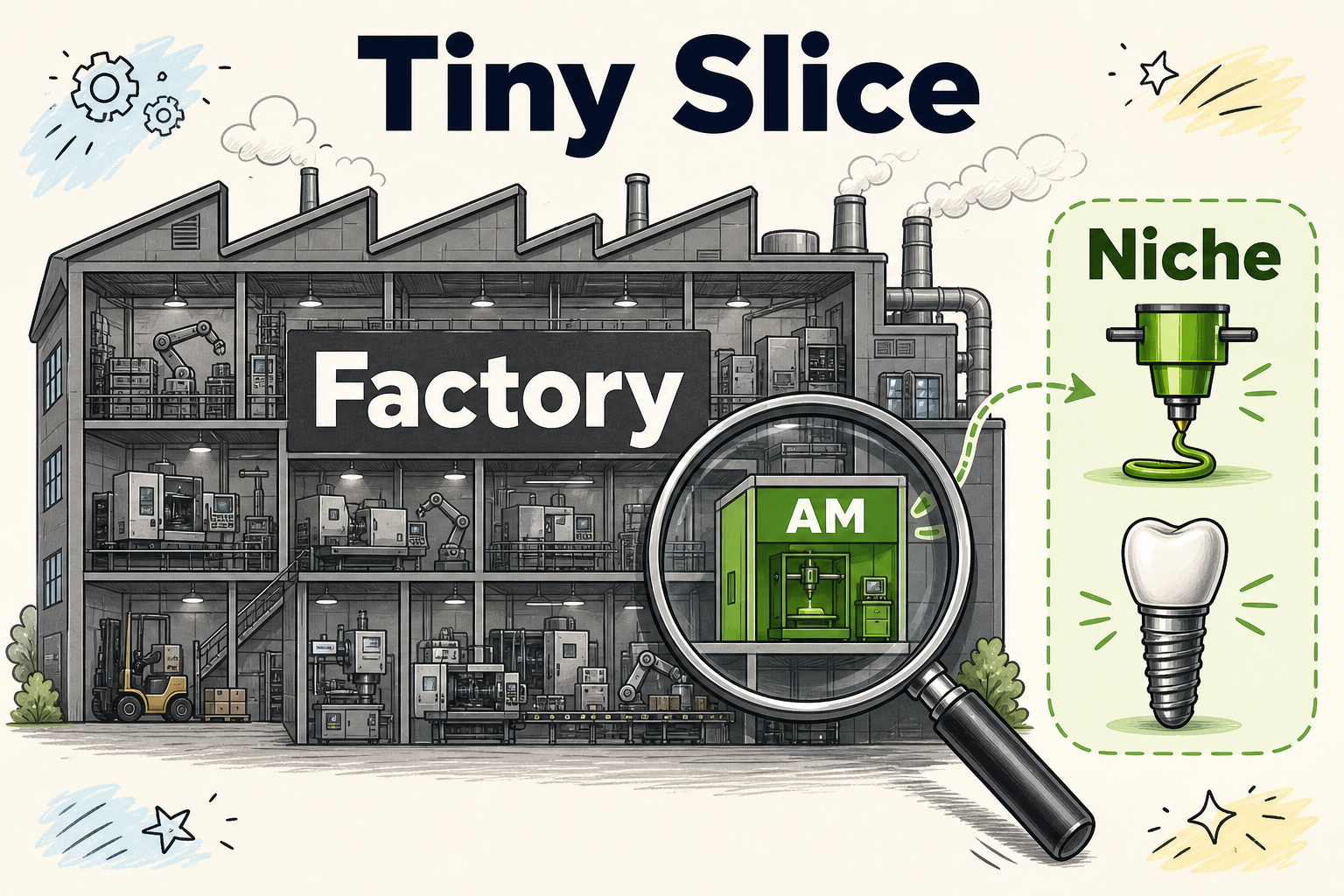
A sophisticated skeptic in 2026 can say all of the following without denying GE nozzles or dental aligners.
Additive manufacturing is still a tiny slice of manufacturing value-add. It has not disrupted factories in the economy-wide sense promised in popular technology media a decade ago. Many pure-play additive equities destroyed capital through rollup fantasies, slow enterprise sales cycles, and high cash burn even when the underlying machines worked. Cost, materials, post-processing, and standardization remain binding constraints; 2026 challenge lists from market analysts still lead with equipment cost, material limits, standards and quality assurance, digital-file IP, workforce, and post-processing complexity. Higher interest rates and operational complexity cooled marginal industrial adoption in the mid-2020s. Not every pilot became a plant. Complexity for its own sake remains a failure mode: printing a part that should have been a bent tube wastes money. Environmental virtue is conditional. Lightweighting in flight can save fuel for years; energy-heavy metal lasers with poor utilization and high scrap can lose a full life-cycle comparison to optimized conventional routes. Consumer home manufacturing was a category error — a cool fabricator mistaken for a supply chain.
If no credible counter-argument existed, bulls would only need press releases. The counter-arguments are credible. Therefore the bull case must be narrow and mechanistic: specific geometries, spares, medical customization, defence readiness — not universal replacement.
Failed forecasts deserve a museum wall. Gartner-era claims that 3D printing would produce on the order of a hundred billion dollars a year in global IP losses by 2018 did not arrive as predicted. Hype-cycle dynamics are not unique to additive, but additive was a textbook case: media peak, trough of disillusionment, slope of enlightenment in industrial niches.
Operational failure modes recur with depressing reliability. Pilot purgatory: no design-for-additive redesign, print-as-machined, pretty prototypes, no cost win. Hidden post-process tax: quotes ignore HIP, machining, inspection; schedules slip and margins vanish. Powder quality drift: reuse without controls; property scatter; scrap. Software lock-in: parameters and manufacturing systems captive; switching costs exceed machine price. Security afterthought: cloud-connected shops in regulated programs fail procurement. Equity narrative capture: strategy set by stock story; deal churn; talent exit.
In 2026 the over-discussed list includes fully autonomous lights-out metal factories for arbitrary parts, near-term replacement of automotive stamping, bioprinted organs as general additive progress, and AI that deletes qualification. The under-discussed list includes boring tooling and fixtures, dental and medical customization economics, defence-driven trusted capacity, hybrid DED-plus-CNC repair, digital inventory for obsolescent industrial spares, and continuous-fiber polymer structures on non-flight-critical load paths.
The skeptic’s job is not to stop the factory. It is to stop the fairy tale so the factory can be managed. The last chapter before the appendix turns that discipline into decision rules.