Last updated: 2026-07-20
14. Appendix: Questions That Keep the Story Honest
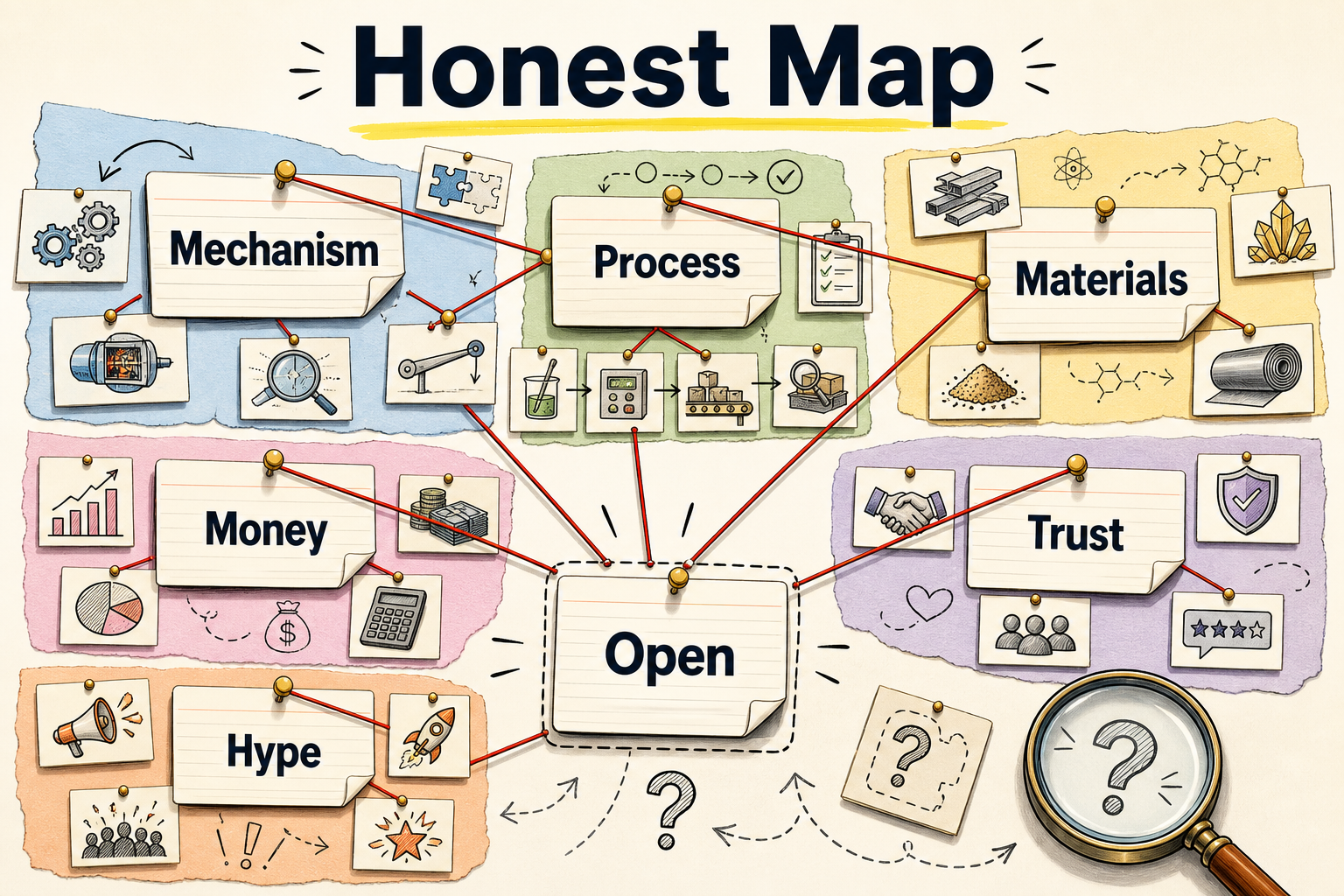
This appendix preserves the research question map. The chapters answer in narrative form. The map is here so nothing important has to be smuggled back in later as an afterthought.
Primary 1 — Framing and mechanism
What is additive manufacturing, and what hard-to-vary mechanism distinguishes it from cutting, casting, and molding?
Secondary lanes: ISO/ASTM 52900 definition versus colloquial “3D printer”; what becomes abundant versus scarce; consumer desktop versus industrial maturity paths; bits-to-atoms portal beside IoT, robotics, and synthetic biology; what would falsify “digital manufacturing”; which analogies help or mislead; how a non-technical decision-maker spots an AM problem.
Rabbit holes: why consumer hype failed while aerospace scaled; whether “additive” is process principle or business model.
Primary 2 — Process taxonomy
What are the seven ISO/ASTM process categories, and which drive industrial value in 2025–2026?
Secondary lanes: extrusion wins and stalls; vat dental/medical niches; powder bed as aero/medical workhorse; DED as repair and hybrid; binder jetting as volume path or qualification-limited; jetting and sheet lamination as peripheral; brand-name decoding; hybrid AM plus subtractive as factory architecture.
Rabbit holes: binder jet versus laser PBF after Desktop Metal / ExOne turmoil; continuous carbon fiber versus autoclave layup for secondary structures.
Primary 3 — Materials and properties
Which materials are production-ready, and what material physics still caps AM?
Secondary lanes: polymer classes; metal process–material pairs that are flightworthy; ceramics and multi-material; powder cost and contamination; anisotropy, residual stress, porosity, roughness; AI materials discovery horizons; recycled feedstock.
Rabbit holes: copper and reflective alloys; bioprinting as separate LAC.
Primary 4 — Economics and break-even
When is AM cheaper or strategically better than traditional manufacturing?
Secondary lanes: classical volume break-even shifts 2015–2026; total cost of ownership; material and machine amortization; digital spares versus warehouses; mass customization reality versus marketing; service bureaus and CapEx; signals for high-volume auto structural crossover.
Primary 5 — Market size, structure, and growth
How large is the AM industry in 2025–2026, and is growth still “exponential”?
Secondary lanes: what Wohlers / AM Research / AMPOWER / MarketsandMarkets measure; why $12B and $24B both circulate; hardware versus materials versus software versus services; polymer versus metal; pure-plays versus captive OEMs; trend classification; Asia-Pacific device growth versus North American/European defense-heavy demand.
Primary 6 — Industrial adoption reality
Where has AM crossed from prototype theater into qualified production?
Secondary lanes: aerospace and defense serial parts; medical and dental economics; energy spares; automotive tooling versus structural production; construction codes versus demos; additively manufactured electronics as caution; operating-model changes that separate pilots from plants.
Story anchors: GE LEAP nozzle; Desktop Metal / Nano Dimension counter-story.
Primary 7 — Qualification, standards, and trust
What makes an AM part good enough for flight, implant, or nuclear service?
Secondary lanes: ISO/ASTM, aerospace specs, FDA pathways, Nadcap-style oversight; process versus material versus part qualification; in-situ monitoring evidence versus marketing; post-processing as schedule; ML defect detection versus NDT; audit packs; IP and file security.
Primary 8 — AI × AM convergence
How strong is the convergence in 2026?
Secondary lanes: generative design production use versus slideware; build-prep automation; closed-loop control deployments; LLM metallurgy risk; digital twin accuracy limits; whether AI removes or concentrates the DfAM bottleneck; weak versus strong convergence.
Primary 9 — Consumer / prosumer versus industrial split
What happened to “every home a factory,” and what is the healthy split today?
Secondary lanes: maker boom plateau; high-speed desktop economics 2023–2026; hobby saturation versus vertical niches; prosumer bleed into light industrial; end-user IP and liability; whether consumer innovation still feeds industrial platforms.
Primary 10 — Geopolitics, defense industrial base, Canada
How are defense strategies and export controls reshaping AM equipment and supply chains?
Secondary lanes: FY2026 NDAA covered-nation machine rules; U.S. defense AM budget pulse; Canada’s Defence Industrial Strategy and Canadian-content targets; powder and dual-use controls; secure digital thread; allied spare-parts networks; Canadian lender and sovereign-capability angles.
Primary 11 — Contrarian scan and failure modes
Who is right that AM is overhyped, and what failure modes keep recurring?
Secondary lanes: Gartner-era misses; pure-play value destruction; rates, powder, complexity as brakes; workforce and standardization as structural constraints; complexity for its own sake; conditional environmental claims; what remains true in the skeptic case.
Primary 12 — Outlook, bottlenecks, strategic bets
What is the realistic 2026–2032 path, and which bottlenecks decide winners?
Secondary lanes: ranked bottleneck stack; next paradigm candidates; LTCs versus churning PTCs; convergence bets; manufacturer build-versus-buy rules; investor and lender filters; explicitly unresolved questions.
Unresolved on the research date
| ID | Question | Why unresolved |
|---|---|---|
| U1 | Exact Wohlers 2026 full table breakdown | Paywalled primary; secondary citations only |
| U2 | True serial production share of global manufacturing value-add | No single official series |
| U3 | Long-run binder jetting metal allowables for structural auto/aero | Qualification incomplete or proprietary |
| U4 | Net climate impact of metal PBF at scale versus forged/cast | LCA depends on energy mix, buy-to-fly, use-phase savings |
| U5 | Whether Nano Dimension residual strategy stabilizes | Restructuring ongoing mid-2026 |
The map is not the territory. It is the set of questions that keep the territory from being replaced by a brochure.