A long-form essay
The Slow Catch the Swift
Hephaestus and Aphrodite — making and wanting in one house.
Last updated: 2026-08-15
Hephaestus is the lame smith of the gods. Aphrodite is the goddess of desire. The Greeks told us they were married — and then they could not agree on the wife, the wedding, or even what to call the trap.
This essay follows one story in eleven movements. Who they are. How she was born, twice. How he fell, twice. The chair that would not let go. The other wife at the bronze door. The invisible web. The necklace that outlived the joke. The temples that refused to house the couple. What the pairing is actually for. What later ages gilded. What the poems still will not close.
Abstract
Nothing in this pairing makes sense except as two powers forced into one house: craft that locks matter, and desire that unlocks people. Homer’s war poem gives the smith a wife named Charis — Grace — who opens a bronze door. Homer’s homecoming poem puts Aphrodite in his bed and lets a web finer than a spider’s thread decide what the marriage is worth. Hesiod marries him to Aglaia and never mentions the other match. The famous wedding-as-prize is a later reconstruction. The oldest full scene is already a song inside a song. What the pairing produces is not a household. It is a set of objects that keep doing a maker’s will after he has left the room.
Chapters
- The Song in the Hall
- A Maiden in the Foam
- The Day He Fell
- A Chair That Would Not Let Go
- The Other Wife
- Bonds Fine as a Web
- The Necklace Harmony Could Not Refuse
- Separate Temples
- Lock and Solvent
- After the Greeks
- What the Poems Leave Open
Extra stories
Additional researched tales that do not repeat the essay’s main scenes:
- The discus past the mark
- The herdsman on Ida
- Aphrodite on her mother’s knees
- The god who hated his own hands
- The axe in the frame
- The younger Graces
- The ivory girl of Cyprus
- The women who killed the husbands of Lemnos
- The boar on the ridge
1. The Song in the Hall
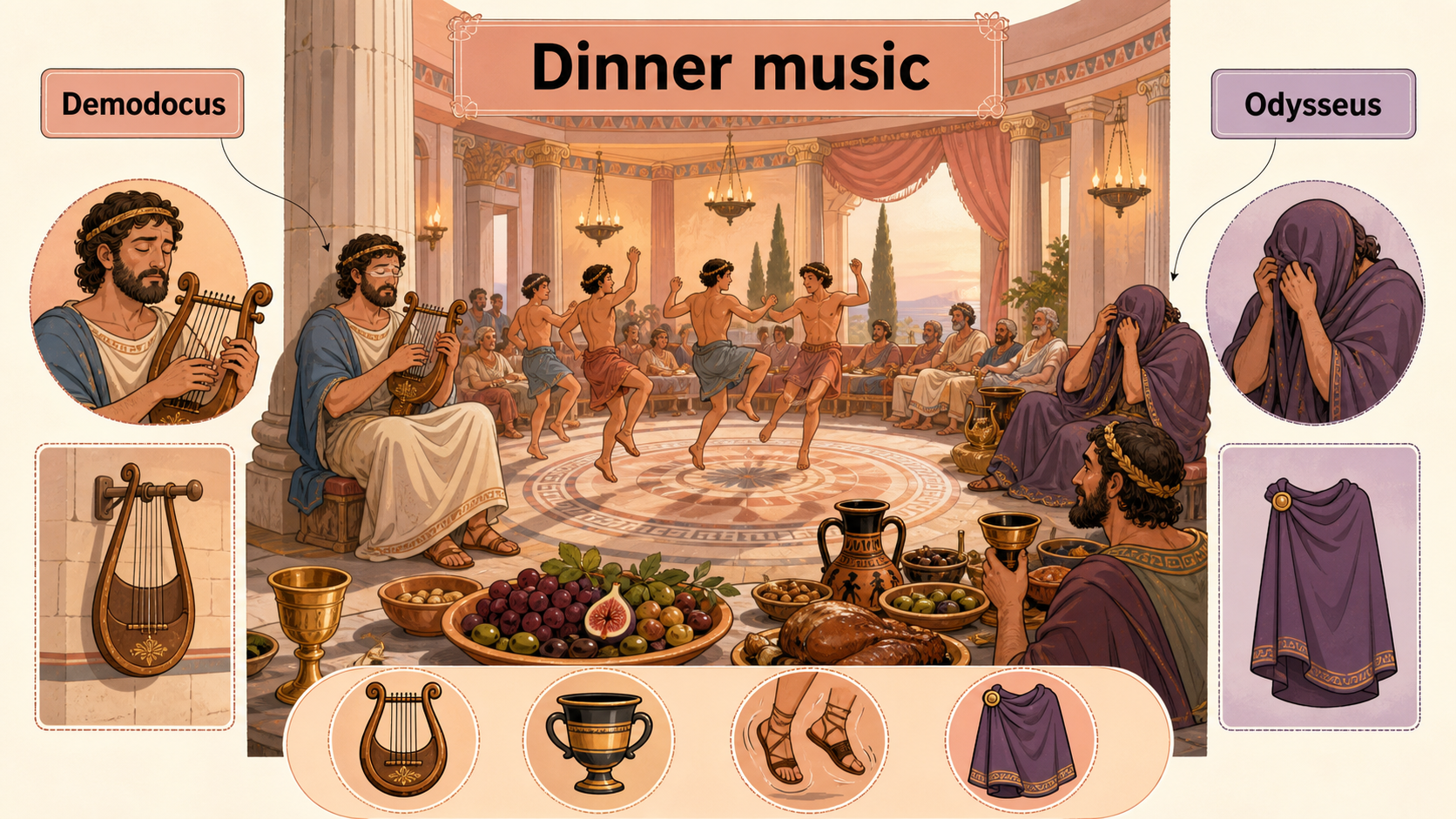
A blind singer sat against a pillar. A lyre hung on a peg above his head.
This is a scene from Homer’s Odyssey, the long Greek poem about Odysseus trying to get home from the Trojan War. Odysseus has washed up in a rich island court. The king’s name is Alcinous. The singer’s name is Demodocus. A herald led him in by the hand, set out food and wine, and left him there.
They ate. They poured wine. Then Demodocus sang — not about love. He sang about a quarrel between Odysseus and Achilles. Odysseus pulled a cloak over his head so the room would not see him cry.
Later there were games. A young man told the stranger he did not look like an athlete. The stranger, who still had not given his name, threw a discus past every mark they had. Alcinous called the dancers back and sent for the lyre again.
Demodocus struck the strings and sang about Ares and Aphrodite.
That is how the oldest full story of this marriage arrives. Not as a holy book. As dinner music.
Here are the three gods in that song, in plain words.
Hephaestus is the smith of the gods. He works fire into metal. He is lame. The Greeks had a word for his kind of skill: techne — knowledge you can teach, hide, and use against people stronger than you. Not a mood. A craft.
Aphrodite is the goddess of sexual desire. She is the reason someone who had plans walks into a house that is obviously empty.
Ares is the god of war. He is fast. Hephaestus is slow. The song will say that out loud, once the trap has closed.
The poet has not yet reached the anvil. He has already done three things. He put the story in a mouth that cannot see. He put the listener under a cloak. He put dancers between one weeping and the next.
These gods were entertainment before they were doctrine.
The song is also about looking. A sun god will watch. The husband will call the other gods to watch. A messenger god will say he would take three times the bonds if the goddesses watched too. And in the hall where the song is sung, a nameless man is trying not to be watched while he cries.
What the song will not do is tell us how they married.
Homer can give you the bill for a bride. He does not walk you through a wedding. Later ages, uneasy with that gap, invented a prize, a drunk procession, a girl waiting at the end of a mule ride. Some of that later stitching is good. None of it is what the blind man sang while the boys struck the floor.
Before the trap, then, the births. Before anyone can be given away, someone has to decide whether Aphrodite has a father. Before anyone can be scorned for a misshapen body, someone has to decide who threw Hephaestus, and into what.
The next chapter starts in the sea.
2. A Maiden in the Foam
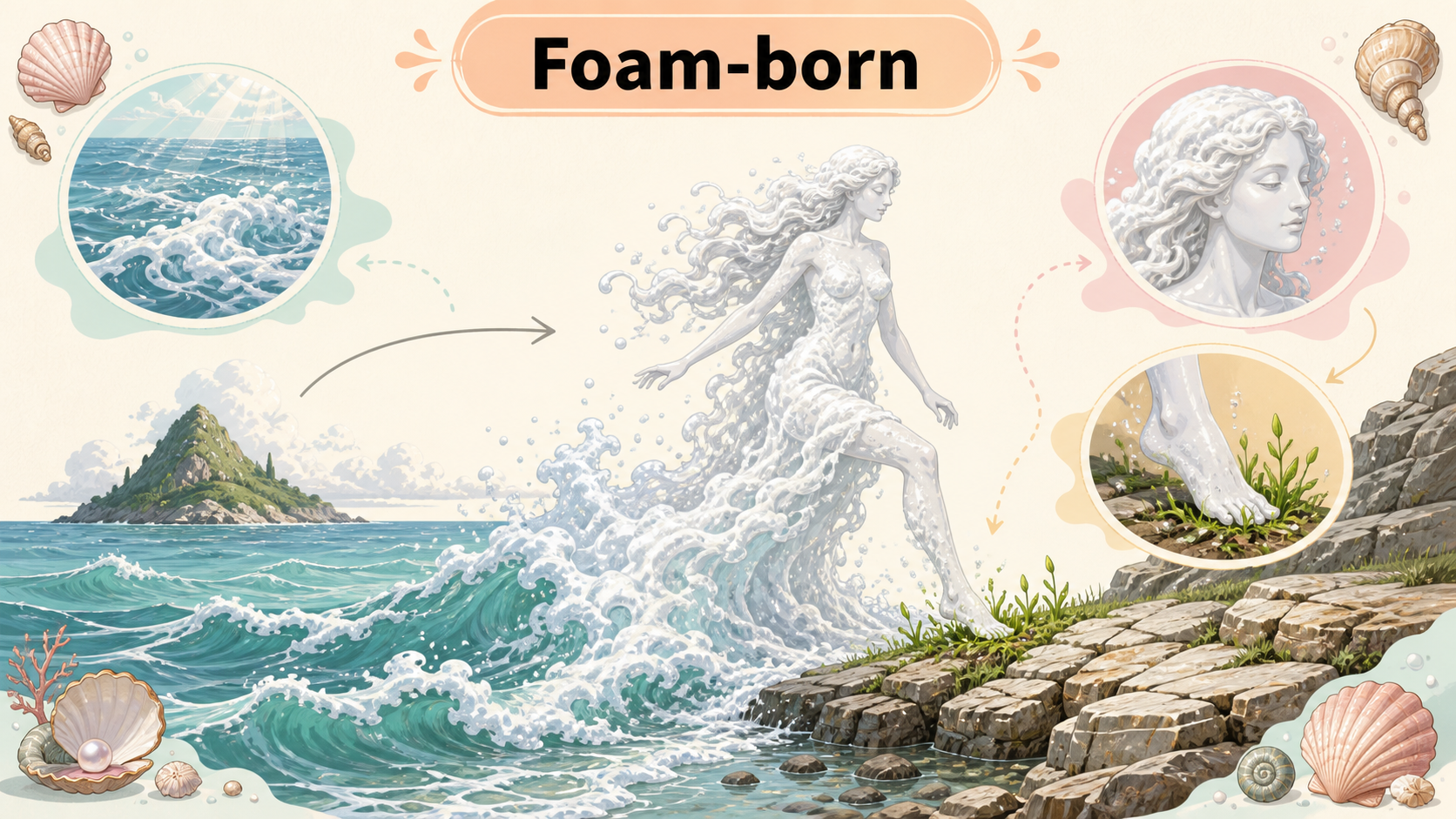
The oldest birth story for Aphrodite is not a seashell postcard.
Kronos hid in his parents’ bed with a flint sickle. Ouranos — Heaven — came down to lie on Earth, as he always had. The son castrated the father and threw what he cut into the water. The pieces drifted a long time. White foam spread from the immortal flesh. In the foam a girl grew.
That telling comes from Hesiod, a poet roughly of Homer’s world, writing a family tree of the gods rather than a war story. He likes to explain names. Aphros is foam. Aphrodite is foam-born. She touched Cythera, so she is Cytherea. The birth finished in the swell off Cyprus, so she is Cyprogenes.
She stepped onto the island as an awful and lovely goddess, and grass rose under her feet.
Sexual love, in this genealogy, enters the world as the leftover of a son mutilating a father. The blood that hit the earth became Furies and Giants. The part that hit the water became the goddess later blamed for every bed she did not even attend.
In this version she is older than Zeus. She is not a daughter anyone can give away. She is the sea’s answer to a crime in the sky.
Homer needed a different woman.
In the Iliad, Aphrodite is wounded in the fighting before Troy. She does not run to Ocean. She runs to her mother, Dione. Zeus is her father. In Demodocus’s song she has “but newly come from the presence of her father,” and her husband will demand that this father pay back the wooing-gifts — the bride-price — for his shameless girl.
Foam cannot be billed. A father can.
So the tradition keeps two Aphrodites. That is not sloppy. It is two jobs. One goddess must be able to arrive from outside the family, like a foreign luxury landing on an island. The other must sit in Zeus’s household as someone who can be transferred.
A long hymn to Aphrodite calls her Zeus’s daughter and then has Zeus turn her own weapon against her. Tired of being driven by her into mortal women, he makes her want a mortal man: Anchises, a herdsman on the slopes of Mount Ida. She lies with him. She bears Aeneas. She forbids the man to boast.
That hymn is not the marriage story. It is the other old experiment. Someone had to trap Aphrodite. Zeus does it to her will. The smith will do it to her body.
Hephaestus has two births as well. Those belong in the next chapter, because they end in a fall.
3. The Day He Fell
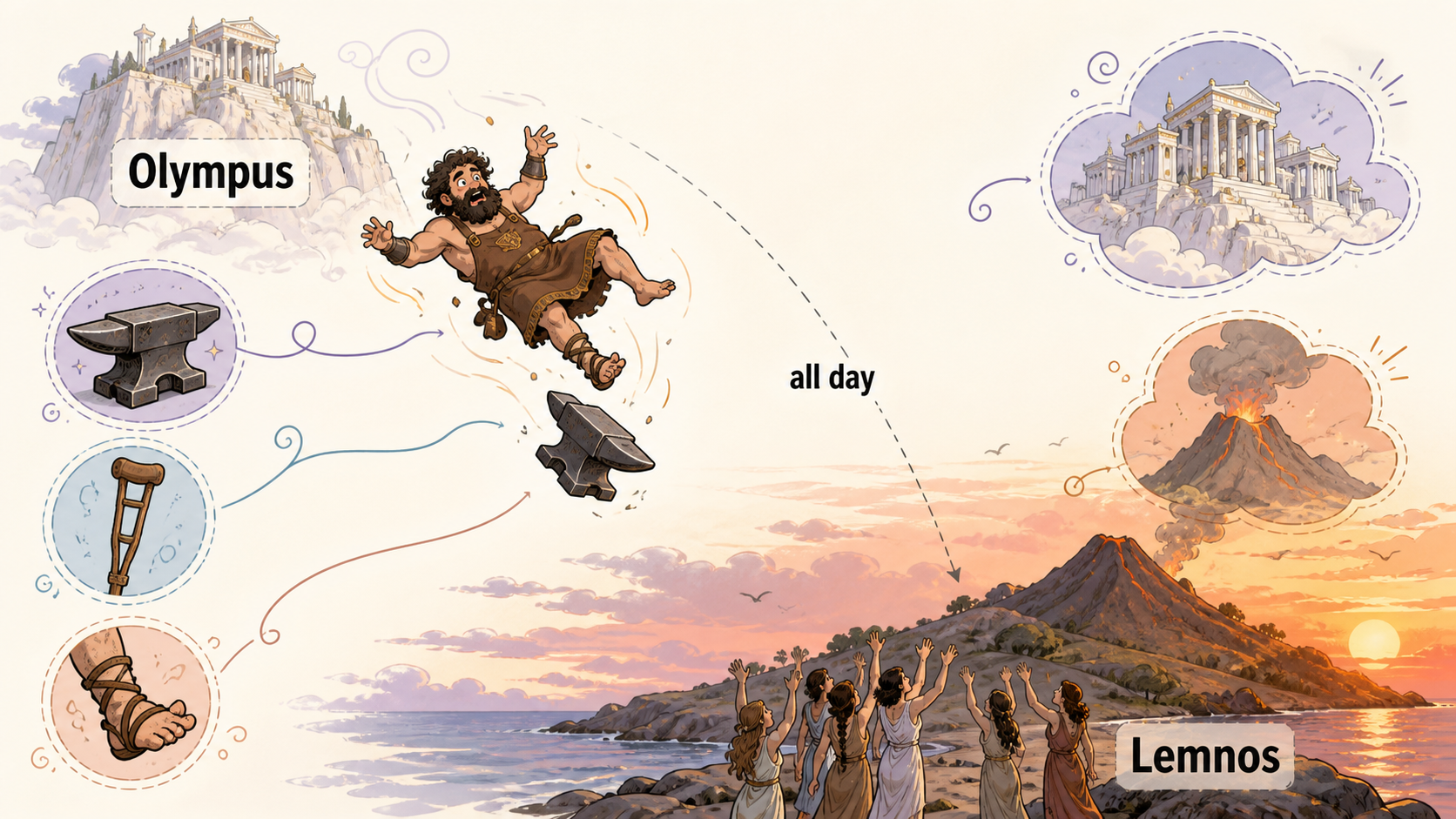
He dropped all day.
Hesiod’s version of his birth is almost blunt. Zeus has just produced Athena from his own head. Hera, angry, bears Hephaestus without a father. She copies the trick and cuts the father out. The product is not a warrior. It is a craftsman.
In a hymn she tells the other gods what she thought of that child. Weak. Shrivelled of foot. A shame. She took him in her hands and cast him into the sea.
Homer, in other moods, gives the smith a father. He needs one. A father can catch a grown son by the foot and throw him from the threshold.
In the first book of the Iliad, Hephaestus is trying to keep his mother from another fight with Zeus. He reminds her of the last time he took her side. The father caught him by the foot and threw him. From morning to sunset he was a falling thing. He landed on Lemnos, a volcanic island in the north Aegean, and there was not much life left in him. The Sintians, the people of the island, took care of what remained.
That is one fall. It has a map. Lemnos becomes, in his own later words, far the dearest of all lands. When he needs a lie that Ares will believe, he will pretend to go there.
The other fall is quieter and worse.
In Book 18 he is talking to his wife — and the wife, in this book, is not Aphrodite. He tells her why he owes Thetis everything. His mother wanted to hide him for being lame. Thetis and another sea-nymph, Eurynome, caught him in the water. For nine years he worked in their cave, making pins, clasps, cups, necklaces, while Ocean went on forever outside. No other god knew. No mortal knew. Only the two women who had saved him.
The sea-nymphs do not raise a warrior. They raise a jeweler.
The first things he makes are adornments. The same class of object Aphrodite will wear. The same class he will one day curse into a necklace a city cannot take off.
Which fall made him lame? The poems will not say. In Hera’s throw, the limp is why she throws him. In Zeus’s throw, the landing wrecks the legs. Homer keeps both scenes in the same poem and does not apologize. “Hephaestus is lame” is not a medical date. It is a mark. This god’s power will never be the power of the perfect body.
When the thrown child comes back, he will not come back with an army.
He will come back with furniture.
A throne can do what a body could not. It can hold a queen still.
4. A Chair That Would Not Let Go
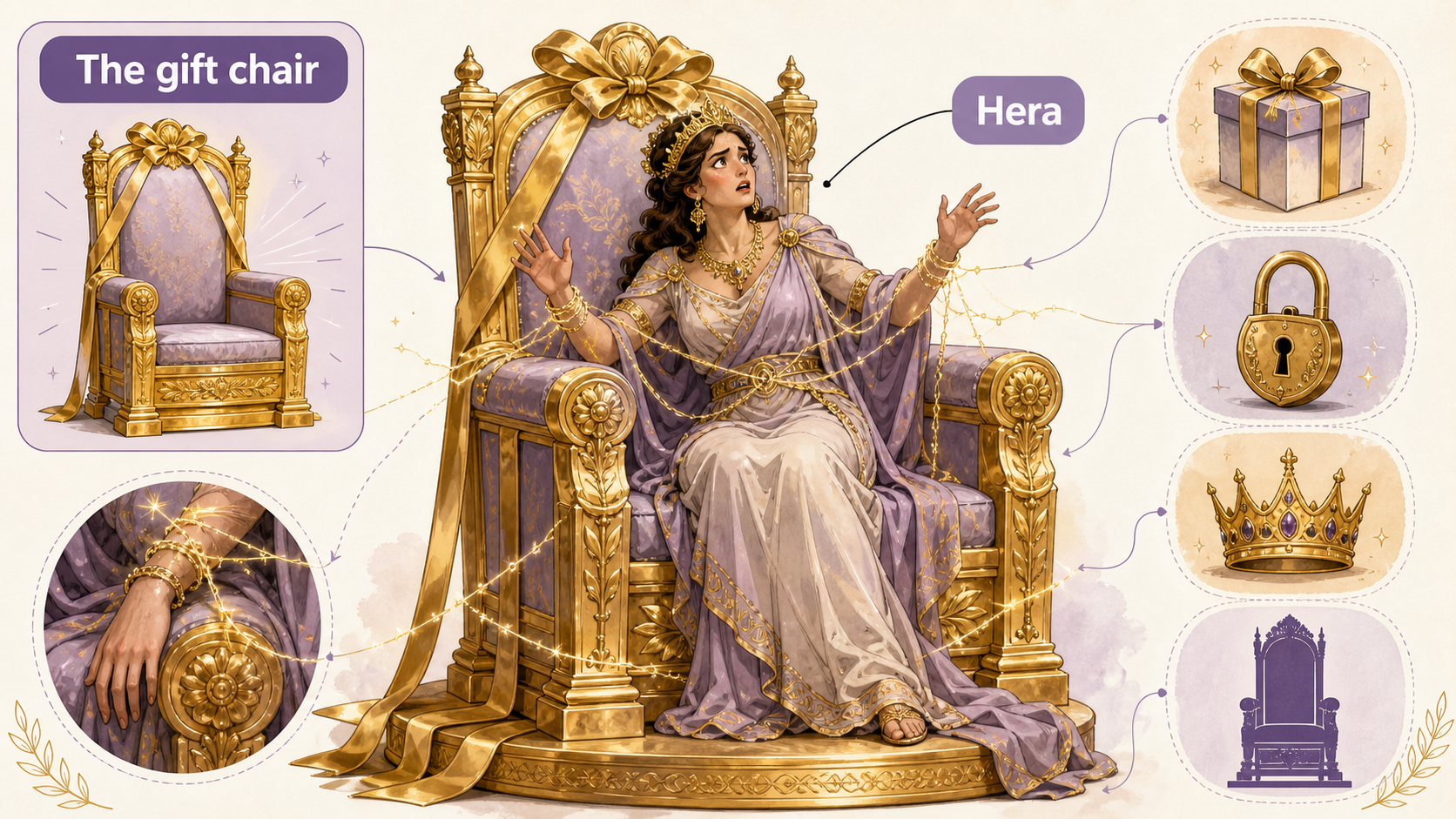
Hera sat down.
The chair was a gift from her son. Once she touched it, she could not get up. Invisible fetters closed. The queen of the gods, who had thrown a baby into the sea, hung in a piece of furniture.
This is not in Homer. It is a later story, told by travel writers and Latin handbooks and painted on Athenian vases. The shape of it is still Hephaestus: a wound answered by an object that keeps doing his will after he has left the room.
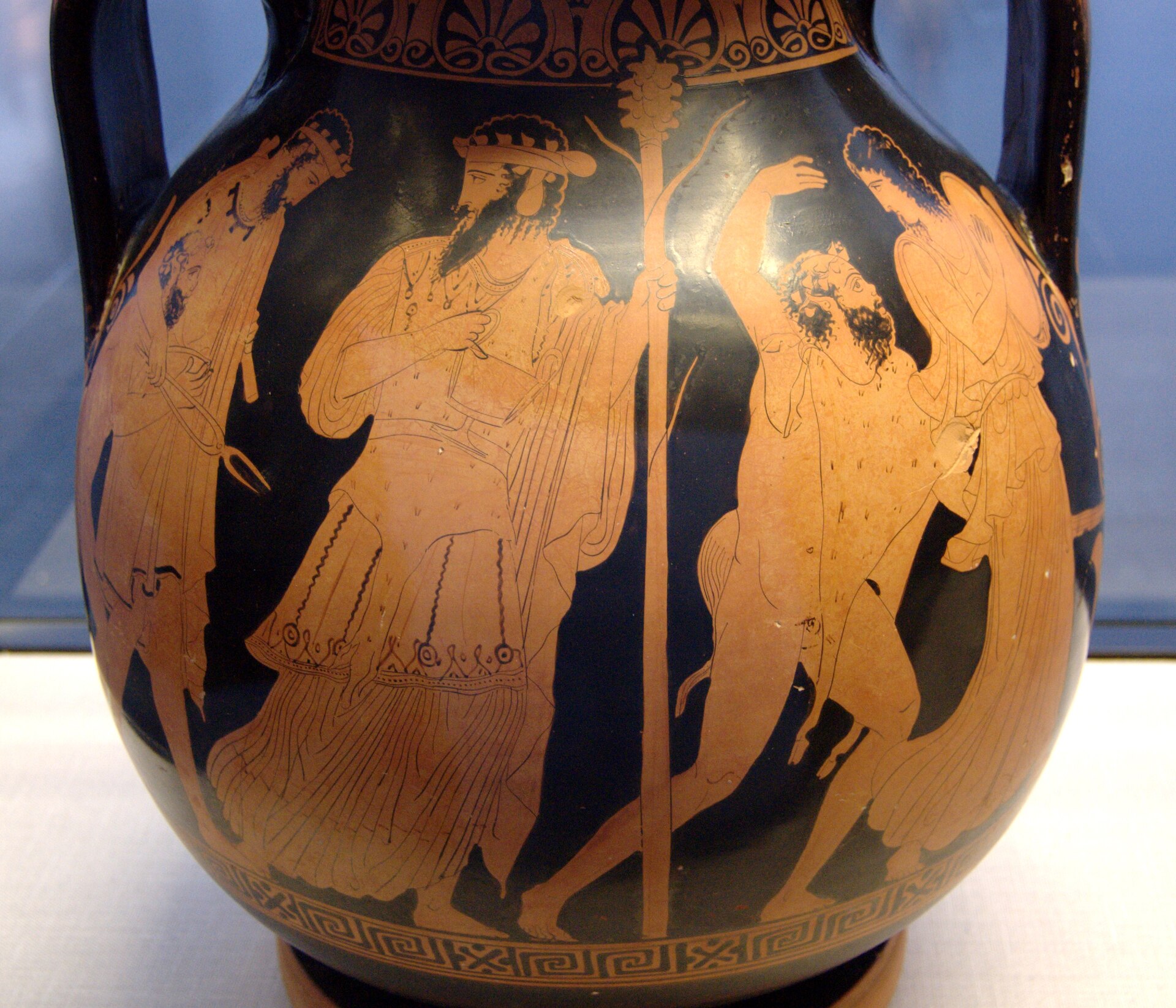
Pausanias, walking through Athens centuries later, saw the next part painted in a temple of Dionysus. Dionysus bringing Hephaestus up to heaven. The legend under the paint is simple. The thrown son sent the chair. When Hera was held, he would not listen to any god except Dionysus. Dionysus made him drunk and brought him home.
Hyginus, writing in Latin, adds a slammed door. Summoned to free his mother, Hephaestus denied that he had a mother.
Force tried first. Ares went to the forge. War failed to extract a craftsman. Wine did not fail. Dionysus does not storm a will. He changes it.
The return becomes a procession: satyrs, a mule, a drunk god riding back up the mountain he was thrown from. On a famous sixth-century Athenian vase — the François Vase — Hera sits trapped. Ares, who has failed, sits humbled. Dionysus leads. Hephaestus rides. At the end of the arrival, Aphrodite stands waiting.
A vase is not a contract. It is a painter telling you the woman and the mule belong in the same joke.
Later handbooks, uncomfortable with an unexplained marriage, turn the vase into a bargain. Zeus offered Aphrodite to whoever brought the smith back. She agreed, expecting Ares to win. Ares lost. Dionysus suggested another reading: come yourself, free the queen, claim the prize.
Homer will not vouch for that plot. Homer will only vouch for the bill. In the net scene the husband says he paid wooing-gifts to Zeus for a shameless girl, and he wants the gifts back. Later Greek poets still remember a cup given when Zeus handed over “the Kyprian Queen.”
That is the secure core. Zeus as giver. Goods as law. A house built by the groom.
The throne is the first net. A gift that looks like honor. Bonds no one sees until they try to rise. A public problem only the maker can solve.
What the old texts will not give us is the wedding night. The tradition jumps from the mule to the bed that will be shamed. In between, if we want a ceremony, we have to admit we are inventing.
The Iliad, which knows all about Thetis and the cave and the throw, invents nothing of the kind. When Thetis comes to that bronze house, another woman opens the door.
5. The Other Wife
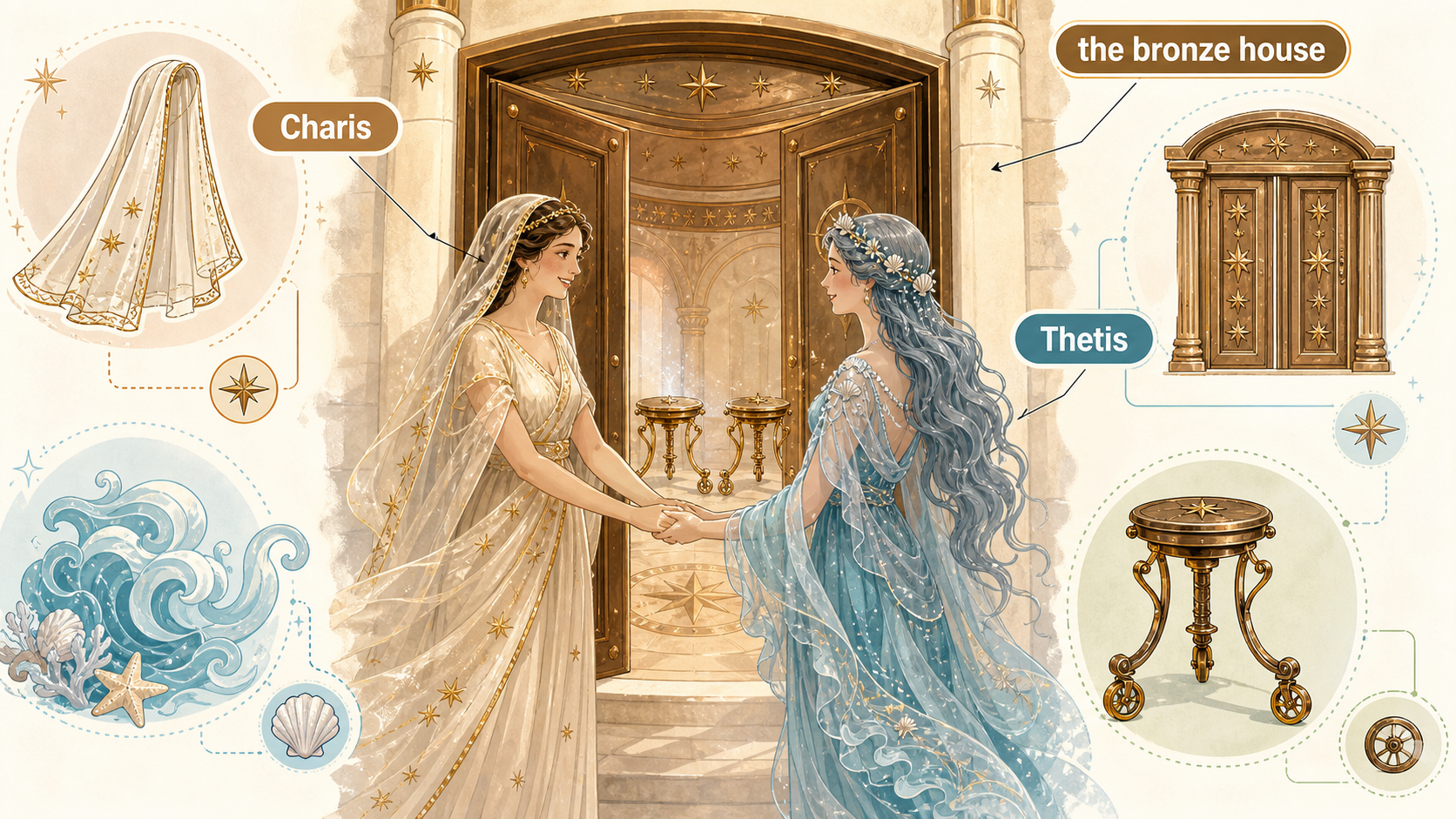
Charis saw her first.
Thetis had reached a house of bronze, the finest among the homes of the gods, built by the lame god himself. Inside, Hephaestus was sweating from bellows to anvil, finishing twenty tripods fitted with golden wheels so they could run to the gods’ assembly and roll home again. The handles were not done.
Charis came forward, took Thetis by both hands, and called her an honored guest. She led her in. She seated her. Only then did she call her husband. “Hephaestus, come quickly. Thetis has need of you.”
This is Book 18 of the Iliad. The wife of the famous smith is Grace.
Charis is not only a name. It is the Greek word for the charm that makes a gift acceptable, a guest welcome, a made thing pleasing. Hesiod says the Grace Hephaestus took was Aglaia, youngest of the three Charites. Ancient readers already saw the overlap. Homer’s Charis and Hesiod’s Aglaia look like the same office with two labels.
In this household, beauty is not adultery. Beauty is the finish on the work. The tripods will walk. The shield Thetis came for will hold a city, a dance, a lawsuit, a field. The wife at the door is the principle that makes skill lovable instead of merely useful.
The Odyssey needs a different principle.
A Grace who personifies pleasing finish does not shame a bed. Aphrodite does. Demodocus’s song requires a wife who can be caught with the war god, a wife whose body can be contrasted with a limp, a wife whose father can be billed. Charis cannot give the poet that. So the other poem puts the other woman in the house.
Later readers, trained by novels, invent a timeline. First the bad marriage, then a divorce, then a kinder second wife. Homer does not narrate a divorce. Hesiod does not mention a prior Aphrodite. The net scene ends with Aphrodite going to Cyprus to be bathed by the Graces, not with a lawyer.
Some poets skip the smith entirely and call Ares Aphrodite’s husband. That is a third household. The tradition is not a serial. It is a set of local answers to a local need.
The war poem binds craft to Grace because it needs a workshop that can make a cosmos on a shield. The homecoming poem binds craft to Desire because it needs a theory of shame, looking, and cunning. Homer could imagine a Hephaestus who was not a cuckold. He used that Hephaestus when a mother came for armor. He used the other one when a blind singer needed a laugh that would also be a law.
Thetis sits on the good chair. Hephaestus puts his tools away. He does not mention a net. He does not mention Ares.
If you want the religion of the bed, you have to leave this house and go back to the hall. The bonds are about to become visible.
6. Bonds Fine as a Web
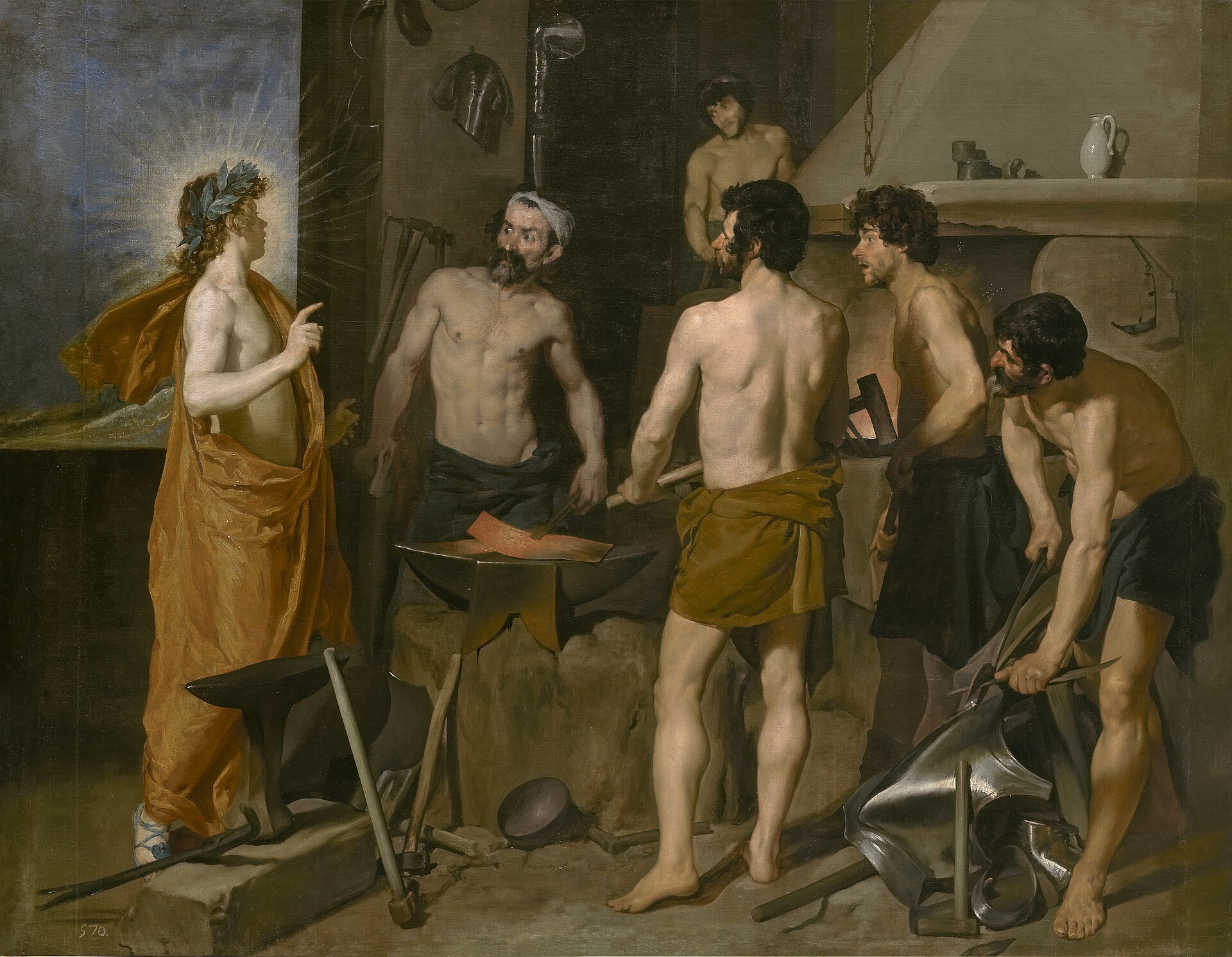
Helios saw them.
That is the whole beginning. Not a rumor. The sun, who sees for a living, marked Ares and Aphrodite lying together in the smith’s house and took the news to the husband.
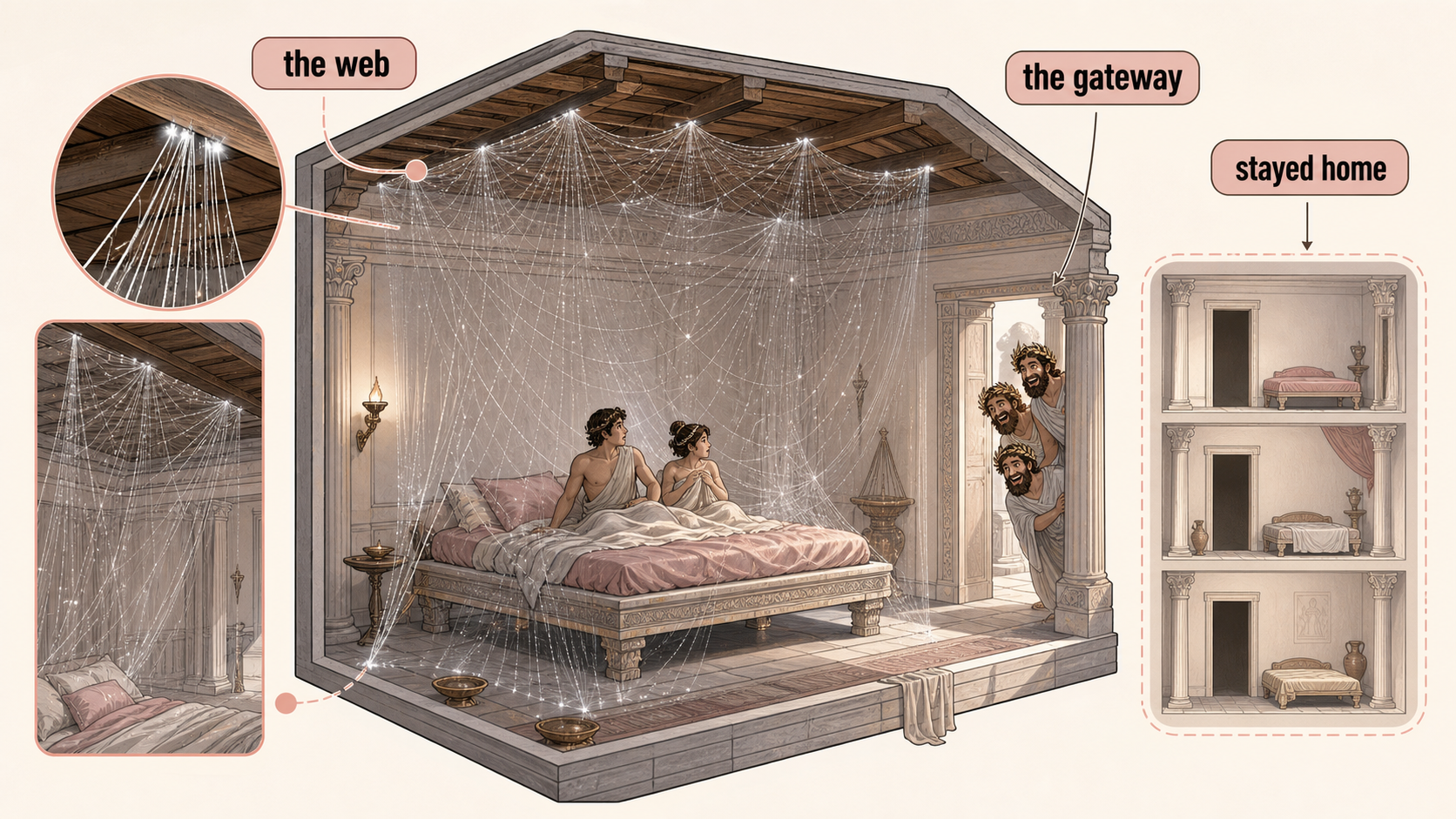
Hephaestus heard it and went to the forge. He set the great anvil on its block. He made bonds that could not be broken or loosed. Then he went to the bedroom and spread them around the bed-posts and hung more from the beams, fine as spiders’ webs, so well made that no one, not even the gods, could see them.
He pretended to leave for Lemnos.
Ares kept no blind watch. He saw the craftsman go and walked straight to the house. Aphrodite had only just come from her father. Ares took her hand. Come to bed. Hephaestus is gone.
A welcome thing, the poem says, it seemed to her to lie with him.
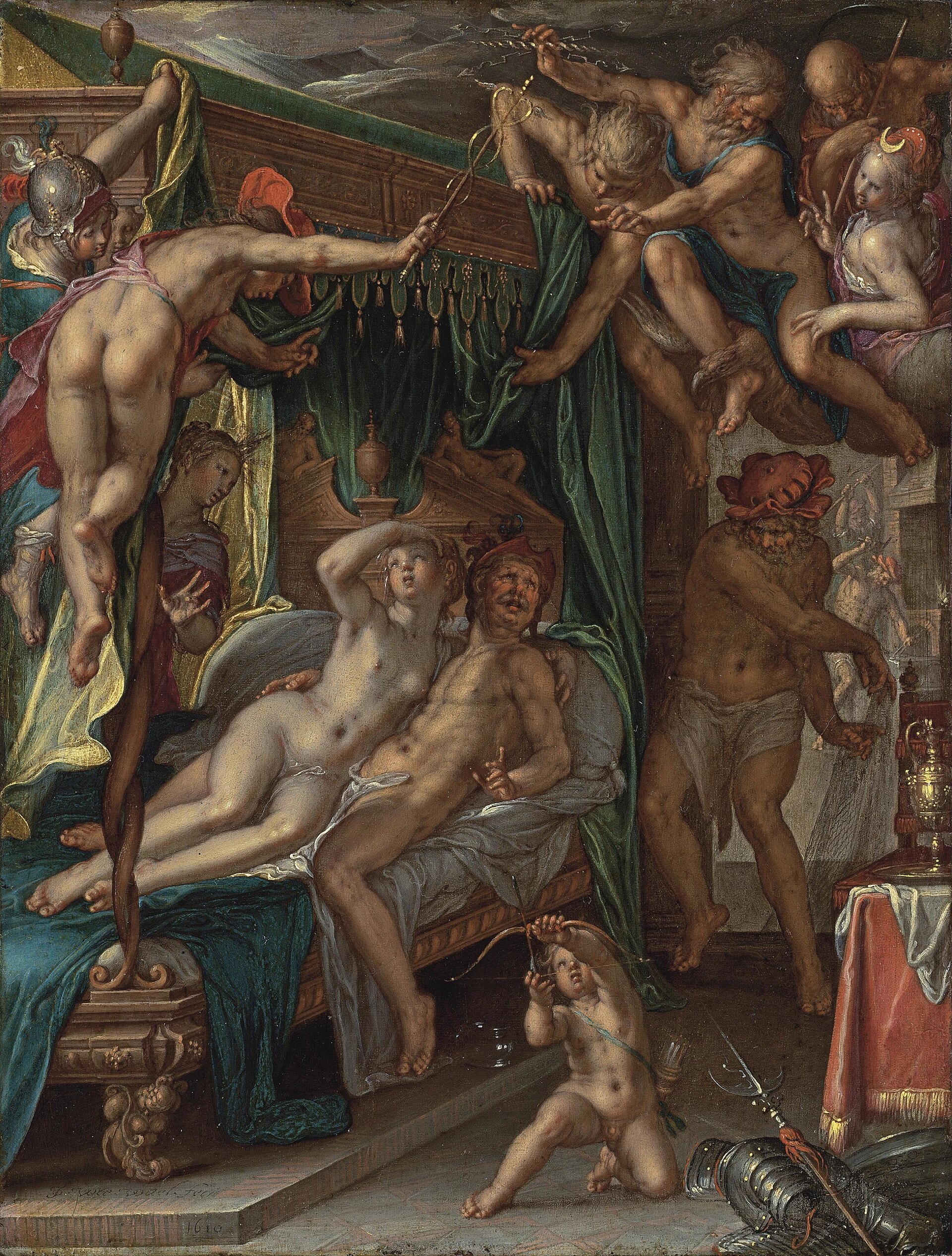
They went to the couch. They lay down. The bonds clung. They could not stir. Then they knew there was no more escaping.
Hephaestus had not gone to Lemnos. He stood in the gateway and screamed for every god to come see a laughable matter and a monstrous one.
The gods came. The goddesses stayed home, for shame.
That refusal is already a criticism, sitting in plain sight.
The male gods laughed. Hermes said he would take three times the bonds, and the goddesses looking too. Poseidon did not laugh. He stood surety — he promised to pay if Ares ran — and that promise is what opened the trap. Hephaestus wanted his bride-price back from Zeus. What he got was a fine, a bath, and a proverb.
Ares is swift, the song says. Hephaestus is slow. The slow catch the swift.
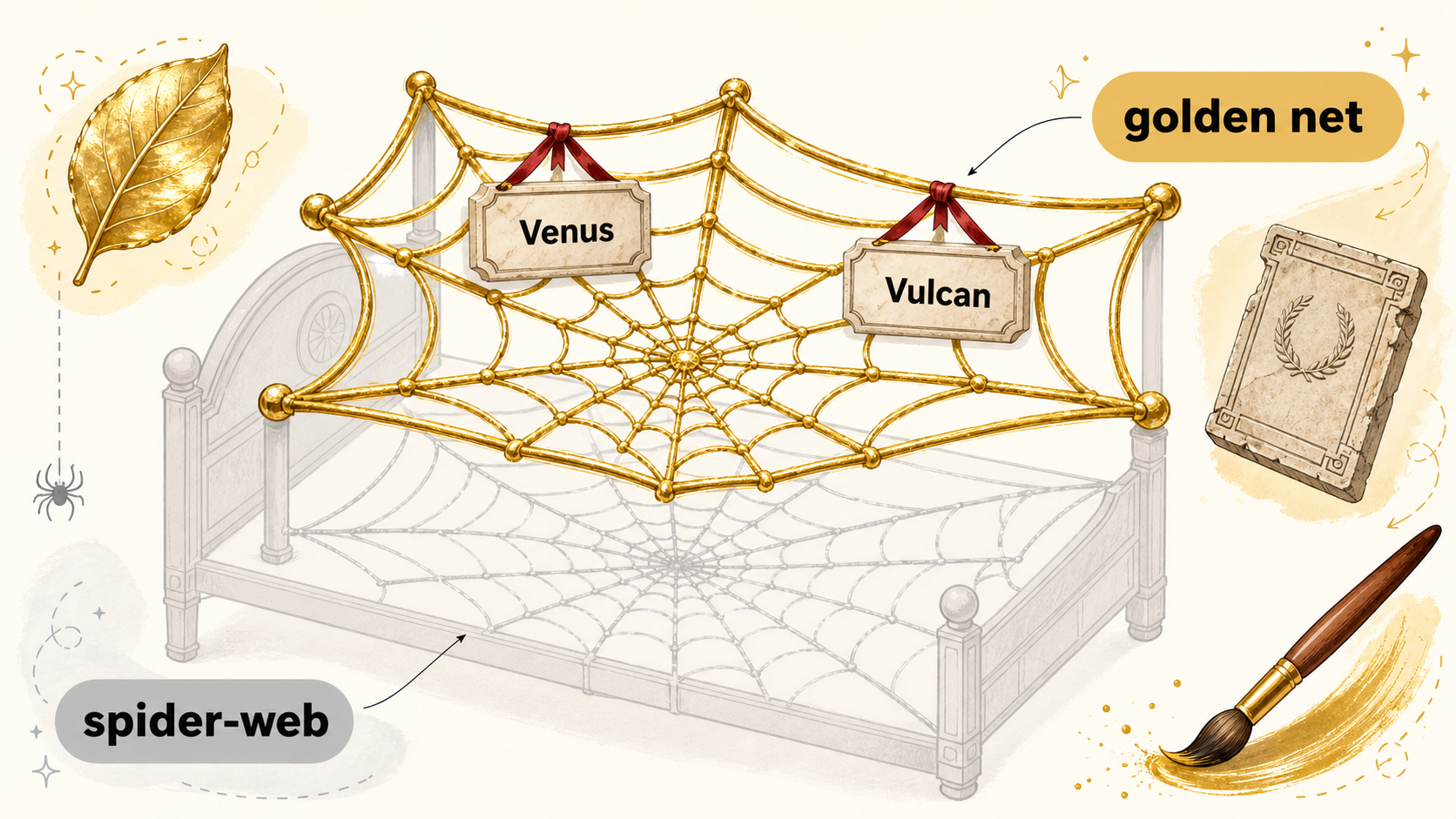
Later English will call the bonds a golden net. Homer does not. He says spider-web, unbreakable, unseen. Gold is how a later ear recognizes a divine object. The old image is better. You do not see a web until you have already walked into it.
The marriage, if this is the marriage, produces no child in these lines. It produces a proverb and a bath.
The child will come later. It will be an object. It will be worn by the daughter of the affair.
7. The Necklace Harmony Could Not Refuse
The gods went to a wedding.
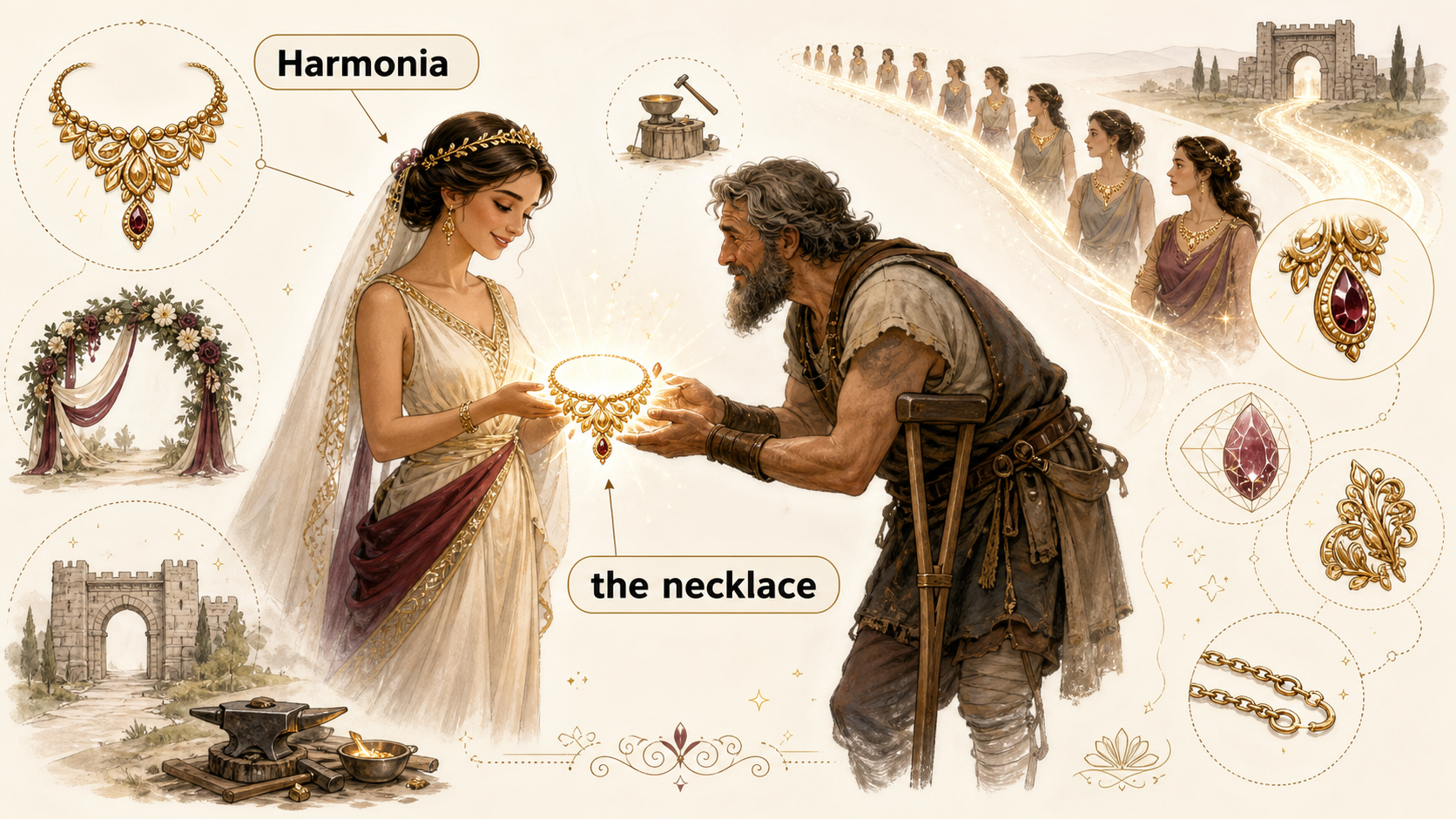
Cadmus, who had sown a dragon’s teeth and founded Thebes, was taking a wife named Harmonia. Her name means the fitting-together of things that do not want to fit. Her parents, in the Theban story, were Ares and Aphrodite. Desire and war had made a daughter called Harmony. That is either a joke or a hope.
Hephaestus came with a gift.
The most common later telling says he was still angry, and that the necklace he had made — sometimes a robe with it — was so finely worked it could not be refused. Harmonia put it on. Every woman who wore it afterward carried a misfortune that behaved like an heirloom. The chain of Theban queens ran hot. The story of Oedipus sits at the far end of a piece of jewelry.
A wedding gift that cannot be refused is the net taught to travel. The bonds in the Odyssey hold two bodies for an afternoon. The necklace holds a city for generations. Once Hephaestus’s will has been made into matter, it does not require his presence.
This is the marriage’s true child.
The poems are unwilling to give the couple a baby. Aphrodite’s known offspring in the main line belong to Ares. Hephaestus has other children, almost all of them local and odd — smith-spirits on Lemnos, a nymph of Etna, a Roman king born from a hearth. They are fire-children and island-children. They are not hers.
Barrenness is not a gap. It is the point. Desire plus war produces Harmony, then panic. Desire plus craft produces, in the stories that matter, an artifact.
There is one other child who belongs here because he shows what Hephaestus fathers when Aphrodite is not in the room.
Athena came to him for weapons. Overcome, he tried to take her. She fought him off. Semen fell on her thigh. She wiped it with wool and flung the wool to the earth. Gaia — Earth — conceived. The child, Erichthonius, is sometimes an infant wound with a snake. Athena put him in a box and told the daughters of an early king not to look. They looked. Athens gained an early king out of a failed assault and an act of cleaning.
That story is civic, not conjugal. The craftsman reaching for the other crafts-goddess produces a founding myth. The craftsman married to Desire produces a joke and a curse.
He can also make a woman from scratch. Zeus, angry that Prometheus has given men fire, tells Hephaestus to plaster earth with water and make a face like the immortal goddesses. The other gods add gifts. Hermes names her Pandora — a sorrow for men who eat bread.
Hephaestus can assemble a woman. He cannot keep the woman he was given. Clay dressed as a goddess and a goddess treated as goods are the same rhyme in two registers.
Harmonia’s necklace is that rhyme worn on a throat.
The temples, unlike the myths, refused to house the couple. Cities had other needs.
8. Separate Temples
No city married them in stone the way the poems married them in a bed.
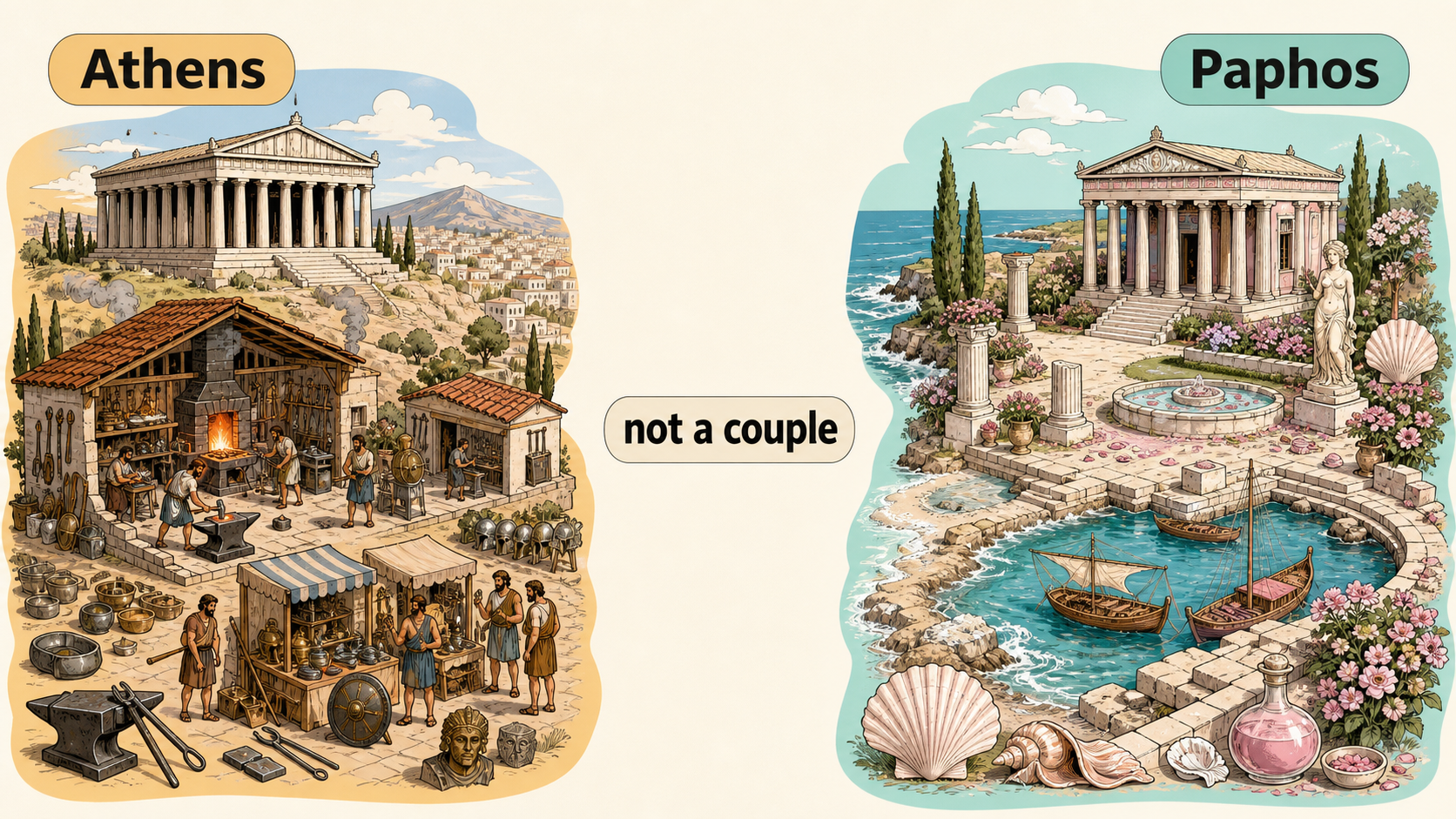
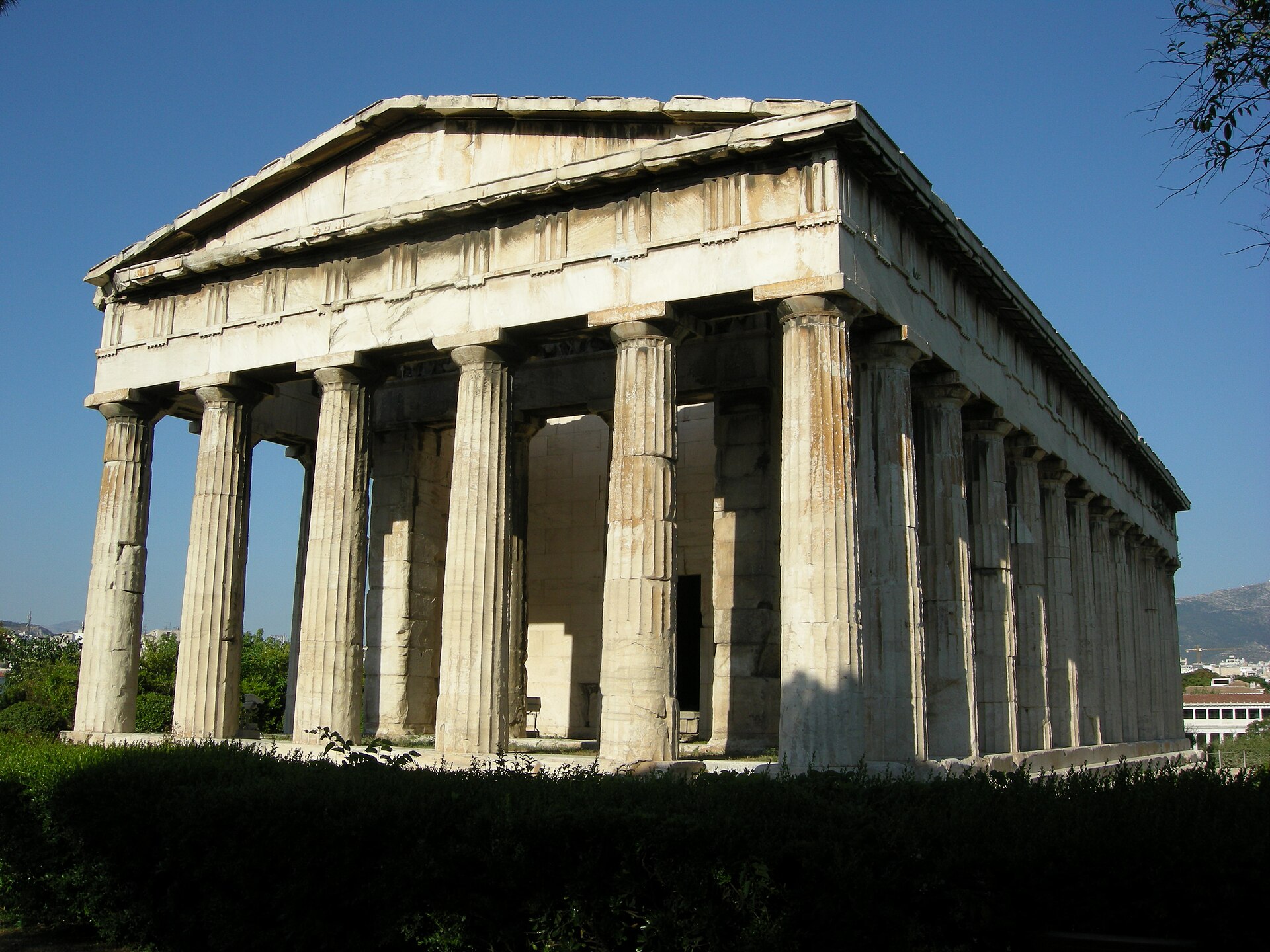
Hephaestus had two homes. Lemnos was the mythic one: forge-island, dearest land. Athens was the civic one. Above the market, the Hephaisteion still stands, among the least ruined temples in the Greek world. It did not house a love goddess. It housed the smith beside Athena of work. Bronze-workers had a festival. The city honored fire that had been put to use.
That is the Iliad’s household made into a calendar. The smith plus a working partner. Not the smith plus Desire.
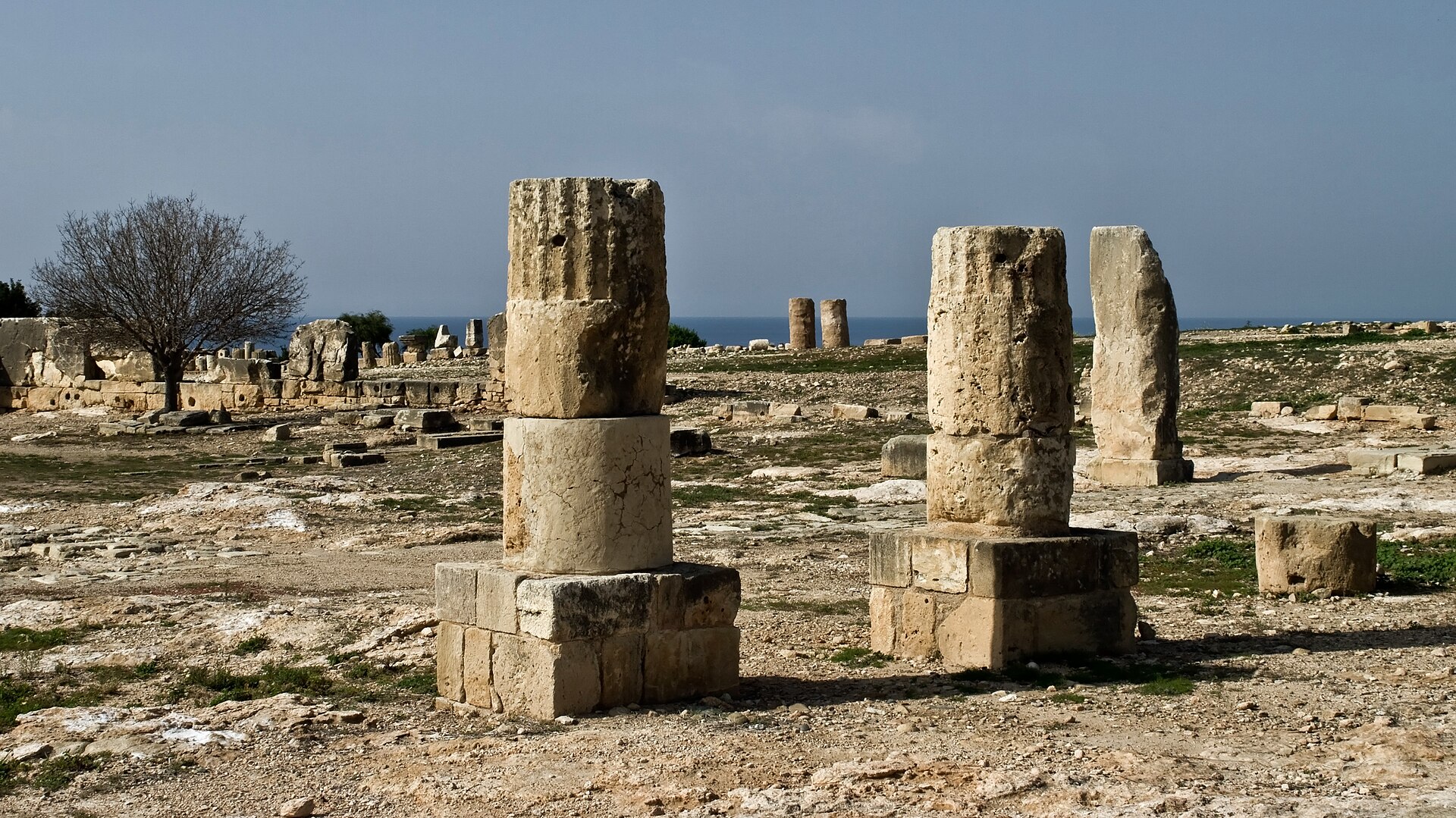
Aphrodite landed where the foam story said she would. Cythera first, then Cyprus — especially Paphos — and on the mainland the great magnet was Corinth, a port that understood expensive company.
Two of her civic titles, Urania and Pandemos, would later be moralized at another dinner party. In Plato’s Symposium, a speaker splits them into heavenly love of souls and common love of bodies. Cult did not mean that. Urania is an honorific. Pandemos names her “of all the people.” The philosophy is a later tool laid on older civic names.
Then there is Corinth’s reputation.
An ancient geographer, Strabo, says the sanctuary of Aphrodite was so rich it possessed more than a thousand dedicated courtesans. A victory ode remembers a hundred girls vowed to the goddess if a man won at Olympia.
That is enough to prove a real link between a port goddess and courtesans. It is not enough to prove a temple of nonstop sacred sex. The picture of a thousand girls under incense and columns is one of the most successful urban legends in classical studies. The honest residue is smaller and still sharp. Corinth was famous for companions. Aphrodite was their goddess. The rest is tourism.
Cult tells you what a city needed. Athens needed metal and work sharing a temple above the market. Cyprus needed a landing of desire. Corinth needed a goddess who understood a port. Lemnos needed fire in the ground.
None of those needs requires a married couple.
The myths marry them anyway, because a story has a problem a temple calendar does not. A story has to put making and wanting in one room and watch what breaks.
9. Lock and Solvent
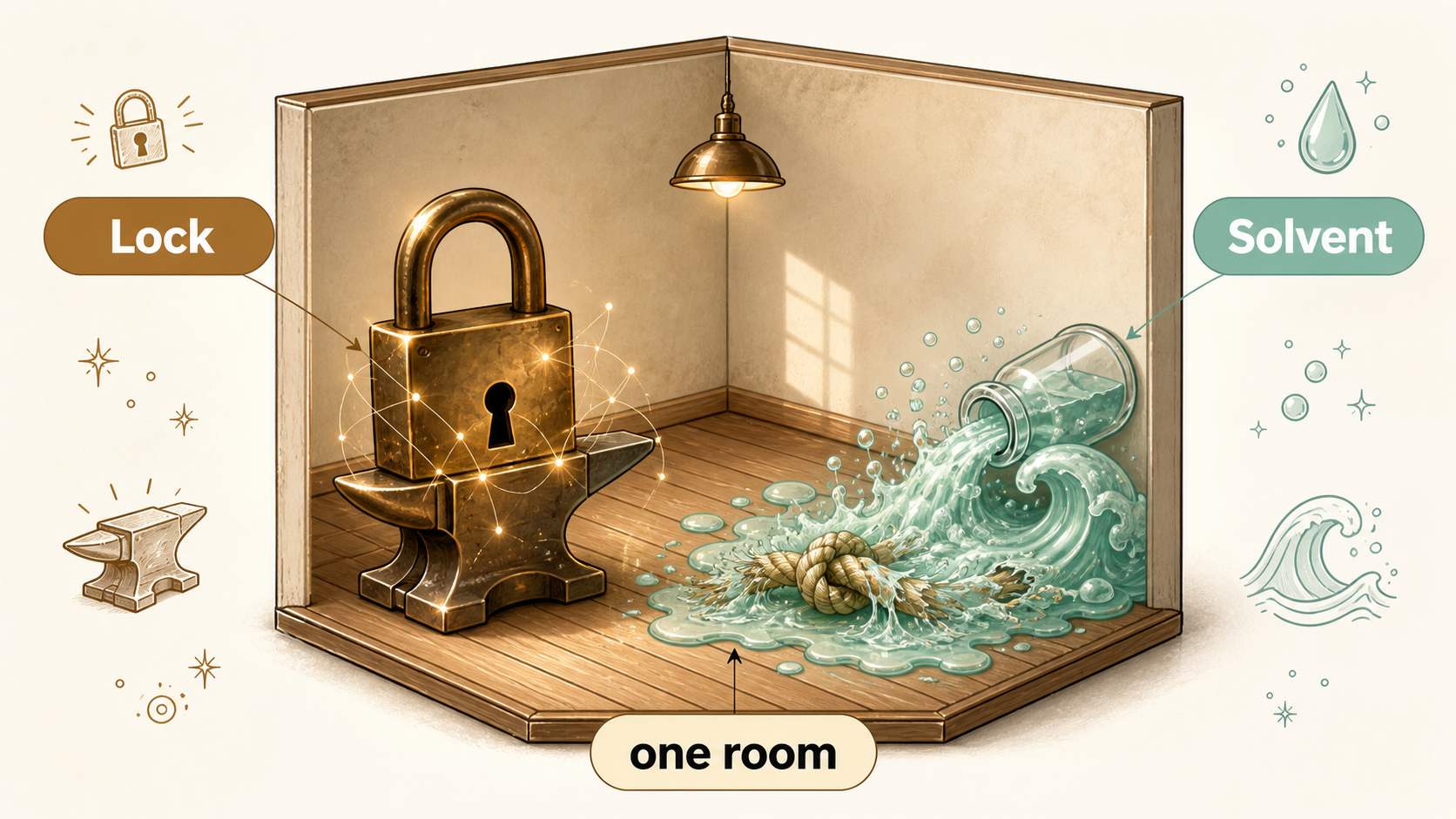
Put a lock and a solvent in the same room and you do not get a household. You get an experiment.
Techne is skilled making. It turns heat, metal, and patience into a shape that holds. Eros is wanting. It turns a person who had plans into a person who will walk into a house that is obviously a trap.
Hephaestus is techne with a limp, which means skill that cannot pretend to be force. Aphrodite is eros that may be older than Zeus, which means desire that cannot pretend to be a daughter’s duty.
When the poems marry them, they are not matching personalities. They are staging a collision.
The details that cannot be swapped are few. The husband makes invisible bonds. The wife is desire. The audience laughs. The strong god is caught. The legal demand is a returned price, not a death.
Replace Hephaestus with Zeus and you get a thunderbolt. Replace Aphrodite with Charis and you get the workshop in the Iliad, which is a different experiment and a calmer one. Replace the public laughter with a private murder and you get a different religion.
The cute moral is: ugly genius deserves a beautiful wife, she cheats, he wins by brains, laugh. The old lines already cut that down.
Hephaestus is the only Olympian defined by impairment, and the Odyssey makes him say the impairment is why he is scorned. That teaches an audience to hear lameness as the reason a wife may leave, and then to cheer when craft compensates. The compensation is real. So is the insult.
Aphrodite is transferred by Zeus, priced by gifts, displayed to a room of male gods, and reset by a bath. The goddesses refuse to watch. Desire is named a shameless girl by the man who bought her. The poem lets him say it. It does not have to be the last word.
And the smith is technology. Invisible infrastructure is his masterpiece. The people who live inside it do not see the bonds until they try to get up. Any age that builds systems finer than their users can notice is still inside this joke.
The Iliad already solved the problem another way. Marry craft to Grace, not to Desire. That house produces wheeled tripods and a polite door. It does not produce a theory of adultery. Homer could imagine it. He simply did not use it when he needed a theory of looking.
The reach of the mechanism is the proof that it is not a one-off gag. The throne binds a queen. The net binds a bed. The necklace binds a bloodline. Pandora is a made woman who cannot be recalled. In every case Hephaestus answers a wound by leaving behind an object that keeps doing his will.
Making and wanting still share houses. The bonds are still hard to see until someone tries to stand up.
10. After the Greeks
Rome changed the names and kept the bed.
Hephaestus became Vulcan. Aphrodite became Venus. The forge could sit under Mount Etna. English, which inherited Latin schoolrooms, still says Venus and Vulcan more readily than Aphrodite and Hephaestus. The Greek tension — foam-born outsider versus Dione’s daughter — is harder to hear in the new names.
Venus also became a political grandmother. Through Aeneas, the son of the hymn’s forced desire, she enters the blood-story of Julius Caesar’s family. That Venus is not the woman in the spider-web. That Venus is an ancestor.
“Golden net” is a later title. Homer said spider-web, unbreakable, unseen. Gold is how a later ear recognizes a divine object. The handle is fine. The quotation is not.
The thousand girls of Corinth are a mixed thing. Ancient writers give the hooks. Later writing turned them into a tourist fact: columns, incense, a temple that never closed. Peel the postcard off and what remains is still interesting. A port goddess. Courtesans who prayed. A city that could not outrun its reputation.
Painters understood the license. The net story offers a nude, a bed, bonds, and a crowd of male onlookers, and then permits the painter to call the result moral instruction. The Odyssey’s goddesses, who stayed home for shame, are rarely invited onto those canvases. The healthier old image is still the mule: a trapped queen, a failed war god, a drunk craftsman, a woman waiting as a prize.
Modern storytelling keeps trying to give the pair an ending the poems withheld. They fall in love. They divorce as friends. She stays with Ares. He finds happiness with Aglaia. The old texts will not help. They were not a series. They were tools picked up for a job and put down.
A retelling that keeps only “ugly husband, beautiful cheat, clever trap” has discarded the two births, the two wives, the bride-price, the goddesses’ absence, Poseidon’s surety, Lemnos, the throne, and the necklace. Those are not decorations. They are the mechanism.
A retelling that makes them a love story has to invent the love.
A retelling that makes Hephaestus only a victim has to ignore the throne, the net, the necklace, and the assault on Athena. He is a maker of bonds. Some of those bonds are justice. Some are revenge that outlives its cause. Some are crimes.
The pairing survives because it is not simple. Reception keeps trying to make it simple.
The slow still catch the swift, when the slow have built the room.
11. What the Poems Leave Open
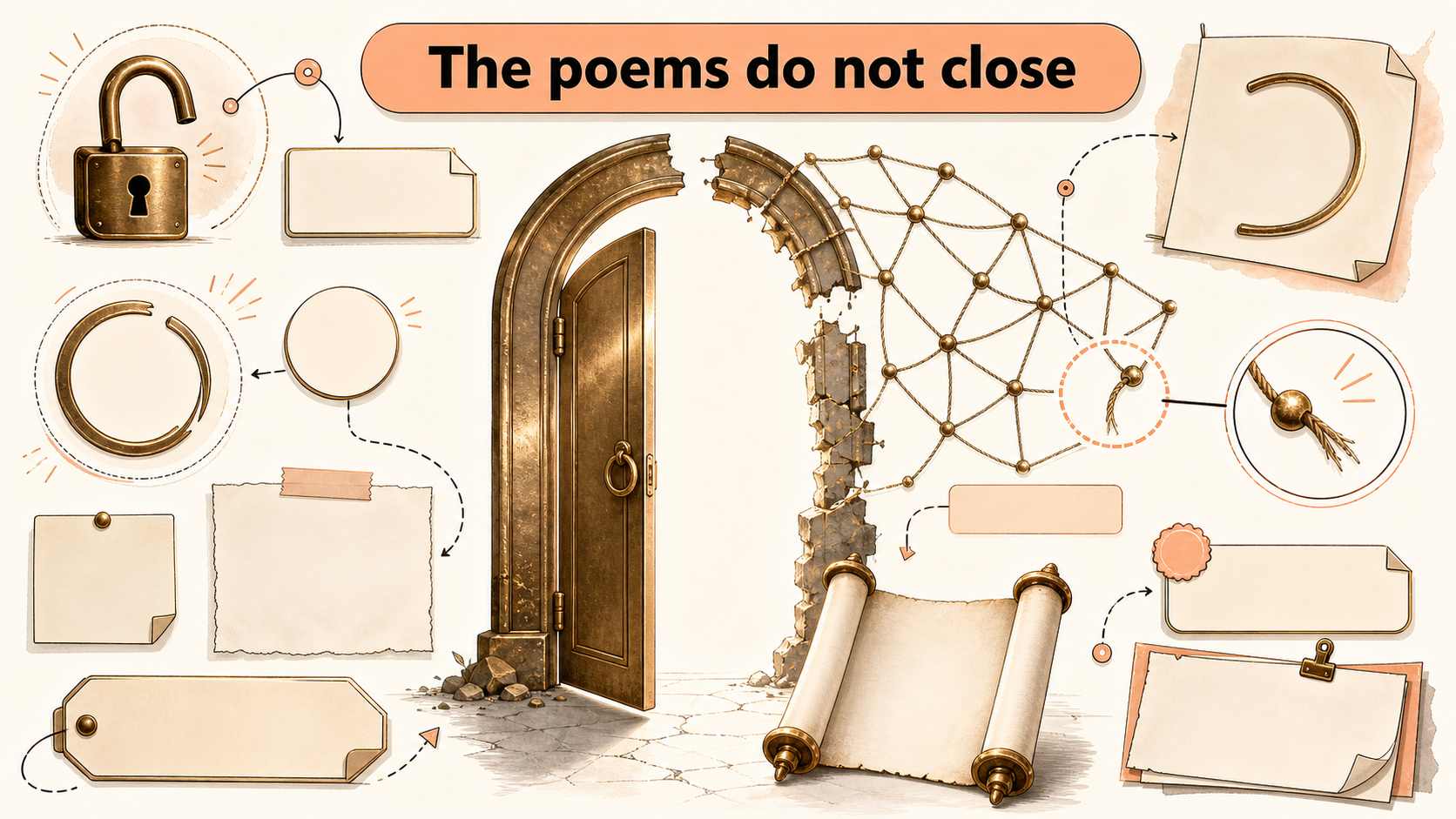
The poems do not close. That is not a failure. It is the honest shape of the file.
They do not agree who threw Hephaestus, or whether the limp caused the throw or the throw caused the limp. They do not agree whether Aphrodite is older than Zeus or sitting in his household as transferable goods. They do not agree who keeps house with the smith. Homer’s war poem opens the bronze door on Grace. Homer’s homecoming poem puts Desire in the bed. Hesiod marries him to Aglaia and never mentions the other match.
A tidy novel would pick one timeline and call the rest errors. The old material is not a novel. It is a set of tools. When a poet needed a workshop, he reached for Charis. When he needed a theory of shame, he reached for Aphrodite. When a city needed metal, it built the Hephaisteion beside Athena of work and left Desire on Cyprus.
A few questions are still worth keeping in the hand, not because they have answers, but because they stop a retelling from sanding the story down.
Is the limp a scar or a birthmark — and what changes if you choose?
Does Homer vouch a wedding, or only a bill?
Why do the goddesses stay home, and why is Poseidon the one who will not laugh?
If the necklace is the true child of the marriage, what kind of parent is a craftsman?
Did any Greek community ever worship them as a couple? The temples say no.
What would count as evidence that the pairing was, after all, a love story?
Nothing in the old file answers that last one.
The absence is part of the picture. Making and wanting were forced into one house. The house became a trap, a joke, and a law court at the same time. Later ages gilded the web and renamed the pair. The old collision does not need the varnish.
It needs the proverb, and the limp, and the woman who will not stay priced.
Jump to a chapter
Go deeper in the source dossier
Births, falls, the throne, two wives, the net, the necklace, cult, sources, and the question ledger.