Last updated: 2026-08-15
The Axe in the Frame
Zeus had a headache that was not a headache.
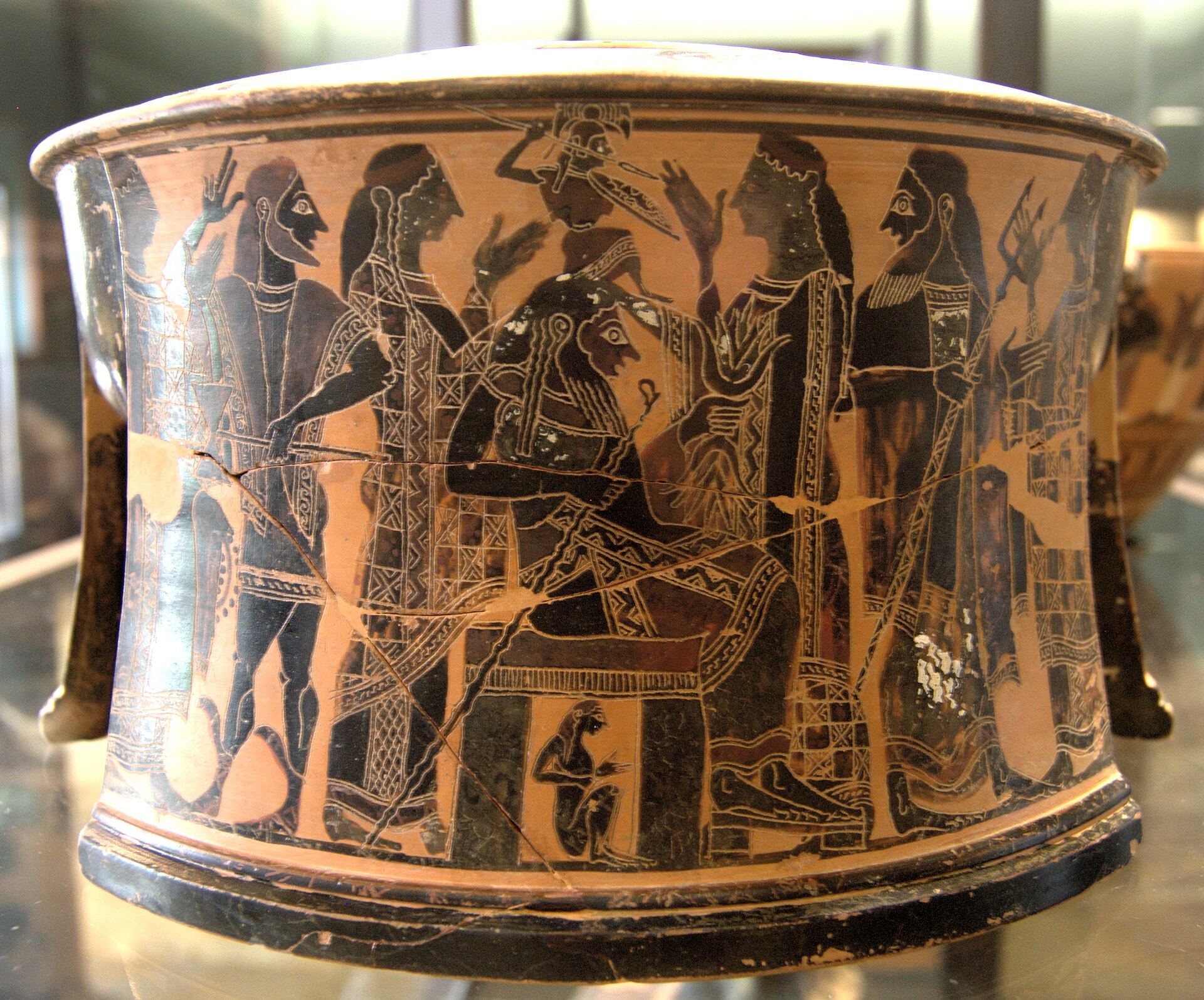
He had swallowed Metis, cunning herself, after a prophecy that her child would overthrow him. The child did not stop growing. In the old telling, someone has to open the skull. Pindar, celebrating a Rhodian victor, puts the bronze-bladed axe in Hephaestus’s skilled hand. From the cleft summit of the father’s brow Athena springs aloft, and the broad sky takes her war-cry.
Apollodorus, later and fussier, allows a fork. Prometheus or Hephaestus, by the river Triton, struck the head of Zeus, and Athena came up already dressed for war.
Philostratus, walking through a picture gallery in Naples, describes a painting of that exact second. Athena has just burst forth fully armed. The axe is still in the frame, so you know whose device did it. Hephaestus, in the painting, looks at a loss. He had meant to gain the new goddess’s favor with a gift. His lure is spent. Her armor was born with her. There is nothing a smith can add to a woman who arrived already finished.
That is the joke the net story never tells. Sometimes craft opens. Sometimes the thing that comes out does not need you.
The same hands will later reach for this goddess and fail, and Athens will get a snake-child from the failure. Here, at the beginning, he is only the midwife of a mind. The god of making splits the god of rule, and what steps out is the goddess of a city that will put both of them in one temple above a market — Athena of work beside the smith, not Aphrodite of the foam.
The axe and the net are the same intelligence pointed in two directions. One releases a daughter Zeus tried to keep inside. The other holds a wife Zeus had been willing to sell. Hephaestus does not choose which jobs arrive. He chooses how finely the edge is made.
Why This Story Works
It gives the smith a scene that is not humiliation and not revenge. He is necessary. He is also already unnecessary. The goddess of skill does not owe the god of skill a gift, because she came out wearing her own.
Source
- Pindar, Olympian 7.33–38; Apollodorus 1.20; Philostratus the Elder, Imagines 2.27, collected at https://www.theoi.com/Olympios/HephaistosMyths.html