Last updated: 2026-08-15
9. Lock and Solvent
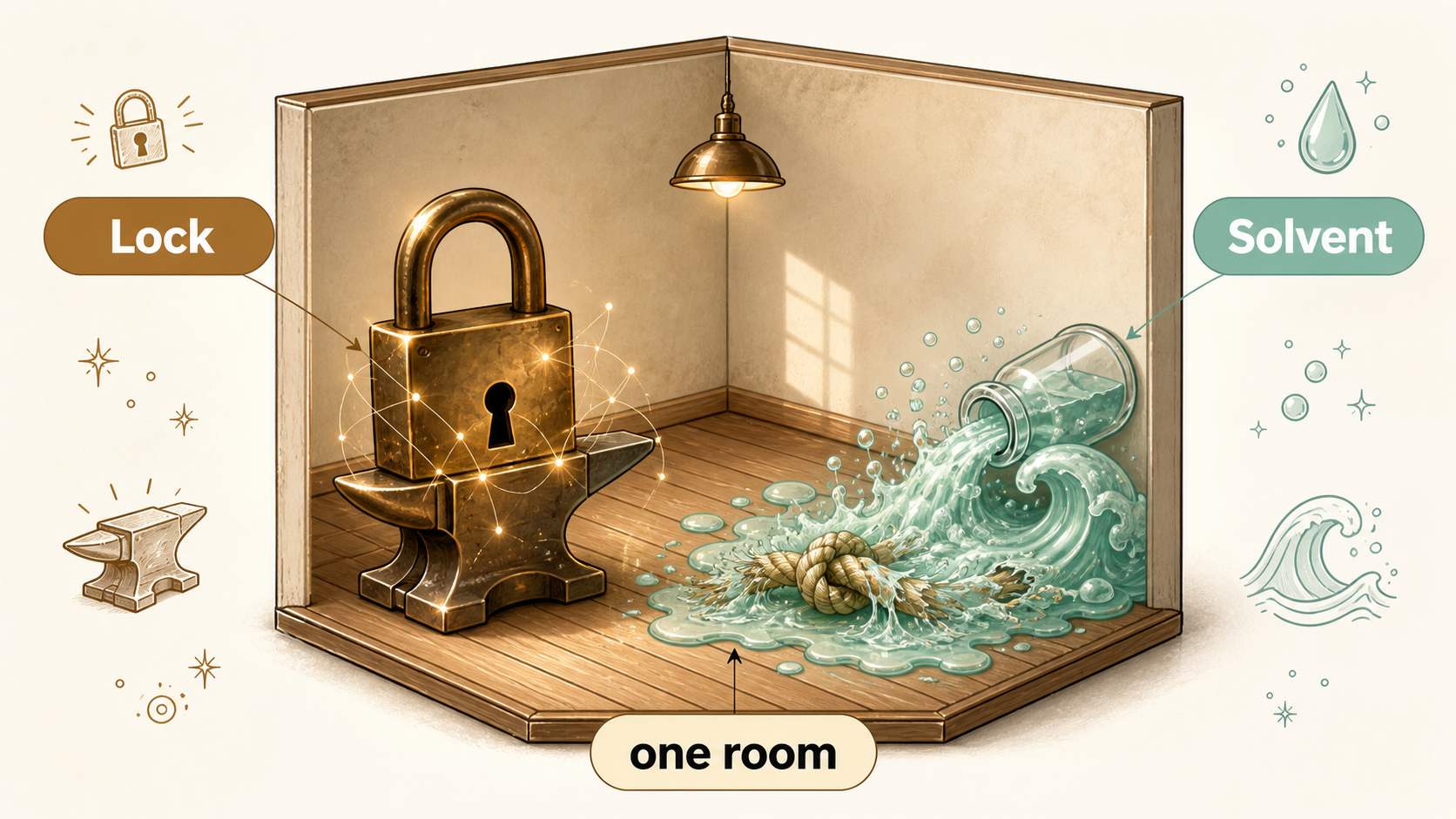
Put a lock and a solvent in the same room and you do not get a household. You get an experiment.
Techne is skilled making. It turns heat, metal, and patience into a shape that holds. Eros is wanting. It turns a person who had plans into a person who will walk into a house that is obviously a trap.
Hephaestus is techne with a limp, which means skill that cannot pretend to be force. Aphrodite is eros that may be older than Zeus, which means desire that cannot pretend to be a daughter’s duty.
When the poems marry them, they are not matching personalities. They are staging a collision.
The details that cannot be swapped are few. The husband makes invisible bonds. The wife is desire. The audience laughs. The strong god is caught. The legal demand is a returned price, not a death.
Replace Hephaestus with Zeus and you get a thunderbolt. Replace Aphrodite with Charis and you get the workshop in the Iliad, which is a different experiment and a calmer one. Replace the public laughter with a private murder and you get a different religion.
The cute moral is: ugly genius deserves a beautiful wife, she cheats, he wins by brains, laugh. The old lines already cut that down.
Hephaestus is the only Olympian defined by impairment, and the Odyssey makes him say the impairment is why he is scorned. That teaches an audience to hear lameness as the reason a wife may leave, and then to cheer when craft compensates. The compensation is real. So is the insult.
Aphrodite is transferred by Zeus, priced by gifts, displayed to a room of male gods, and reset by a bath. The goddesses refuse to watch. Desire is named a shameless girl by the man who bought her. The poem lets him say it. It does not have to be the last word.
And the smith is technology. Invisible infrastructure is his masterpiece. The people who live inside it do not see the bonds until they try to get up. Any age that builds systems finer than their users can notice is still inside this joke.
The Iliad already solved the problem another way. Marry craft to Grace, not to Desire. That house produces wheeled tripods and a polite door. It does not produce a theory of adultery. Homer could imagine it. He simply did not use it when he needed a theory of looking.
The reach of the mechanism is the proof that it is not a one-off gag. The throne binds a queen. The net binds a bed. The necklace binds a bloodline. Pandora is a made woman who cannot be recalled. In every case Hephaestus answers a wound by leaving behind an object that keeps doing his will.
Making and wanting still share houses. The bonds are still hard to see until someone tries to stand up.