Last updated: 2026-08-15
1. The Song in the Hall
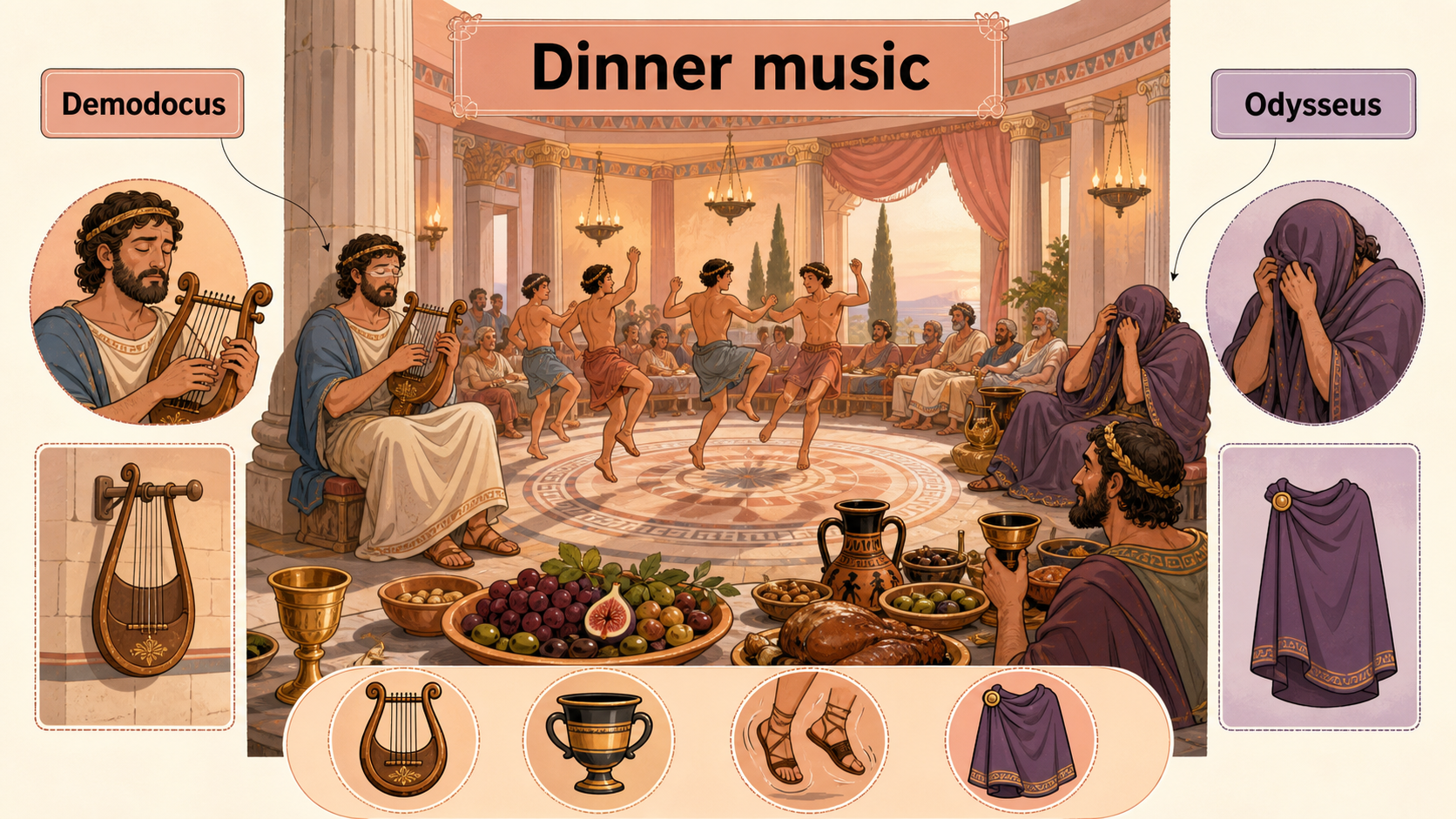
A blind singer sat against a pillar. A lyre hung on a peg above his head.
This is a scene from Homer’s Odyssey, the long Greek poem about Odysseus trying to get home from the Trojan War. Odysseus has washed up in a rich island court. The king’s name is Alcinous. The singer’s name is Demodocus. A herald led him in by the hand, set out food and wine, and left him there.
They ate. They poured wine. Then Demodocus sang — not about love. He sang about a quarrel between Odysseus and Achilles. Odysseus pulled a cloak over his head so the room would not see him cry.
Later there were games. A young man told the stranger he did not look like an athlete. The stranger, who still had not given his name, threw a discus past every mark they had. Alcinous called the dancers back and sent for the lyre again.
Demodocus struck the strings and sang about Ares and Aphrodite.
That is how the oldest full story of this marriage arrives. Not as a holy book. As dinner music.
Here are the three gods in that song, in plain words.
Hephaestus is the smith of the gods. He works fire into metal. He is lame. The Greeks had a word for his kind of skill: techne — knowledge you can teach, hide, and use against people stronger than you. Not a mood. A craft.
Aphrodite is the goddess of sexual desire. She is the reason someone who had plans walks into a house that is obviously empty.
Ares is the god of war. He is fast. Hephaestus is slow. The song will say that out loud, once the trap has closed.
The poet has not yet reached the anvil. He has already done three things. He put the story in a mouth that cannot see. He put the listener under a cloak. He put dancers between one weeping and the next.
These gods were entertainment before they were doctrine.
The song is also about looking. A sun god will watch. The husband will call the other gods to watch. A messenger god will say he would take three times the bonds if the goddesses watched too. And in the hall where the song is sung, a nameless man is trying not to be watched while he cries.
What the song will not do is tell us how they married.
Homer can give you the bill for a bride. He does not walk you through a wedding. Later ages, uneasy with that gap, invented a prize, a drunk procession, a girl waiting at the end of a mule ride. Some of that later stitching is good. None of it is what the blind man sang while the boys struck the floor.
Before the trap, then, the births. Before anyone can be given away, someone has to decide whether Aphrodite has a father. Before anyone can be scorned for a misshapen body, someone has to decide who threw Hephaestus, and into what.
The next chapter starts in the sea.