Last updated: 2026-08-15
The God Who Hated His Own Hands
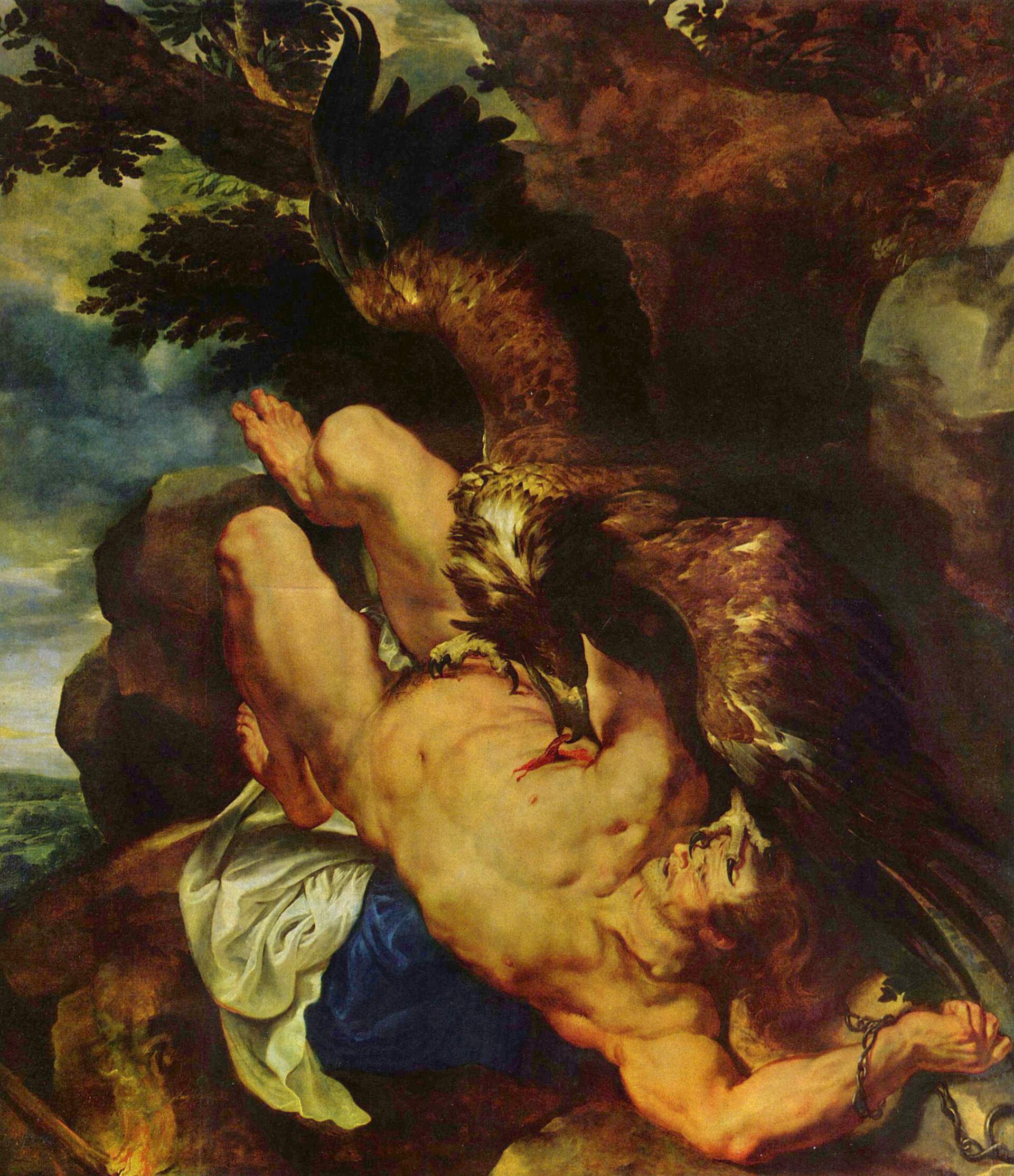
Kratos and Bia — Power and Force — drag Prometheus to the end of the world.
Scythia, the play calls it: an untrodden solitude, a ravine the winter can reach. Hephaestus walks with them. The job is his. Zeus has ordered the flower of the smith’s own art, fire, to be answered by shackles of adamant. The man-loving Titan who stole that fire for creatures who eat bread is to be clamped to the rock so that he may learn what new power feels like.
Kratos is impatient. Hephaestus is not. Aeschylus gives the smith the first long refusal in Greek drama that is not a hero’s. He does not have the nerve, he says, to bind a kindred god upon a cleft assailed by cruel winter. Yet it is perilous to disregard the Father. Against his will, no less than Prometheus’s, he must drive the bronze.
He groans. Kratos mocks the groaning. Why pity a god who gave away your prerogative? Hephaestus answers with the only theology that ever sounds like his: a strangely potent tie is kinship, and companionship as well. Then he says the line that belongs on the workshop wall.
Oh handicraft that I hate so much.
Kratos tells him the craft is not to blame. Hephaestus wishes the lot had fallen to another. Every job is troublesome, says Power, except to be commander of gods. No one is free except Zeus. Hephaestus knows it by this task. He cannot deny it.
The hammering is written as procedure. Wrists. The other arm. The wedge through the chest. Girths about the sides. Legs. Each order comes twice, because Force does not trust softness. Hephaestus does the work properly and says so. Then he leaves. Prometheus remains. Later he will tell Io, who wanders past in her own torment, the short version. Zeus by his will. Hephaestus by his hand.
This is the smith without a marriage plot. No Aphrodite, no net, no laugh in a gateway. Only the knowledge that the person who can make unbreakable bonds will be made to use them, and that he will hate the gift while he uses it. The same hands that hide a web in a bedframe can weep while they drive a wedge. Craft is not a character. Craft is a capacity. Character is what you do when the capacity is commandeered.
Why This Story Works
It stops the easy reading of Hephaestus as a clever victim who always turns the trap around. Sometimes the trap is assigned. The god of making is also the god who cannot refuse a work order from a newer, harder king.
Source
- Aeschylus, Prometheus Bound 1–87, 612, quoted via Theoi: https://www.theoi.com/Olympios/HephaistosMyths.html