Last updated: 2026-08-15
The Younger Graces
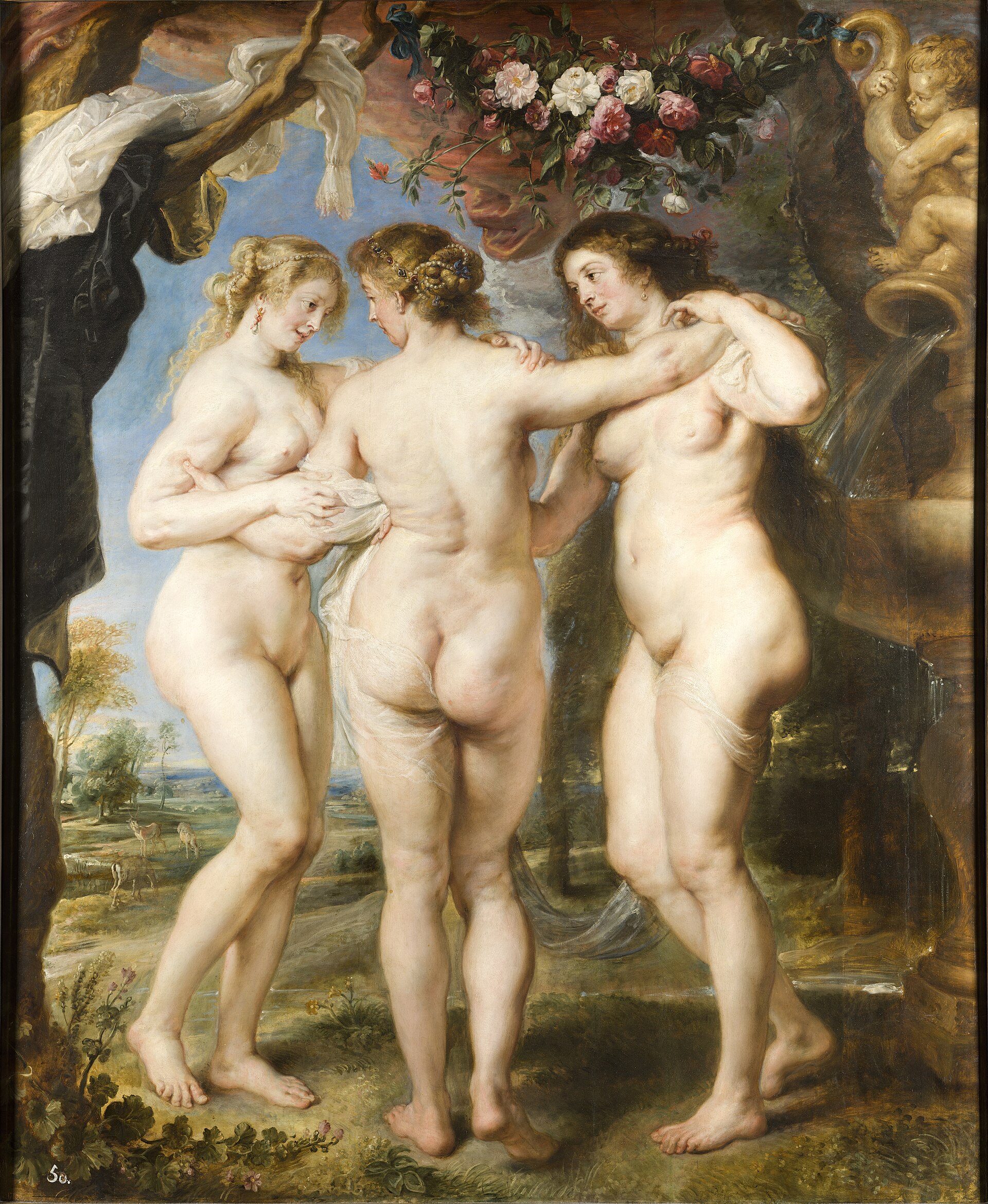
If you follow Hesiod instead of the Odyssey, the smith’s wife is Aglaia, youngest of the three Charites, and the house does not end in a net.
Orphic and later lists give them daughters. Eukleia: Good Repute. Eupheme: Good Speech, or the well-omened cry. Euthenia: Prosperity, the plenty that looks like a full storeroom. Philophrosyne: Kindliness, the warmth that makes a guest stay.
These are not celebrities. No one paints them in a bed. They are what charis looks like when it is allowed to have children. A workshop that marries Grace does not produce Harmonia’s necklace. It produces the conditions under which a made thing can be received without shame: a good name, a clean word, enough, and welcome.
The names are almost embarrassingly on the nose. That is the point of this kind of Greek thinking. A union is tested by what it generates. Ares and Aphrodite generate Fear, Fright, and a Harmony who cannot keep a city safe. Hephaestus and Aglaia, in this quieter genealogy, generate the social virtues of a craft well practiced.
No archaic narrator walks us through their childhoods. There is no hymn of Eukleia at the loom. The list is the story, and the list is a counter-fact. Homer could imagine this household. In the Iliad he puts Charis at the door and never mentions a daughter, because he is busy with a shield. Hesiod files the marriage under “what the gods took.” Later mythographers, who hated loose ends, gave the pair a next generation that sounds like a workshop blessing.
If the Odyssey is the experiment in which craft lives with desire, this is the control. Same smith. Different beauty. Different issue.
Why This Story Works
It makes the two-wife problem concrete. You do not need a lecture on charis versus eros once you have seen what each pairing is said to bear.
Source
- Hesiod, Theogony 945; Theoi on Aglaia and the younger Charites: https://www.theoi.com/Ouranios/KharisAglaia.html
- Theoi, Hephaestus loves: https://www.theoi.com/Olympios/HephaistosLoves.html