Last updated: 2026-08-15
5. The Other Wife
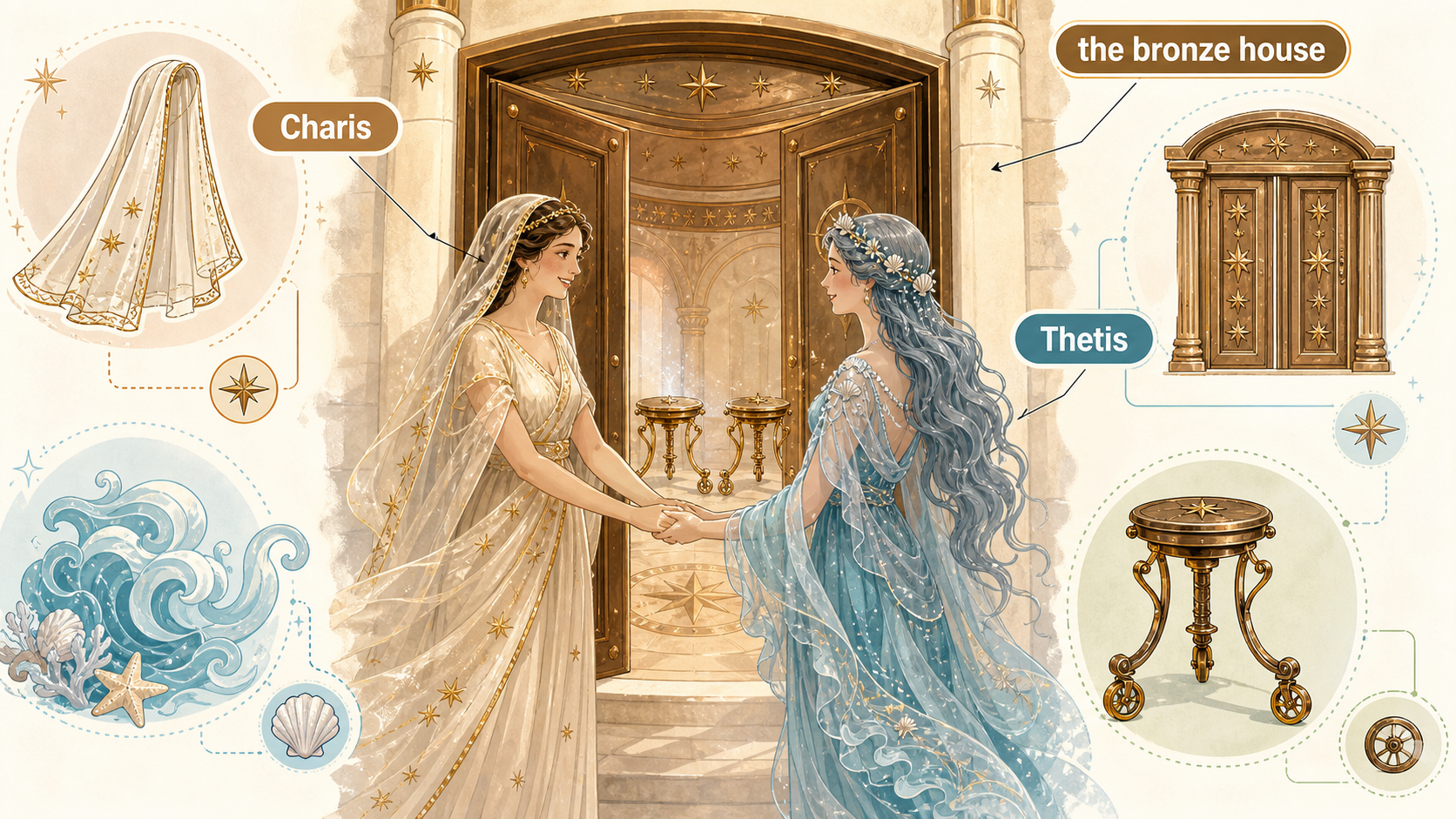
Charis saw her first.
Thetis had reached a house of bronze, the finest among the homes of the gods, built by the lame god himself. Inside, Hephaestus was sweating from bellows to anvil, finishing twenty tripods fitted with golden wheels so they could run to the gods’ assembly and roll home again. The handles were not done.
Charis came forward, took Thetis by both hands, and called her an honored guest. She led her in. She seated her. Only then did she call her husband. “Hephaestus, come quickly. Thetis has need of you.”
This is Book 18 of the Iliad. The wife of the famous smith is Grace.
Charis is not only a name. It is the Greek word for the charm that makes a gift acceptable, a guest welcome, a made thing pleasing. Hesiod says the Grace Hephaestus took was Aglaia, youngest of the three Charites. Ancient readers already saw the overlap. Homer’s Charis and Hesiod’s Aglaia look like the same office with two labels.
In this household, beauty is not adultery. Beauty is the finish on the work. The tripods will walk. The shield Thetis came for will hold a city, a dance, a lawsuit, a field. The wife at the door is the principle that makes skill lovable instead of merely useful.
The Odyssey needs a different principle.
A Grace who personifies pleasing finish does not shame a bed. Aphrodite does. Demodocus’s song requires a wife who can be caught with the war god, a wife whose body can be contrasted with a limp, a wife whose father can be billed. Charis cannot give the poet that. So the other poem puts the other woman in the house.
Later readers, trained by novels, invent a timeline. First the bad marriage, then a divorce, then a kinder second wife. Homer does not narrate a divorce. Hesiod does not mention a prior Aphrodite. The net scene ends with Aphrodite going to Cyprus to be bathed by the Graces, not with a lawyer.
Some poets skip the smith entirely and call Ares Aphrodite’s husband. That is a third household. The tradition is not a serial. It is a set of local answers to a local need.
The war poem binds craft to Grace because it needs a workshop that can make a cosmos on a shield. The homecoming poem binds craft to Desire because it needs a theory of shame, looking, and cunning. Homer could imagine a Hephaestus who was not a cuckold. He used that Hephaestus when a mother came for armor. He used the other one when a blind singer needed a laugh that would also be a law.
Thetis sits on the good chair. Hephaestus puts his tools away. He does not mention a net. He does not mention Ares.
If you want the religion of the bed, you have to leave this house and go back to the hall. The bonds are about to become visible.