Last updated: 2026-08-15
4. A Chair That Would Not Let Go
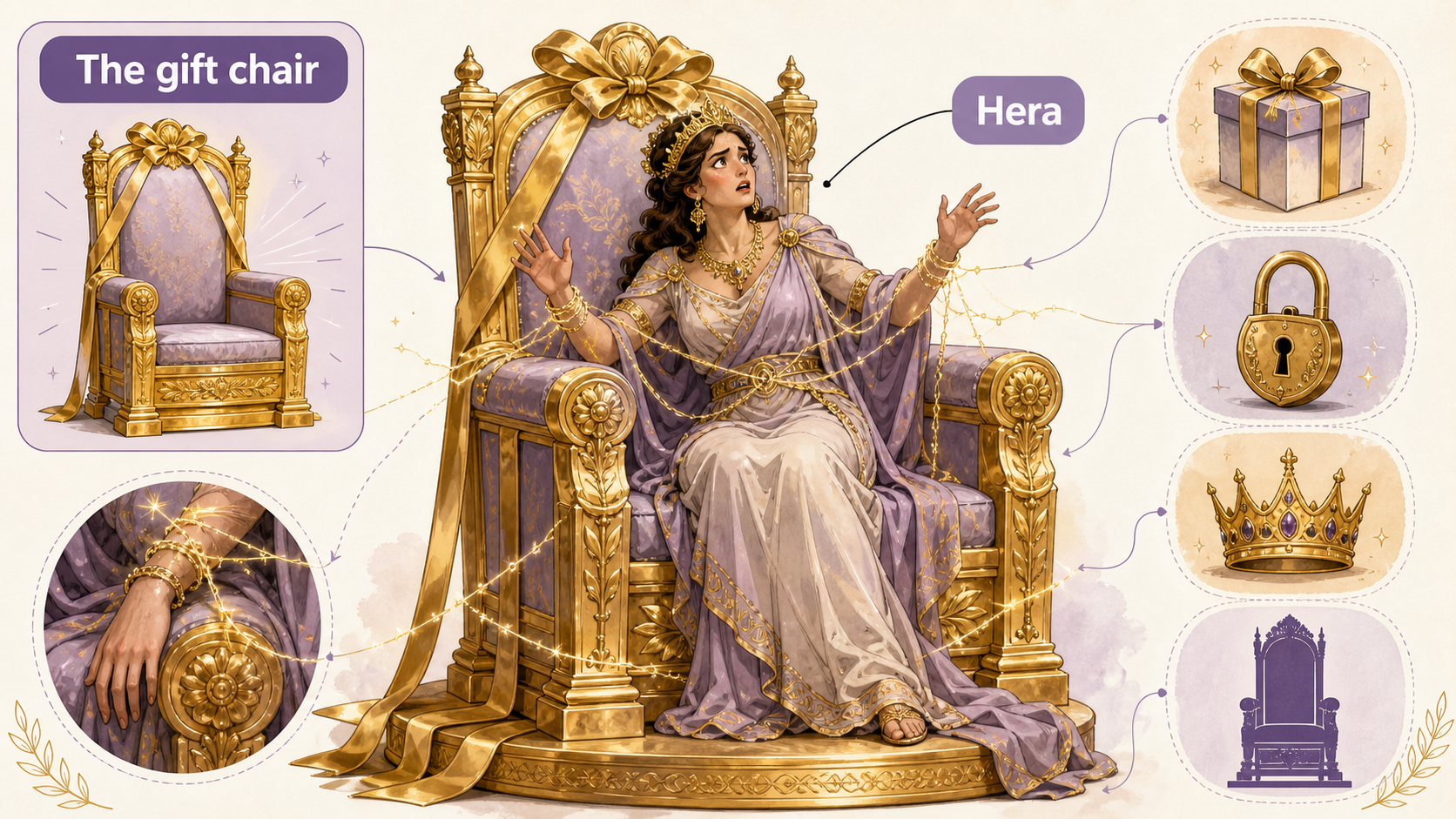
Hera sat down.
The chair was a gift from her son. Once she touched it, she could not get up. Invisible fetters closed. The queen of the gods, who had thrown a baby into the sea, hung in a piece of furniture.
This is not in Homer. It is a later story, told by travel writers and Latin handbooks and painted on Athenian vases. The shape of it is still Hephaestus: a wound answered by an object that keeps doing his will after he has left the room.
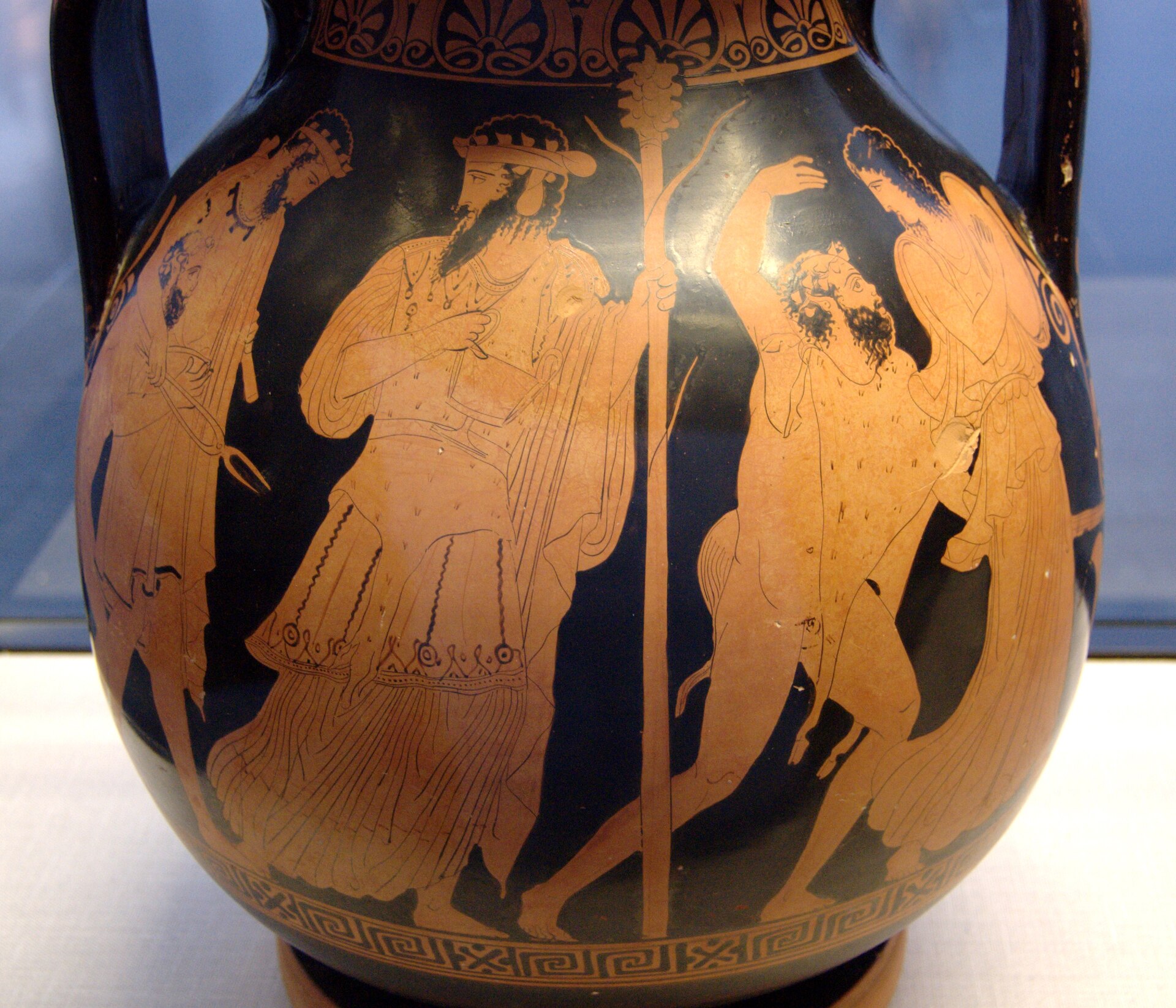
Pausanias, walking through Athens centuries later, saw the next part painted in a temple of Dionysus. Dionysus bringing Hephaestus up to heaven. The legend under the paint is simple. The thrown son sent the chair. When Hera was held, he would not listen to any god except Dionysus. Dionysus made him drunk and brought him home.
Hyginus, writing in Latin, adds a slammed door. Summoned to free his mother, Hephaestus denied that he had a mother.
Force tried first. Ares went to the forge. War failed to extract a craftsman. Wine did not fail. Dionysus does not storm a will. He changes it.
The return becomes a procession: satyrs, a mule, a drunk god riding back up the mountain he was thrown from. On a famous sixth-century Athenian vase — the François Vase — Hera sits trapped. Ares, who has failed, sits humbled. Dionysus leads. Hephaestus rides. At the end of the arrival, Aphrodite stands waiting.
A vase is not a contract. It is a painter telling you the woman and the mule belong in the same joke.
Later handbooks, uncomfortable with an unexplained marriage, turn the vase into a bargain. Zeus offered Aphrodite to whoever brought the smith back. She agreed, expecting Ares to win. Ares lost. Dionysus suggested another reading: come yourself, free the queen, claim the prize.
Homer will not vouch for that plot. Homer will only vouch for the bill. In the net scene the husband says he paid wooing-gifts to Zeus for a shameless girl, and he wants the gifts back. Later Greek poets still remember a cup given when Zeus handed over “the Kyprian Queen.”
That is the secure core. Zeus as giver. Goods as law. A house built by the groom.
The throne is the first net. A gift that looks like honor. Bonds no one sees until they try to rise. A public problem only the maker can solve.
What the old texts will not give us is the wedding night. The tradition jumps from the mule to the bed that will be shamed. In between, if we want a ceremony, we have to admit we are inventing.
The Iliad, which knows all about Thetis and the cave and the throw, invents nothing of the kind. When Thetis comes to that bronze house, another woman opens the door.