Last updated: 2026-08-15
3. The Day He Fell
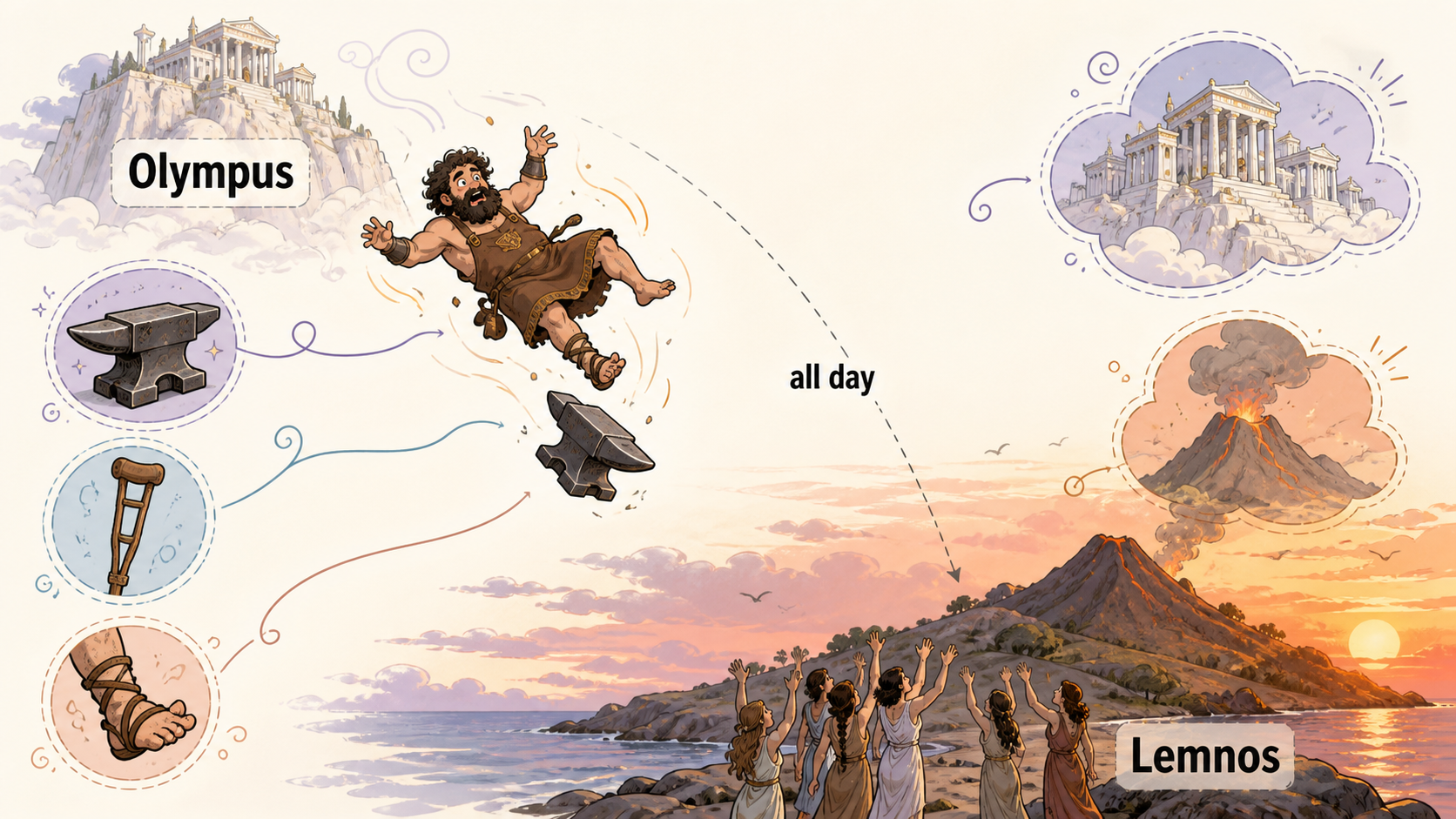
He dropped all day.
Hesiod’s version of his birth is almost blunt. Zeus has just produced Athena from his own head. Hera, angry, bears Hephaestus without a father. She copies the trick and cuts the father out. The product is not a warrior. It is a craftsman.
In a hymn she tells the other gods what she thought of that child. Weak. Shrivelled of foot. A shame. She took him in her hands and cast him into the sea.
Homer, in other moods, gives the smith a father. He needs one. A father can catch a grown son by the foot and throw him from the threshold.
In the first book of the Iliad, Hephaestus is trying to keep his mother from another fight with Zeus. He reminds her of the last time he took her side. The father caught him by the foot and threw him. From morning to sunset he was a falling thing. He landed on Lemnos, a volcanic island in the north Aegean, and there was not much life left in him. The Sintians, the people of the island, took care of what remained.
That is one fall. It has a map. Lemnos becomes, in his own later words, far the dearest of all lands. When he needs a lie that Ares will believe, he will pretend to go there.
The other fall is quieter and worse.
In Book 18 he is talking to his wife — and the wife, in this book, is not Aphrodite. He tells her why he owes Thetis everything. His mother wanted to hide him for being lame. Thetis and another sea-nymph, Eurynome, caught him in the water. For nine years he worked in their cave, making pins, clasps, cups, necklaces, while Ocean went on forever outside. No other god knew. No mortal knew. Only the two women who had saved him.
The sea-nymphs do not raise a warrior. They raise a jeweler.
The first things he makes are adornments. The same class of object Aphrodite will wear. The same class he will one day curse into a necklace a city cannot take off.
Which fall made him lame? The poems will not say. In Hera’s throw, the limp is why she throws him. In Zeus’s throw, the landing wrecks the legs. Homer keeps both scenes in the same poem and does not apologize. “Hephaestus is lame” is not a medical date. It is a mark. This god’s power will never be the power of the perfect body.
When the thrown child comes back, he will not come back with an army.
He will come back with furniture.
A throne can do what a body could not. It can hold a queen still.