Last updated: 2026-08-15
7. The Necklace Harmony Could Not Refuse
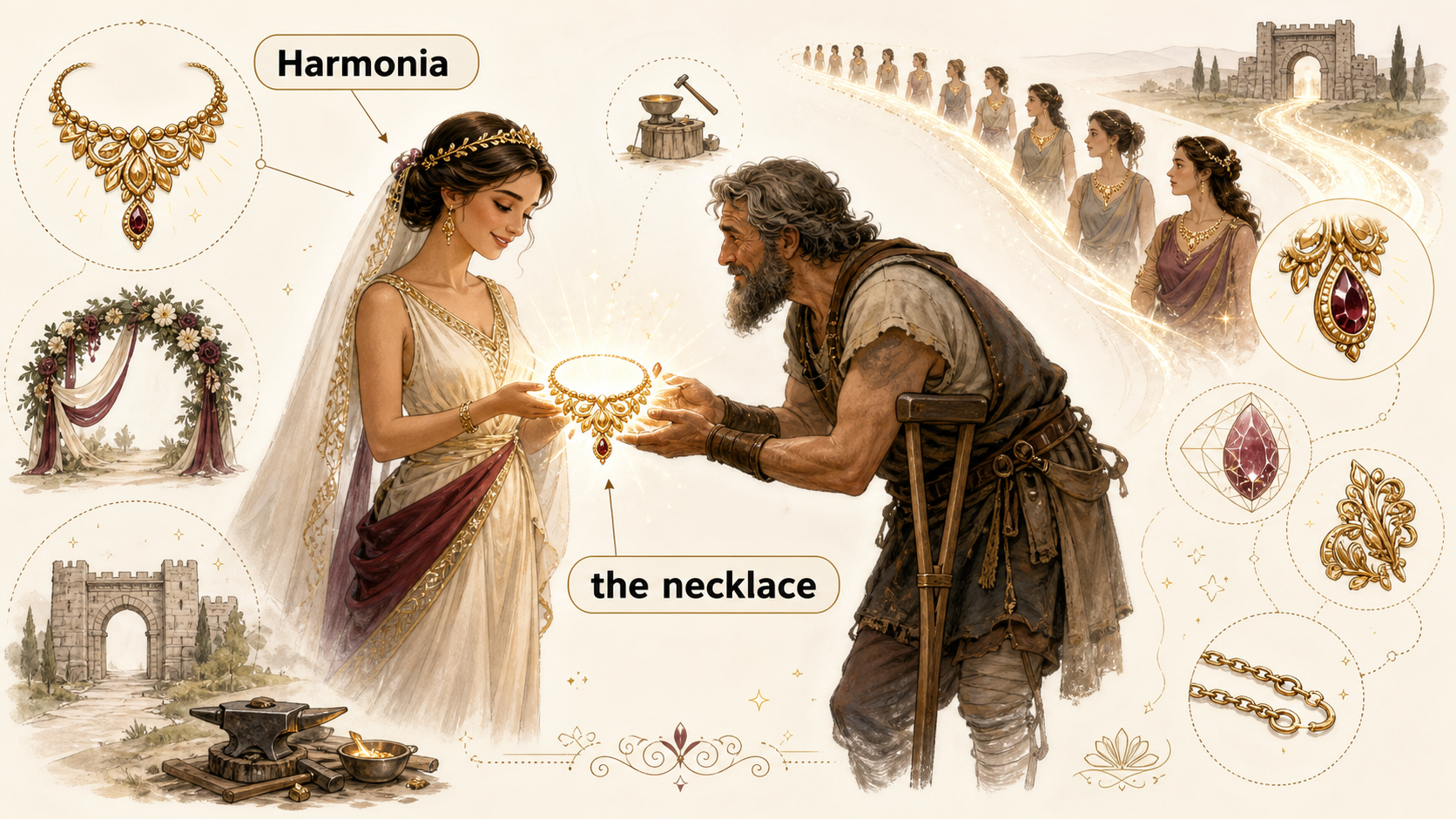
The gods went to a wedding.
Cadmus, who had sown a dragon’s teeth and founded Thebes, was taking a wife named Harmonia. Her name means the fitting-together of things that do not want to fit. Her parents, in the Theban story, were Ares and Aphrodite. Desire and war had made a daughter called Harmony. That is either a joke or a hope.
Hephaestus came with a gift.
The most common later telling says he was still angry, and that the necklace he had made — sometimes a robe with it — was so finely worked it could not be refused. Harmonia put it on. Every woman who wore it afterward carried a misfortune that behaved like an heirloom. The chain of Theban queens ran hot. The story of Oedipus sits at the far end of a piece of jewelry.
A wedding gift that cannot be refused is the net taught to travel. The bonds in the Odyssey hold two bodies for an afternoon. The necklace holds a city for generations. Once Hephaestus’s will has been made into matter, it does not require his presence.
This is the marriage’s true child.
The poems are unwilling to give the couple a baby. Aphrodite’s known offspring in the main line belong to Ares. Hephaestus has other children, almost all of them local and odd — smith-spirits on Lemnos, a nymph of Etna, a Roman king born from a hearth. They are fire-children and island-children. They are not hers.
Barrenness is not a gap. It is the point. Desire plus war produces Harmony, then panic. Desire plus craft produces, in the stories that matter, an artifact.
There is one other child who belongs here because he shows what Hephaestus fathers when Aphrodite is not in the room.
Athena came to him for weapons. Overcome, he tried to take her. She fought him off. Semen fell on her thigh. She wiped it with wool and flung the wool to the earth. Gaia — Earth — conceived. The child, Erichthonius, is sometimes an infant wound with a snake. Athena put him in a box and told the daughters of an early king not to look. They looked. Athens gained an early king out of a failed assault and an act of cleaning.
That story is civic, not conjugal. The craftsman reaching for the other crafts-goddess produces a founding myth. The craftsman married to Desire produces a joke and a curse.
He can also make a woman from scratch. Zeus, angry that Prometheus has given men fire, tells Hephaestus to plaster earth with water and make a face like the immortal goddesses. The other gods add gifts. Hermes names her Pandora — a sorrow for men who eat bread.
Hephaestus can assemble a woman. He cannot keep the woman he was given. Clay dressed as a goddess and a goddess treated as goods are the same rhyme in two registers.
Harmonia’s necklace is that rhyme worn on a throat.
The temples, unlike the myths, refused to house the couple. Cities had other needs.