Last updated: 2026-07-23
OOM Research: Synthetic Biology
Executive abstract
Synthetic biology is what happens when the living world becomes an information technology. Cells already run on a stack that can be explained without jargon if we go slowly: DNA stores instructions as sequences of four chemical letters; genes are readable stretches of those instructions; proteins are the molecular machines built from those instructions; and regulation (including epigenetics) decides which machines run when. Gene sequencing turns that chemistry into digital data — the atoms-to-bits portal. Gene editing and DNA synthesis push bits back into atoms — rewriting blood stem cells, pig genomes, microbial factories, and experimental “minimal” cells. The same platform now supports clinical CRISPR medicines, formal trials of gene-edited pig kidneys, proxy de-extinction animals, early human paths for partial epigenetic reprogramming, alternative-protein bioprocesses, and the breeding logic behind high-tech farms.
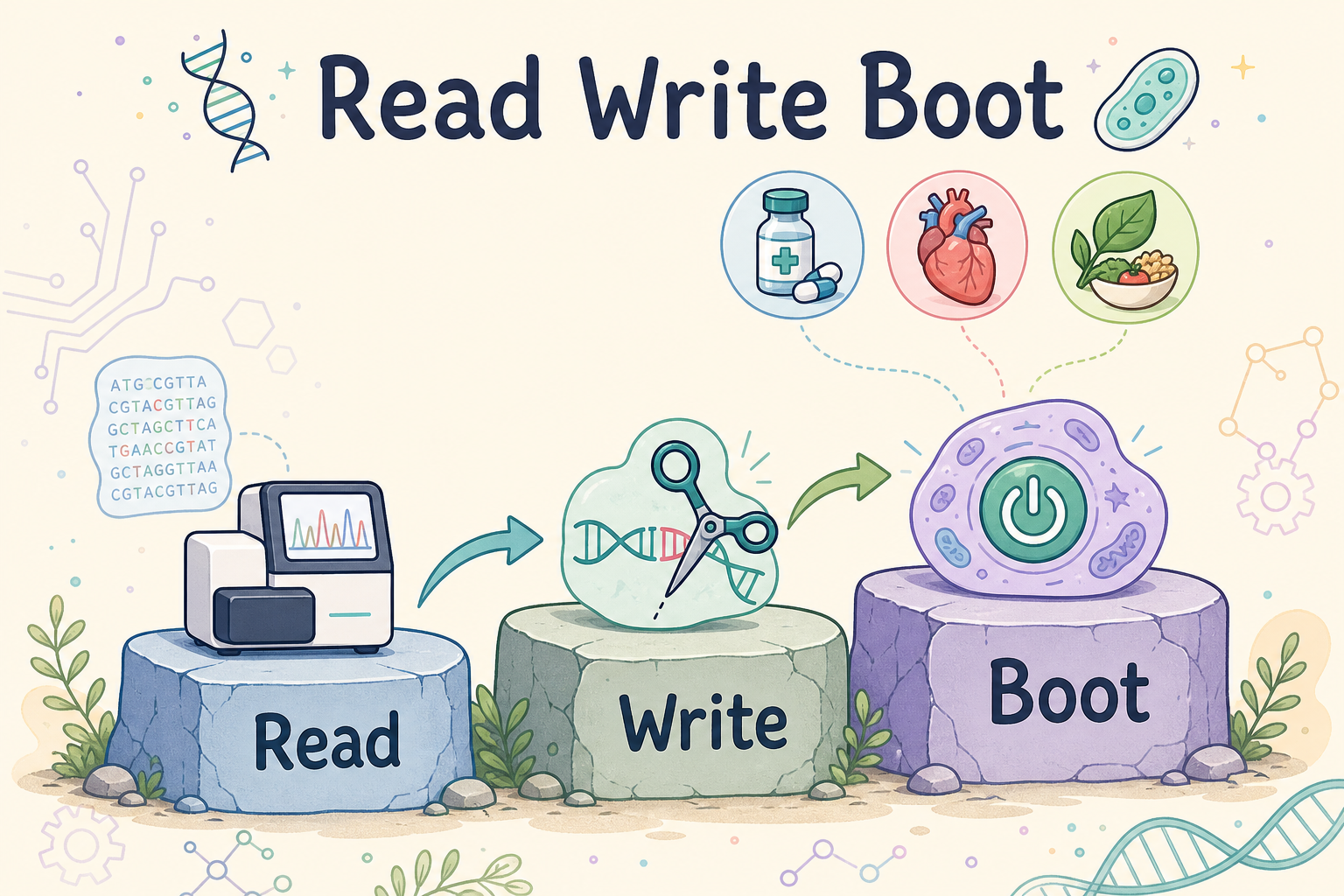
The deepest capability story is the read → write → boot loop. Sequencing costs fell by orders of magnitude from the multi-billion-dollar Human Genome Project era to industrial claims on the order of a few hundred dollars of list economics per human genome on high-throughput instruments — an exponential NGS-era trend with real but different bottlenecks in interpretation and clinical action. CRISPR turned bacterial immunity into programmable scissors; in December 2023 the FDA approved Casgevy, the first CRISPR-based medicine, for sickle cell disease. JCVI’s syn1.0 (2010) and syn3.0 (2016) showed that chemically synthesized and minimized bacterial genomes can run living cells — historic, and still full of genes of unknown function. United Therapeutics’ UKidney moved xenotransplantation into an FDA-cleared trial path in 2025, with the first EXPAND transplant at NYU Langone in November 2025. Colossal Biosciences produced gene-edited canids messaged as dire wolf de-extinction in 2024–2025; the careful scientific description is proxy trait engineering, not full taxonomic resurrection. Life Biosciences’ ER-100 partial reprogramming path received FDA clinical clearance in January 2026 for optic disease — a real longevity-adjacent threshold that is not the same as systemic age reversal. Alternative proteins and vertical farming apply biotech and controlled environments to food: microbes and cell culture for proteins; stacked indoor farms for greens — both gated hard by unit economics and energy physics.
The governing prediction is uneven: platform tools (sequencing, editing, AI protein design, fermentation) compound; each application hits its own wall (delivery, immunity, photons, payers, trust). Longevity escape velocity by 2030 is not the base case. Ending the organ waitlist “next year” is not either. The biology century is real as a platform shift, not as a single apocalypse-or-utopia switch.
Table of contents
- 01. DNA, genes, and proteins — the living information stack
- 02. Gene sequencing — turning life into data
- 03. Gene editing — rewriting the instructions
- 04. Full synthetic life forms — genomes written, cells bootstrapped
- 05. Colossal Biosciences and de-extinction
- 06. United Therapeutics and gene-edited organs
- 08. Alternative proteins — food from cells and microbes
- 09. Vertical farming — CEA under an energy microscope
- 10. Capabilities, milestones, trends, and predictions
- 11. Risks, contrarian views, and failure modes
- References
- Question ledger
Short answers
| Question | Short answer |
|---|---|
| What is synbio? | Engineering living systems by reading/writing genetic (and increasingly epigenetic) information |
| DNA / gene / protein? | Storage / instructional segment / working molecular machine |
| Sequencing trend? | Exponential cost collapse in NGS era; interpretation now bottlenecks value |
| Editing milestone? | Casgevy FDA approval Dec 2023 |
| Synthetic life? | Synthetic/minimal bacterial genomes yes; freeform complex life no |
| Colossal dire wolf? | Living proxies via editing; “true species back” disputed |
| UTHR organs? | 10-edit pig kidney in EXPAND trial; first transplant Nov 2025 |
| Longevity? | Real partial-reprogramming clinical on-ramp 2026; LEV 2030 unlikely |
| Alt protein? | Fermentation nearer-term; cultivated meat still cost-gated |
| Vertical farms? | Niche greens tool; energy-bound; not staple-calorie savior |
Core mechanism
Life is an information stack embodied in chemistry. Cheap reading and increasingly precise writing of that stack create compounding design loops; applications inherit both the power and the physical constraints of biology.
Three vivid anchors: watermarked synthetic genomes (2010); Victoria Gray and Casgevy’s path to approval (2019–2023); a gene-edited pig kidney placed under a named clinical protocol at NYU in November 2025.