Last updated: 2026-07-23
01. DNA, genes, and proteins — the living information stack
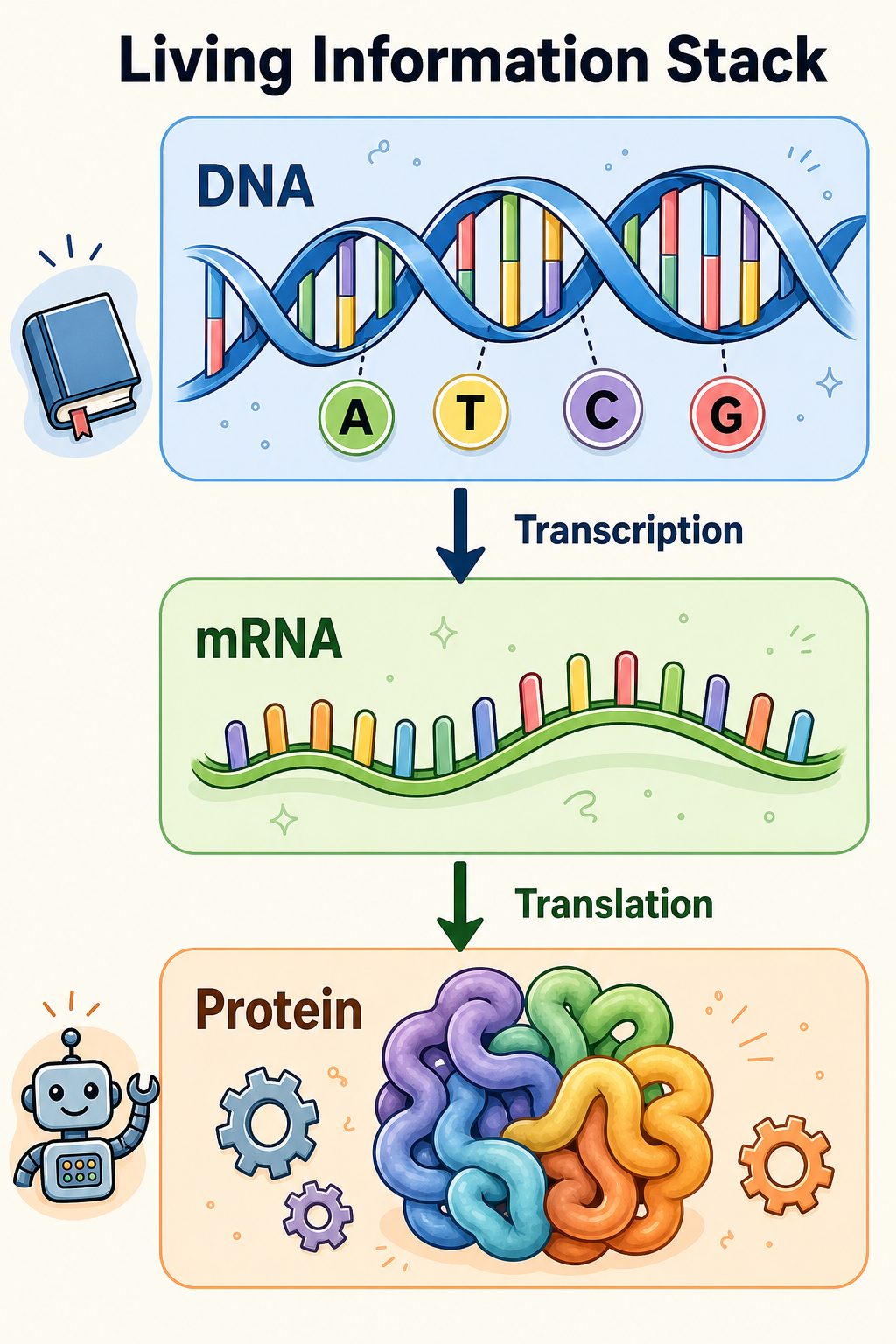
Why this chapter exists
❓ What physical stuff has to be true before “editing life” is more than a slogan?

Synthetic biology only makes sense if you can hold three linked facts at once: living cells store instructions in DNA; those instructions specify proteins; proteins are the molecular machines that do almost all of the cell’s real work. Everything later in this report — sequencing machines, CRISPR scissors, pig kidneys, mammoth edits, lab-grown meat — is a tool layered on top of that stack. This chapter builds the stack from atoms upward without assuming prior biology coursework.
Cells are factories with a library
❓ What is a cell, in plain mechanism language?
A cell is a membrane-bound chemical factory. Inside it, thousands of reactions run in parallel: taking in nutrients, building structures, sensing the environment, dividing into two cells. Animal and plant bodies are vast societies of specialized cells. Bacteria are single-celled organisms that can still carry a complete instruction set for survival and reproduction.
The cell’s library of instructions is mostly DNA. The cell’s workforce is mostly protein. The bridge between library and workforce is a set of copying and decoding steps that biologists summarize as the central dogma of molecular biology: DNA is transcribed into RNA; RNA is translated into protein. Information can flow DNA → RNA → protein in ordinary cells; reverse paths exist in special cases (for example some viruses), but they do not erase the main production line.
Definition — DNA: Deoxyribonucleic acid is a long polymer (a chain of repeating chemical units) that stores hereditary information as a sequence of four chemical “letters.”
Definition — gene: A gene is a stretch of DNA that is used, under regulation, to produce a functional product — usually a protein, sometimes a functional RNA.
Definition — protein: A protein is a chain of amino acids folded into a precise 3D shape that can catalyze reactions, form structures, transport cargo, receive signals, or cut other molecules.
Why this is a good explanation
Hard-to-vary test: You cannot swap “proteins do the work” for “carbohydrates do the work” and keep molecular biology intact; enzymes, receptors, antibodies, and structural filaments are overwhelmingly protein (with important RNA exceptions such as the ribosome’s catalytic core).
Refutability: The framework would break if cells routinely built complex adaptive machines without nucleic-acid templates or without polymer folding into function.
Reach: The same stack explains sickle-cell disease (one DNA letter change → wrong hemoglobin protein → sickled red blood cells) and industrial enzyme design.
The four-letter code
❓ How can four chemicals encode an entire organism?
DNA’s alphabet has four bases: A (adenine), T (thymine), C (cytosine), and G (guanine). In the famous double helix, the two strands pair: A with T, C with G. Each pairing is a base pair. Human cells package roughly 3 billion base pairs of nuclear DNA into 23 pairs of chromosomes — long DNA molecules wrapped around protein spools.
Information density comes from sequence, not from exotic chemistry. With four letters, a stretch of n bases has 4ⁿ possible sequences. That combinatorial space is large enough to specify every protein a body needs and the regulatory switches that turn genes on and off in the right tissues at the right times.
A genome is the complete set of genetic material of an organism. A bacterium may have a single circular chromosome with a few hundred to a few thousand genes. A human genome has on the order of twenty thousand protein-coding genes plus vast regulatory and non-coding sequence whose functions are still being mapped.
Codons: words of three letters
Proteins are built from twenty standard amino acids. Cells read RNA three bases at a time. Each triplet is a codon. Most codons map to one amino acid; some signal “start” or “stop.” That mapping — the genetic code — is nearly universal across life on Earth, which is why a human gene can sometimes be inserted into a bacterium and still produce a recognizable protein. Universality is also why synthetic biology can move parts between organisms with engineering intent.
From gene to working machine
❓ What actually happens between “having a gene” and “having a working protein”?
- Transcription. An enzyme complex copies a gene’s DNA sequence into a messenger RNA (mRNA) molecule.
- Processing (in complex cells). The mRNA may be spliced, capped, and exported from the nucleus.
- Translation. A ribosome reads the mRNA and links amino acids into a polypeptide chain.
- Folding and finishing. The chain folds; helpers may add sugars or other marks; the protein is shipped to its job site.
Regulation is as important as the coding sequence. Cells do not run every gene at full blast. Promoters, enhancers, and epigenetic marks (chemical tags on DNA or on the histone proteins that DNA wraps around) decide which genes are readable. That is why a liver cell and a neuron share essentially the same genome but different active programs — and why “partial epigenetic reprogramming” later in this report tries to rewind some of those marks without erasing cell identity.
Sickle-cell disease is the classic one-letter tragedy: a single base change in the β-globin gene swaps one amino acid in hemoglobin. The protein still folds, but under stress it sticks to copies of itself, distorting red blood cells into sickle shapes that clog vessels. Modern CRISPR medicine does not always rewrite that letter directly; Casgevy instead edits a regulatory pathway so fetal hemoglobin comes back online and compensates. Same stack, different lever.
Proteins are geometry that does work
❓ Why does sequence matter if shape does the job?
A protein’s amino-acid sequence determines how it folds in water. Folded shape creates binding pockets, moving parts, and surfaces that stick to partners. Enzymes speed chemical reactions that would otherwise be too slow for life. Ion channels open and close pores in membranes. Antibodies recognize invaders. Structural proteins build hair, connective tissue, and cytoskeletons.
Misfolding is not a footnote. Many diseases are shape failures. Drug discovery and AI protein design both obsess over structure because geometry is function.
Different from: Saying “DNA is the blueprint and proteins are bricks” is a useful cartoon, but incomplete. DNA is more like a conditional program with many overlays; proteins are less like static bricks and more like robots that assemble, cut, signal, and self-destruct on schedule.
What synthetic biology adds to this picture
❓ Where does “synthetic” begin?
Classic biology describes the stack. Genetic engineering moves pieces of it (insert a gene, knock one out). Synthetic biology aims to treat the stack as an engineering medium: standardize parts, digitize genomes, write DNA to order, simulate designs, and close a design–build–test–learn loop the way chip designers close a silicon loop.
Two directions define the EmTech character of the field (see OOM terminology: portal between worlds):
- Atoms → bits: sequencing and measurement turn chemical polymers into digital strings and multi-omics datasets.
- Bits → atoms: DNA synthesis, editing, and cell engineering turn digital designs into living systems and living products.
AI enters as a strong accelerator on both sides: calling bases, assembling genomes, predicting protein structure, proposing edits, and optimizing fermentation strains.
Core vocabulary quick reference
| Term | One-sentence meaning |
|---|---|
| Base pair | One A–T or C–G pair in double-stranded DNA |
| Gene | DNA segment used to make a functional product |
| Genome | Full genetic content of an organism |
| Chromosome | Packaged DNA molecule |
| mRNA | Working copy of a gene used by ribosomes |
| Codon | Three-base word coding an amino acid or stop |
| Amino acid | Building block of proteins |
| Protein | Folded amino-acid chain that performs function |
| CRISPR | Adaptive bacterial immune system repurposed as a programmable DNA-targeting tool |
| Epigenetics | Heritable-or-stable regulatory layers on top of DNA sequence |
Bottom line
Life runs on a readable, writable, and increasingly designable information stack. DNA stores; RNA communicates; proteins act. Synthetic biology is what happens when that stack becomes cheap to read, write, and debug at scale. The next chapters take each major capability in turn.