Last updated: 2026-07-23
06. United Therapeutics and gene-edited organs
The human problem in one number
❓ Why invent pig organs at all?

Transplant medicine is constrained by donor organ scarcity. Patients with end-stage kidney disease can survive for years on dialysis, but quality of life and long-term outcomes are often poor, and many will never receive a human kidney in time. Hearts and lungs have even less waiting-room tolerance. Xenotransplantation — transplanting living cells, tissues, or organs across species — is an old idea that became newly practical when multiplex gene editing could rewrite the donor animal to be less alien to the human immune system.
United Therapeutics (UTHR), a public benefit corporation, is one of the furthest-along commercial efforts to turn gene-edited pigs into a regulated organ source. Parallel scientific and company efforts (notably eGenesis) make this a race, not a monopoly.
What a 10-gene pig kidney is
❓ Which edits turn a pig organ into something a human body might tolerate?
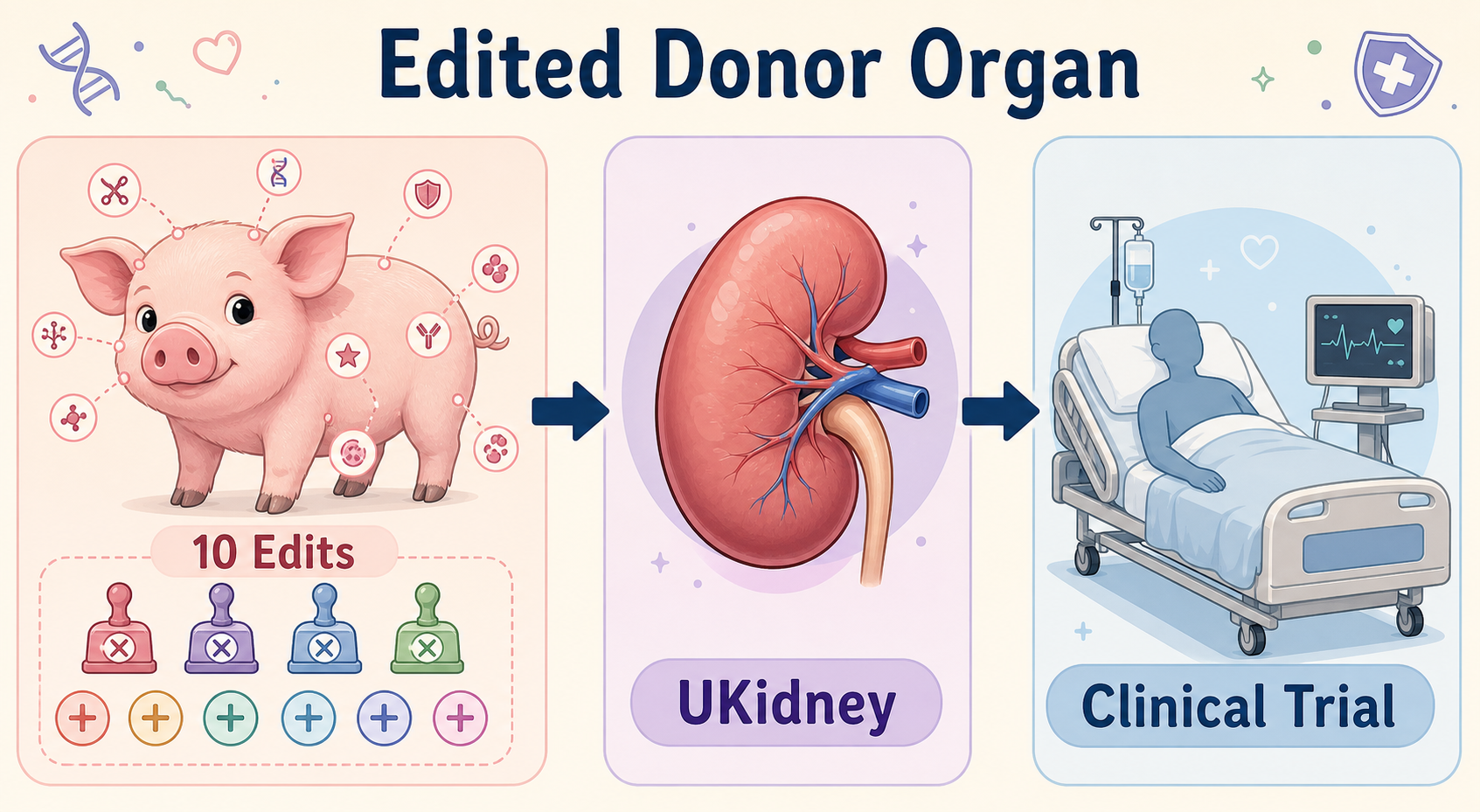
United Therapeutics’ investigational UKidney is described in company materials as coming from a pig with 10 gene edits:
- Four porcine genes inactivated (“knocked out”) — including targets that drive hyperacute rejection (for example carbohydrate antigens humans attack immediately) and pathways that can make the organ grow too large in the human host.
- Six human genes added — to improve immune compatibility, complement regulation, and coagulation compatibility so the human blood–endothelium interface does not become a battlefield.
Exact locus lists evolve with generational pig lines; the engineering logic is stable: remove the worst cross-species red flags, add human regulatory proteins, control growth.
Related pipeline concepts include UHeart (gene-edited pig heart) and lung programs — same platform, harder physiology.
Regulatory and clinical milestones (2025)
❓ When did this leave “compassionate one-offs” and enter trials aimed at approval?
Earlier 2020s surgeries under expanded-access / decedent / single-patient paradigms proved surgical feasibility and revealed failure modes (infection, rejection, organ dysfunction). The industrial threshold is a regulated clinical trial intended to support a Biologics License Application (BLA).
According to United Therapeutics’ investor releases:
- 3 February 2025: FDA clearance of the IND for the UKidney xenotransplantation clinical study. Initial cohort 6 end-stage renal disease patients, expandable toward ~50, designed to support a future BLA. First transplant then expected around mid-2025.
- 3 November 2025: announcement of the first clinical xenotransplantation in the EXPAND study (NCT06878560), performed at NYU Langone Health.
NYU Langone’s public description matches the 10-edit design story and frames EXPAND as testing safety and efficacy in patients with end-stage renal disease. Trial design commentary describes a seamless phase 1/2/3 (“phaseless”) structure rather than three fully separate classical phases — an aggressive development path that still must generate durable evidence.
eGenesis received parallel attention in 2025 as another FDA-cleared clinical path for gene-edited pig kidneys, reinforcing that regulators were willing to open the door to formal human trials, not only heroic exceptions.
The November 2025 NYU operation is the mundane-sounding event that actually changes the future: not a surprise midnight experiment, but patient one in a protocol meant to become a product. History may remember the press release timestamp more than the brand name on the pig.
What has to go right for organs-as-a-product
❓ What does success require beyond a photogenic surgery?
- Graft survival measured in years, not weeks.
- Manageable immunosuppression — ideally less brutal than early xeno cases.
- Zoonosis control — especially porcine endogenous retroviruses (PERVs) and other pathogens; designated pathogen-free facilities and PERV inactivation strategies are part of the field’s engineering brief.
- Scalable GMP animal production — consistent genetics, welfare standards, slaughter/OR logistics that look like manufacturing.
- Surgical and hospital network readiness.
- Payer acceptance if costs are high but dialysis is also expensive — health-economic story matters.
- Public trust after any high-profile failure.
Expert commentary in 2025 still commonly placed widespread clinical use on a multi-year to ~decade horizon even after trial starts. That is not cynicism; it is how biologic platforms mature.
How this differs from “3D-printed organs” and organoids
❓ Is xenotransplantation competing with bioprinting?
| Approach | Idea | 2026-class maturity |
|---|---|---|
| Xenotransplantation | Edit animal organ to fit human | First formal kidney trials underway |
| Human donor expansion | More living/deceased donation, perfusion tech | Incremental but real |
| Bioengineered / bioprinted organs | Build organ from cells + scaffolds | Mostly small tissues; full vascularized organs hard |
| Organoids | Mini organs for research/toxicity | Powerful models; not full replacements yet |
| Implantable devices | Artificial kidney / heart pumps | Devices help; not full biologic replacement for all |
Xeno is currently the nearest path to full-size vascularized organs for some indications. Bioprinting may win niches later; it is not the 2025–2026 kidney waitlist solution.
Risks and contrarian notes
❓ Who is right to be nervous?
- Early recipients may face unknown long-term cancer, infection, or rejection risks.
- A single public disaster could freeze the field.
- Animal ethics: breeding pigs as organ donors is morally contested.
- Equity: will gene-edited organs flow first to rich health systems?
- Overpromise: trial start ≠ cure for organ shortage next year.
Bottom line
United Therapeutics’ UKidney program — IND in February 2025, first EXPAND transplant in November 2025 at NYU Langone — marks the shift of gene-edited pig organs from spectacle case reports toward a product-shaped clinical path. The capability is real enough to trial; it is not yet a solved manufacturing system for ending the waitlist. Watch durable graft function and safety, not just first-surgery headlines.