Last updated: 2026-07-23
05. Colossal Biosciences and de-extinction
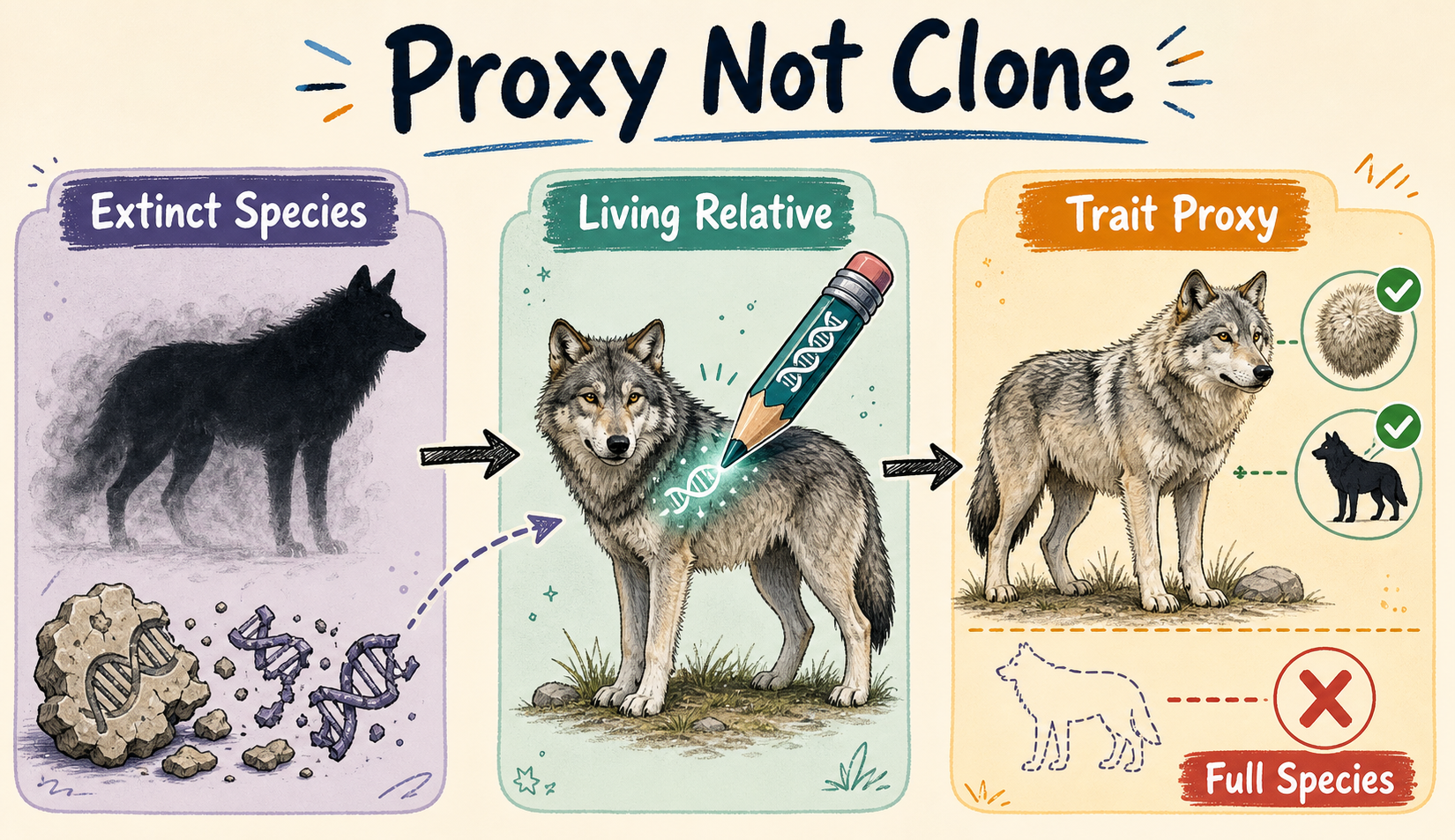
The claim in plain language
❓ Can synthetic biology bring extinct species back?

De-extinction is the attempt to restore extinct organisms, or functional approximations of them, using ancient DNA, genome editing, cloning, and reproductive technologies. Colossal Biosciences (Dallas-based, co-founded with high-profile scientific involvement including George Church’s orbit of ideas) is the best-funded public face of the effort, with flagship projects on the woolly mammoth, dire wolf, dodo, thylacine (Tasmanian tiger), and additional species such as moa and, by 2026 announcements, antelope projects such as the bluebuck.
The honest core: we can increasingly edit living relatives to express traits of extinct species. The contested edge: whether the result should be called the extinct species, a hybrid, a proxy, or a novel organism.
How the technical path works
❓ What is the actual recipe, step by step?
- Recover ancient DNA from well-preserved remains (permafrost mammoths, museum specimens, fossils). DNA is fragmented and contaminated; computational reconstruction yields a draft, not a perfect time machine.
- Compare to the closest living relative (Asian elephant for mammoth; gray wolf lineage for dire wolf projects; pigeons/chickens for dodo work).
- Identify trait-defining differences — coat, fat, cold tolerance, craniofacial structure, hemoglobin, etc.
- Edit the living relative’s cells with multiplex CRISPR-class tools to install those differences.
- Derive embryos (cloning / stem-cell / gamete routes vary by species) and use surrogates or advanced reproductive tech.
- Birth, raise, and (maybe someday) ecologically place the animals under intense welfare and containment constraints.
This is synthetic biology as comparative genomics + multiplex editing + reproductive engineering, not Jurassic Park amber extraction of intact genomes for dinosaurs (DNA survival timescales make non-avian dinosaurs a non-starter; Colossal itself publicly dismisses dinosaur revival on molecular grounds).
Dire wolf: the 2024–2025 spectacle and the scientific pushback
❓ Did Colossal “bring back” the dire wolf?
Company narrative: On the order of October 2024 births of male pups (publicly named Romulus and Remus), with a female (Khaleesi) reported around January 2025, Colossal announced restoration of the dire wolf after roughly 10,000+ years. Animals are described as living on a large secure preserve, not released to the open wild. Company materials frame this as the first de-extinction of an animal species.
Independent scientific pushback: Multiple geneticists and conservation specialists argued the animals are gene-edited gray wolves (or canid proxies) carrying selected dire-wolf-associated traits, not true Aenocyon dirus resurrected in full. Coverage in venues such as Science and analyses by canid specialist communities stressed that a modest set of edits on a lineage that diverged millions of years ago does not equal species revival. Ethical and welfare papers also flag ontological ambiguity: extinct species vs hybrid vs novel organism.
How this report treats it:
Confirmed: living gene-edited canids were produced and publicly messaged as dire wolf de-extinction; the project is a major multiplex-editing and PR milestone.
Not confirmed / rejected by many specialists: that the animals are dire wolves in the strict taxonomic and genomic sense.
Best technical description: trait-forward proxy organisms demonstrating de-extinction platform capabilities.
Naming pups Romulus, Remus, and Khaleesi fused Roman foundation myth and prestige television with molecular biology. That branding supercharged attention — and made the later “not exactly a dire wolf” correction land harder with the public.
Mammoth path: slower, heavier, higher ecological ambition
❓ Where is the woolly mammoth project, really?
Colossal’s mammoth goal is often stated as a cold-resistant elephant with core mammoth traits, not a pixel-perfect clone of Mammuthus primigenius. Asian elephants are ~99%+ genomically close in broad comparison terms used in popular science communication; the engineering problem is still enormous: dozens of trait edits, embryonic development, 22-month-class gestation, surrogate welfare, and eventual habitat questions.
Visible intermediate: woolly mice — mice engineered with mammoth-inspired coat/fat-related phenotypes — used as a rapid testbed (reported widely in 2025).
Public timelines: company and secondary reporting have pointed to embryo work in the mid-2020s and aspirational live calves later in the decade (commonly discussed targets around late 2020s, e.g. ~2028 in some commentary). Treat live-birth dates as aspirational until a primary birth announcement with third-party verification.
Side benefit thesis: tools developed for mammoth work (herpesvirus resistance angles, reproductive tech) are pitched as aiding living elephant conservation — the “conservation gym” framing.
Broader pipeline and business context
❓ Is this a zoo of stunts or a platform company?
Colossal’s portfolio strategy looks like a platform: shared capabilities in ancient DNA, multiplex editing, computational biology, and reproductive science applied across charismatic species. That attracts capital and talent. Secondary 2026 discussion on X and in business chatter has included very large valuation figures; treat private valuation rumors as weak evidence unless tied to primary filings or reputable deal reporting. What matters analytically is that investors are pricing option value on gene-editing + developmental biology, not ticket sales to see a mammoth.
Conservation ethics: strongest steelman and strongest critique
❓ Should we want this?
Steelman for de-extinction tech:
- Forces rapid progress in tools that help endangered living species.
- Could restore missing ecological functions (controversial for mammoths and Pleistocene park ideas).
- Mobilizes public money and attention toward biodiversity.
Strongest critiques:
- Opportunity cost: dollars and charisma might better go to habitat protection and preventing extinctions now.
- Category error: proxies are not the dead species; marketing may mislead donors and regulators.
- Welfare: creating animals for containment spectacle risks instrumentalizing sentient beings.
- Ecology: release without ecosystems, prey structure, and social knowledge is not restoration.
- Moral hazard: “we can always bring them back” weakens urgency to protect what remains.
Capability assessment
| Claim | Assessment (mid-2026) |
|---|---|
| Multiplex edit living mammals for extinct traits | Demonstrated at striking public level |
| Birth of engineered proxy neonates | Demonstrated (dire wolf program) |
| True genomic resurrection of extinct species | Not established; definitional dispute |
| Ecological restoration via de-extinct populations | Not achieved |
| Conservation tool spillover | Plausible; evidence still maturing case-by-case |
Bottom line
Colossal turned de-extinction from conference talk into viral, living animals and a busy multi-species pipeline. The scientifically careful sentence is: they are pioneering proxy-based de-extinction engineering. The marketing sentence often skips the word “proxy.” Both the engineering achievement and the naming dispute belong in any serious account.