Last updated: 2026-07-23
03. Gene editing — rewriting the instructions
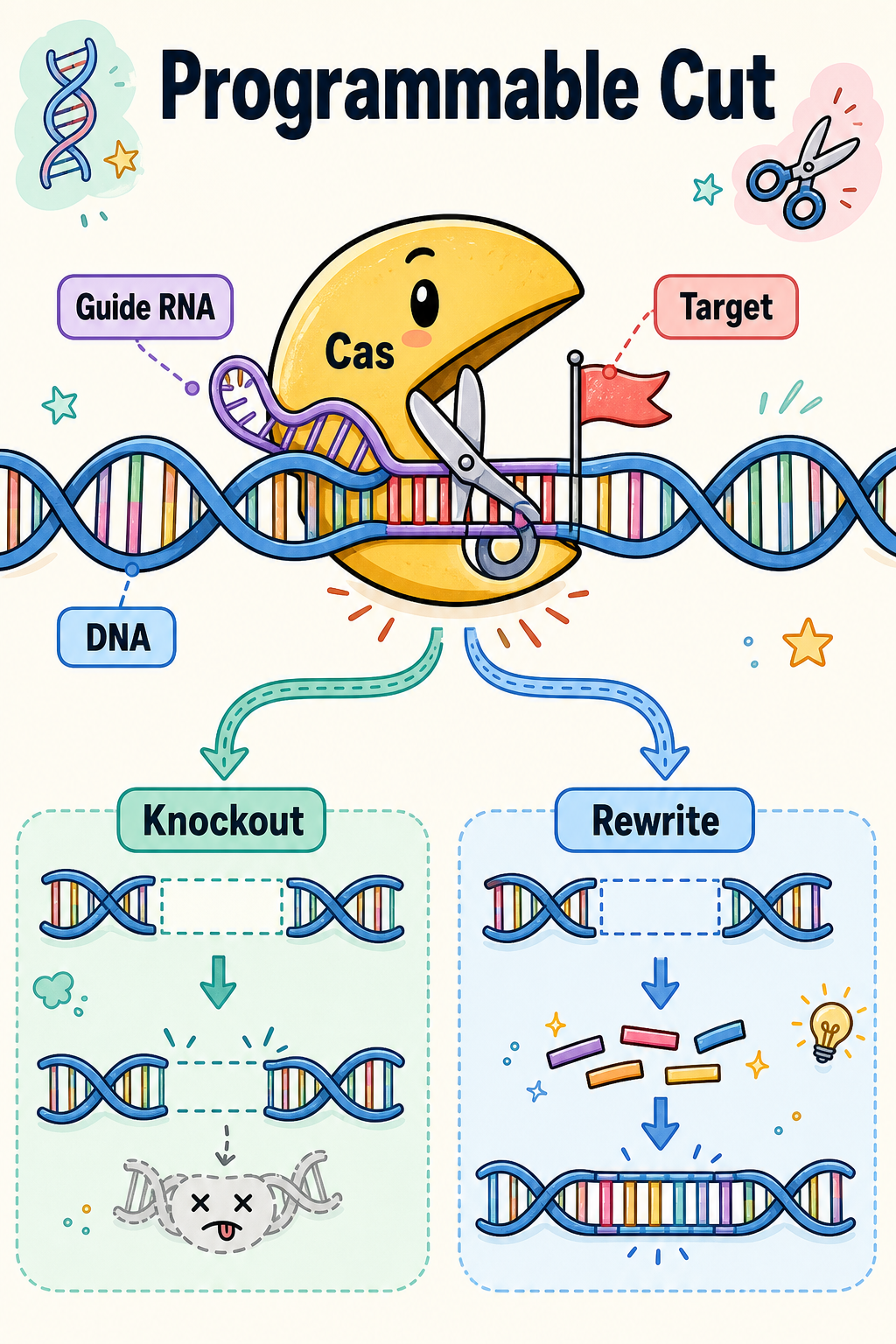
What gene editing is
❓ How is editing different from sequencing or from old-fashioned genetic engineering?

Gene editing means making intentional, site-specific changes to DNA inside living cells. Older genetic engineering could add genes (often landing semi-randomly) or disrupt genes with cruder tools. Modern editors aim at addresses: “cut here,” “change this base,” “insert this cassette at this locus.”
If sequencing is read, editing is write (with synthesis of DNA oligos and gene-length constructs as the supply chain of written parts). In the OOM taxonomy, this sits under Genetic Engineering / the write leg of Synthetic Biology.
CRISPR in one hard-to-vary story
❓ What is CRISPR actually doing at the molecular level?
CRISPR (Clustered Regularly Interspaced Short Palindromic Repeats) began as a bacterial immune system. Bacteria store fragments of viral DNA as spacers; when the virus returns, a guide RNA leads a Cas (CRISPR-associated) enzyme to matching DNA, and the enzyme cuts it.
Emmanuelle Charpentier and Jennifer Doudna’s foundational work (Nobel Prize in Chemistry, 2020) showed that the system could be simplified into a programmable tool: design a guide RNA for your target sequence, and Cas9 (or relatives) will cut there in cells you care about — human, plant, pig, microbe.
After the cut, the cell’s own repair machinery decides the edit:
- Non-homologous end joining (NHEJ) often introduces small insertions/deletions — useful to knock out a gene.
- Homology-directed repair (HDR) can incorporate a supplied DNA template — useful to rewrite sequence, but efficiency varies by cell type and cell-cycle state.
Next-generation editors
| Tool | What it does | Why it matters |
|---|---|---|
| Nuclease CRISPR (Cas9 etc.) | Double-strand break at target | Workhorse knockouts and some corrections |
| Base editors | Chemically convert one base to another without full DSB | Cleaner single-letter fixes |
| Prime editors | “Search-and-replace” with reverse transcriptase fusion | Broader variant classes, still maturing for clinic |
| CRISPRi / CRISPRa | Bind without cutting to repress or activate genes | Expression control, not permanent sequence change |
| Multiplex editing | Many guides / many loci | Essential for pig organs, trait stacks, complex rewiring |
Hard-to-vary mechanism: Programmability comes from Watson–Crick base pairing between guide RNA and target DNA, not from a custom protein redesigned for every address. That is why CRISPR scaled faster than protein-only nucleases such as zinc-finger nucleases for many labs.
Refutability: If guides did not confer sequence specificity, or if Cas enzymes did not cleave (or nick) DNA in a guide-dependent way, the platform explanation would fail.
Delivery: the unglamorous bottleneck
❓ Why isn’t every genetic disease already cured if scissors are cheap?
Editors only work if they reach the right cells at the right dose without wrecking the patient.
- Ex vivo: remove cells (for example blood stem cells), edit in a lab, return them. High control; brutal logistics and cost. Casgevy uses this path.
- In vivo viral vectors (AAV and others): ship DNA instructions into the body. Tropism, dose limits, immune memory against the virus, and cargo size constraints matter.
- Lipid nanoparticles (LNPs): famously used for mRNA vaccines; adapting them for gene editors is an active race.
- Tissue barriers: brain, muscle, heart, and solid organs each fight delivery differently.
Until delivery is solved for a tissue, that tissue’s diseases remain mostly out of reach regardless of how clever the editor is on a slide.
Milestone: Casgevy and the first CRISPR medicine
❓ When did gene editing become an approved medicine rather than a lab demo?
On 8 December 2023, the U.S. FDA approved Casgevy (exagamglogene autotemcel, exa-cel) from Vertex Pharmaceuticals and CRISPR Therapeutics for sickle cell disease in eligible patients — the first FDA-approved therapy using CRISPR/Cas9 genome editing. The UK had authorized it slightly earlier. A second gene therapy for sickle cell, Lyfgenia (a lentiviral addition approach, not CRISPR), was approved in the same U.S. decision window.
Mechanism of Casgevy (simplified): patient hematopoietic stem cells are edited at an enhancer of BCL11A, reducing BCL11A’s repression of fetal hemoglobin. Fetal hemoglobin compensates for defective adult sickle hemoglobin. It is a regulatory workaround, not necessarily a direct repair of the sickle mutation — elegant systems biology as much as “cut the bad letter.”
Clinical reality check: manufacturing is complex; conditioning chemotherapy is harsh; list prices have been reported in the multi-million-dollar range per patient; capacity and center readiness limit throughput. Scientific triumph ≠ automatic global access.
Victoria Gray, among the earliest CRISPR sickle-cell trial participants (dosed 2019), became a public face of the transition from Nobel-winning paper to a person who no longer lived hospital-to-hospital for pain crises. The emotional clarity of that story is real; so is the fact that most of the world’s sickle-cell patients still cannot access the therapy.
Multiplex editing beyond monogenic disease
❓ What happens when you edit ten genes at once instead of one?
Single-gene medicine is only the on-ramp. Industrial and transplant applications need stacks of edits:
- Xenotransplantation pigs (United Therapeutics UKidney and peers): multiple knockouts to remove antigen and growth problems plus multiple human transgenes for complement and coagulation compatibility (see chapter 06).
- De-extinction trait engineering (Colossal and others): many loci for coat, fat, cold tolerance, craniofacial traits (see chapter 05).
- Microbial cell factories: pathway inserts, feedback rewiring, phage resistance.
- Agriculture: multi-trait disease resistance and quality stacks (regulated differently by jurisdiction).
Multiplex success depends on editor efficiency, chromosomal stability, off-target burden, and breeding or cloning pipelines to fix edits in a line.
Risks that do not vanish with better scissors
❓ What failure modes should a non-specialist actually track?
- Off-target edits: wrong locus cut; mitigated by better enzymes, better guides, better assays — not zero.
- On-target messiness: large deletions, rearrangements, mosaicism.
- Immune reactions to Cas proteins or delivery vehicles.
- Germline editing: heritable changes to embryos/sperm/eggs — scientific capability is ahead of global ethical consensus; clinical reproductive use remains broadly restricted or banned.
- Dual use: the same skills that cure can enhance pathogens; DNA synthesis screening and lab norms are part of the control system.
- Equity: cures that cost as much as a house create a two-tier biology.
Capability grey scale
Editing is not binary. Measure it along:
- Precision (intended vs unintended changes)
- Efficiency (% cells correctly edited)
- Delivery reach (which tissues)
- Multiplex depth (how many loci)
- Durability (does the edit persist in the tissue’s stem pool?)
- Clinical operability (manufacturing, conditioning, monitoring)
Casgevy scores high on durability in the blood system for treated patients who engraft well; it scores poorly today on cost and ease. In vivo base editing for liver targets may invert that pattern for other diseases.
Bottom line
Gene editing turned a bacterial immune trick into a general-purpose addressable writer for DNA. The 2023–2024 regulatory approvals prove clinical reality. The 2025–2026 xenotransplant and multiplex projects prove industrial ambition. The remaining bosses are delivery, safety at scale, manufacturing, and fair access — not whether DNA can be cut on command.