Last updated: 2026-07-23
04. Full synthetic life forms — genomes written, cells bootstrapped
What “synthetic life” can mean (and what it must not smuggle in)
❓ Did scientists “create life from scratch,” or something more precise?

Public language jumps quickly to “scientists create life.” The technical record is more specific and more interesting. Distinguish at least four claims:
- Chemically synthesized genome in a living cell — DNA printed and assembled, then bootstrapped into a cellular chassis.
- Minimal cell — a living cell whose genome has been reduced toward the smallest set that still supports autonomous replication under lab conditions.
- De novo designed organism — genome architecture invented from principles, not mostly copied from a natural template.
- Bottom-up protocell — membrane + metabolism + heredity assembled without co-opting an existing cell.
As of this research date, (1) and (2) are demonstrated at bacterial scale by the J. Craig Venter Institute lineage. (3) remains partial: design is still heavily guided by natural genomes and empirical knock-out cycles. (4) is active research with impressive modules but not a free-living, fully synthetic peer of bacteria in practical use.
The JCVI arc: syn1.0 to syn3.0
❓ What exactly did Venter’s teams build?
JCVI-syn1.0 (2010)
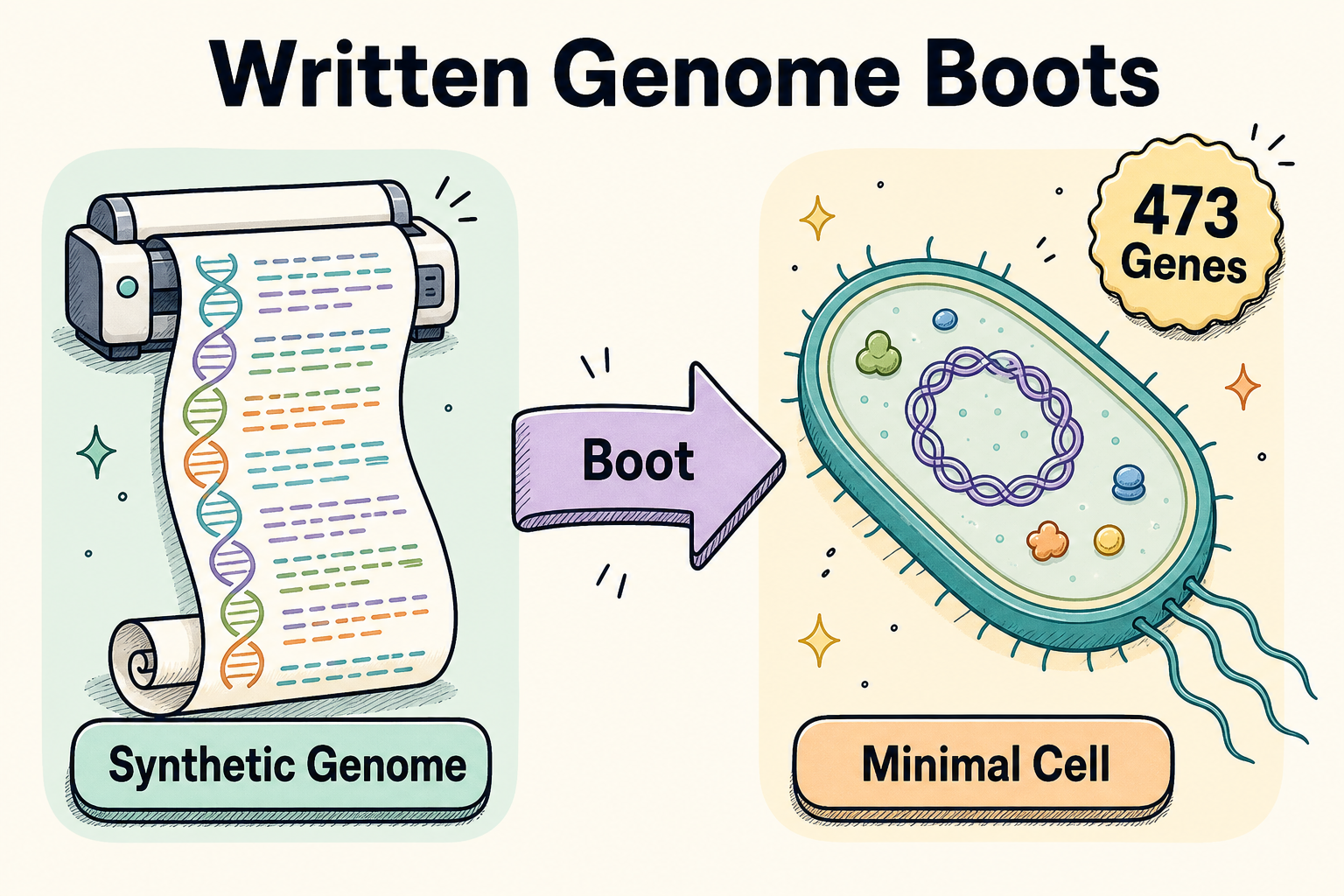
Researchers at the J. Craig Venter Institute and partners constructed a chemically synthesized genome based on Mycoplasma mycoides, assembled it, and transplanted it into a recipient cell of a related species whose own genome was displaced. The resulting cells were controlled by the synthetic genome. The genome was about 1.08 million base pairs and on the order of ~900 genes, including watermark sequences encoding the builders’ names and quotations — a deliberate proof that the DNA was synthetic.
This was not “life from non-life” in the spontaneous-generation sense. It was genome as bootable software installed on biological hardware that already knew how to be a cell.
JCVI-syn3.0 (2016)
Starting from the synthetic mycoplasma platform, the team ran a design–build–test reduction to strip non-essential parts. JCVI-syn3.0 retained roughly 531,000 base pairs and 473 genes — reported as the smallest genome of any self-replicating organism grown in laboratory media at the time. A Science paper (Hutchison et al., 2016) describes the work. Critically, about 149 genes (~30%) had unknown biological function even though knocking them out broke viability. Essential does not mean understood.
Later work on related minimal cells improved growth rates and continued to map mysterious essential genes — a reminder that synthetic biology still discovers biology while trying to engineer it.
The watermarks in syn1.0 — human names encoded in DNA triplets — are a perfect emblem of the era: life’s medium used as both experiment and autograph. The unknown third of syn3.0’s genes is the humbler emblem: we can build a genome we do not fully comprehend.
What the milestone unlocks
❓ Why do minimal and synthetic genomes matter beyond prestige?
- Causal inventory of life: if you can delete and add modules systematically, you learn which parts are load-bearing.
- Chassis engineering: a smaller genome can mean more predictable behavior for industrial microbes (in theory; practice is messy).
- IP and biosecurity dual edge: writeable genomes enable medicine and manufacture — and raise screening obligations for DNA synthesis providers.
- Conceptual proof for the bits↔atoms portal: a genome file can become a colony on a plate.
LAC framing: “Whole-genome writing and cellular bootloading” is a life-altering capability class. Syn1.0/syn3.0 are milestone proofs at prokaryotic difficulty. Eukaryotic whole-genome synthesis (yeast projects, eventual animal cells) is a steeper mountain.
Limits that block the sci-fi leap
❓ What separates today’s synthetic cells from “design any creature in CAD”?
- Unknown essentials: you cannot rationally design what you cannot specify.
- Context dependency: genes make sense inside metabolic and ecological networks, not as isolated Lego.
- Chassis smuggling: genome transplant still relies on pre-existing cellular machinery (ribosomes, membranes, energy systems).
- Eukaryotic complexity: nucleus, organelles, development, and immune systems explode the state space.
- Ethics and governance: pathogen optimization, mirror life debates, and ecological release sit outside pure capability.
Mirror life and extreme risk (brief)
Some researchers warn that life built with opposite molecular chirality (“mirror life”) could evade natural checks. That debate is about future capability and precaution, not a present consumer technology. Include it as a governance horizon, not as a 2026 product category.
Capability grey scale
| Level | Description | Status |
|---|---|---|
| L0 | Edit natural microbes | Routine |
| L1 | Synthesize gene-length DNA to order | Commercial |
| L2 | Assemble megabase genomes | Demonstrated (specialist) |
| L3 | Bootstrap synthetic genome in cell | Demonstrated (mycoplasma class) |
| L4 | Minimal defined genome, fully understood | Incomplete (unknown genes remain) |
| L5 | De novo multicellular organism design | Not achieved |
| L6 | Bottom-up free-living cell from nonliving parts | Research frontier |
Bottom line
Humans have written bacterial genomes and booted them into living cells, then compressed life toward a minimal gene set. That is historic. It is not the same as freely authoring complex animals from a blank file, and it still rests on vast unknown biology. Synthetic life today is best understood as high-end genome engineering plus empirical minimization, not as God-mode creation.