Last updated: 2026-07-23
07. Longevity research — aging as editable biology
Framing without fairy dust
❓ Is aging a disease we can treat with synthetic biology, or a marketing category?

Longevity research studies why bodies decline with time and how to extend healthspan (years in good function) and possibly lifespan. Synthetic biology enters when aging is framed as a set of molecular processes — DNA damage responses, epigenetic drift, senescent cell accumulation, mitochondrial failure, proteostasis collapse — that might be measured, reprogrammed, or cleared with genetic and cellular tools.
This chapter aligns with, and updates, the project’s earlier package at output/longevity-research/ (April 2026): aging is becoming manipulable in narrow, important ways; it is not yet general age reversal or guaranteed longevity escape velocity (LEV) by 2030.
The measurement layer: biological age
❓ If we cannot define aging operationally, how can we treat it?
Epigenetic clocks estimate biological age from DNA methylation patterns at CpG sites. They are among the best current biomarkers linking lifestyle, disease, and interventions to a number that is not mere calendar age. Clocks are imperfect: different clocks disagree; some shifts may be noise or tissue-specific; regulators do not treat “clock went backward” as automatic proof of clinical benefit.
Still, clocks matter because they turn aging into something trial designers can track while waiting for hard endpoints (mortality, disability-free years) that take too long for normal drug development.
Partial epigenetic reprogramming
❓ What is the Yamanaka-factor idea without the hype?
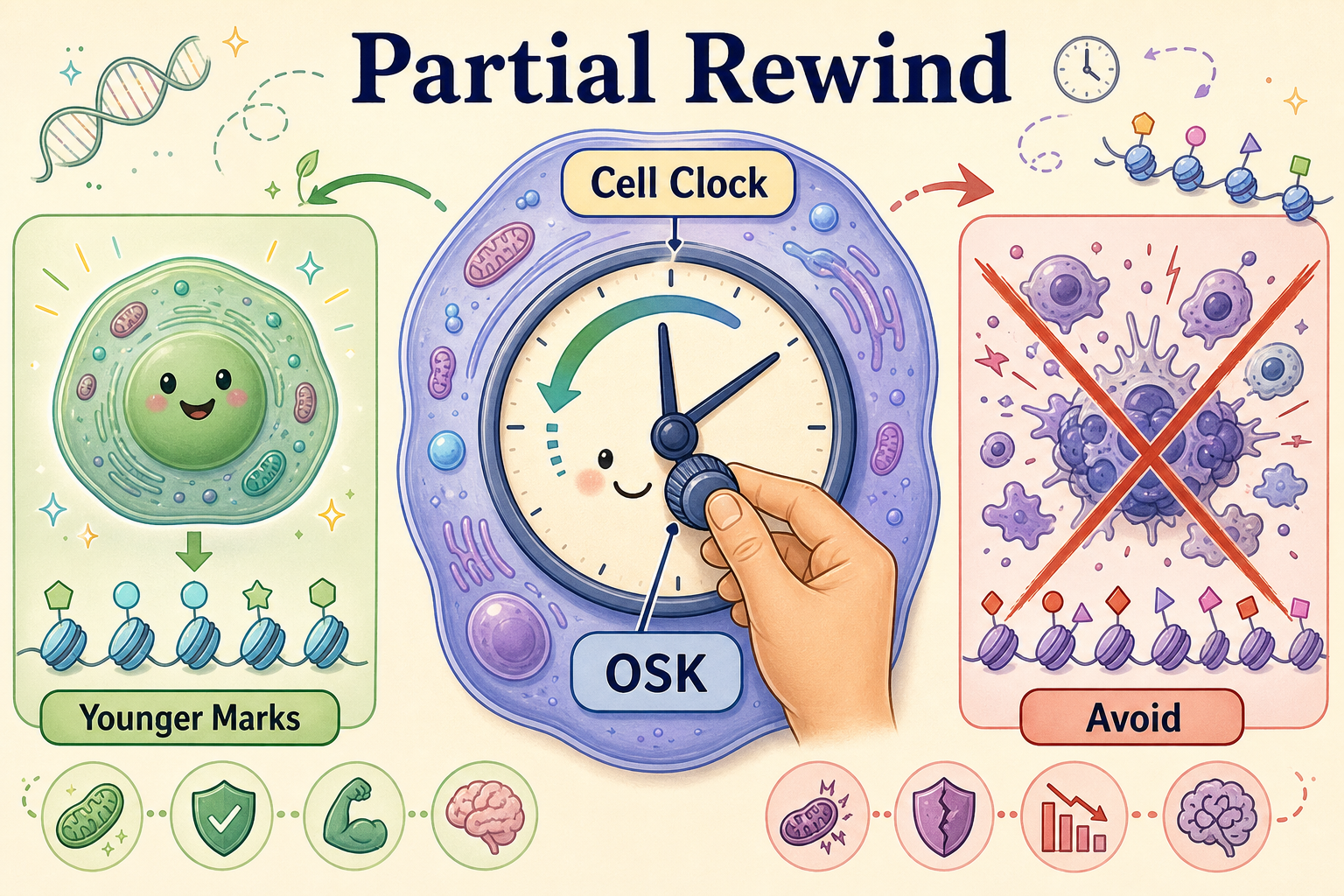
In 2006, Shinya Yamanaka showed that a small set of transcription factors (OSKM: Oct4, Sox2, Klf4, c-Myc) could reprogram adult cells into induced pluripotent stem cells. Full reprogramming resets identity — powerful for regenerative medicine, dangerous if uncontrolled in a body (tumor risk, loss of cell function).
Partial reprogramming aims to express a subset (often OSK, without Myc) temporarily to push the epigenetic state younger while preserving cell type. Animal studies have reported restored vision in injured or aged retinal models and other organ system benefits. The mechanistic bet: much of aging’s dysfunction is a corrupted gene-regulation program; restoring a younger program restores function.
Life Biosciences and ER-100
Life Biosciences has been a visible commercial vehicle for partial epigenetic reprogramming, associated with scientific currents around David Sinclair’s research community and professional management teams. Company communications describe a Partial Epigenetic Reprogramming (PER) platform using OSK.
Milestone: In January 2026, multiple reputable outlets reported FDA clearance for a first-in-human path for ER-100, an epigenetic reprogramming gene-therapy approach aimed initially at optic neuropathies (eye disease) — not at “make a whole person 20 years younger” as a labeled indication. Subsequent 2026 commentary discussed first-patient dosing plans and preclinical breadth (ocular and metabolic/liver directions presented at aging meetings in 2025).
Why the disease-first path matters: regulators know how to evaluate vision endpoints. “Treat aging” remains a harder primary indication. The TAME metformin trial framework and related efforts tried to open aging as a target; commercial teams still usually ride a disease label into the clinic.
The day a partial reprogramming therapy cleared the FDA door for human testing is a genuine threshold — and a Rorschach test. Longevity Twitter heard “age reversal begins.” Trial lawyers and clinicians heard “gene therapy for optic nerve disease with a novel mechanism.” Both readings start from the same press cycle; only one should drive medical expectations.
Other longevity toolkits (map, not encyclopedia)
| Approach | Idea | Maturity sketch |
|---|---|---|
| Senolytics | Clear senescent “zombie” cells | Multiple trials; mixed translation |
| mTOR / metabolic modulators | Rapalogs, metformin, etc. | Human use exists; aging indication contested |
| Gene therapies for specific aging diseases | One pathway, one tissue | Standard advanced-therapy path |
| Cell therapies / plasma factors | Replace or signal younger state | High variance; hype-prone |
| Mitochondrial / NAD+ stack | Energy metabolism | Supplements crowded; pharma bar higher |
| Damage-repair nanomedicine (SENS-like) | Clear junk molecularly | Long-horizon engineering |
Synthetic biology’s distinctive edge is programmable genetic control — editors, inducible promoters, circuit designs — not another pill aisle.
LEV and predictions
❓ What is longevity escape velocity, and is it near?
Longevity escape velocity (LEV) (popularized by Aubrey de Grey and others) is the point where therapies extend life expectancy faster than time passes — a compounding repair regime. It is a coherent concept, not a scheduled product release.
Base case in this report (consistent with prior package): LEV by 2030 is not the responsible central forecast. More likely near-term outcomes: better biomarkers, disease-specific rejuvenation therapies, modest healthspan gains for some populations, and rising inequality of access. High-impact tail scenarios still deserve institutional scenario planning (pensions, insurance) without treating tails as base cases.
Trend classification — partial reprogramming translation:
Metric: preclinical → IND → human safety/efficacy readouts.
Pattern: Stepwise / logistic, not a smooth exponential of human lifespan. Animal successes do not compound automatically into human years.
Mechanism of hype: category error between cellular biomarkers and organismal lifespan.
Bottleneck: delivery, safety (cancer, loss of identity), long endpoint trials, regulatory definitions of benefit.
Cross-links
- Gene editing delivery problems (ch.03) dominate in vivo aging gene therapies.
- Organ replacement (ch.06) is a parallel path: if organs fail, swap them — a brute-force longevity strategy that does not require understanding every hallmark.
- Prior deep dive:
../longevity-research/index.md.
Bottom line
Longevity science is real enough that epigenetic reprogramming has a human clinical on-ramp in the mid-2020s, and synthetic biology supplies the control systems. It is not real enough to promise actuarial immortality on a startup slide deck. Separate disease-modifying rejuvenation, biomarker movement, and lifespan doubling claims every time you read a headline.