Last updated: 2026-07-23
08. Alternative proteins — food from cells and microbes
What “alternative proteins” means
❓ What are we replacing, and with what?

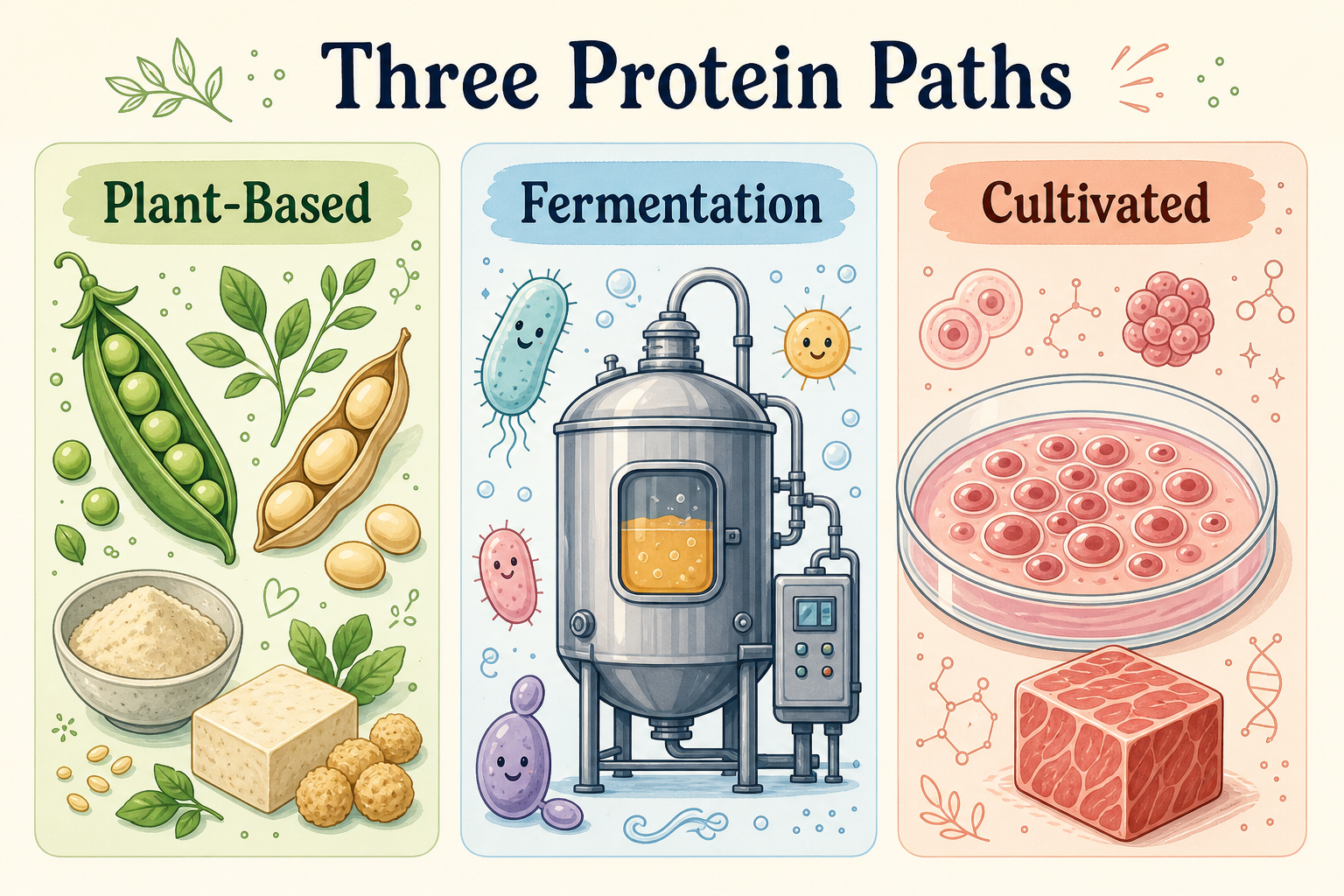
Alternative proteins are foods that supply protein without conventional slaughtered livestock as the primary production system. Three technological families dominate serious discussion:
- Plant-based — fractionate and texturize plant proteins (soy, pea, wheat) into meat-like or dairy-like products. Lowest tech barrier; sensory and ultra-processed critiques apply.
- Precision fermentation — engineer microbes (yeast, fungi, bacteria) to secrete specific proteins (dairy whey/casein analogs, egg proteins, enzymes, heme). The microbe is a factory; the product is a purified protein ingredient.
- Cultivated (cultured) meat — grow animal muscle and fat cells in bioreactors, with scaffolds and media, to harvest meat without raising a whole animal.
Synthetic biology is most central to (2) and (3): strain engineering, growth-factor production, serum-free media design, and metabolic optimization. Alternative Proteins is also an explicit node in the OOM EmTech taxonomy.
Why the category exists
❓ What problem is this actually trying to solve?
- Climate and land: livestock uses large land and contributes meaningfully to greenhouse gases; exact percentages vary by methodology, but the direction of pressure is real.
- Animal welfare.
- Food security and supply chain shocks.
- Pandemic and antibiotic concerns in intensive animal farming.
- Product design: proteins as programmable ingredients for nutrition and texture.
None of these automatically make a startup profitable. Technology must clear taste, price, trust, and regulation simultaneously.
Precision fermentation: the quiet workhorse
❓ Why might microbes beat bioreactor steaks to mass markets?
Precision fermentation extends decades of industrial biotech (insulin, rennet, enzymes). The playbook:
- Insert or edit genes so a host microbe produces a target protein.
- Ferment at scale in stainless steel.
- Purify and sell as an ingredient to food companies.
Advantages: known factory paradigms; potentially clean labels for specific pure proteins; no need to assemble whole muscle tissue.
Hard parts: cost at food (not pharma) margins; downstream purification; generally recognized as safe / novel food approvals by jurisdiction; displacing cheap commodity dairy/egg proteins.
Success looks like ingredients inside familiar products, not necessarily a sci-fi brand on the shelf.
Cultivated meat: hardest physics and economics
❓ Why is growing a chicken nugget in a tank so hard?
Animal cells expect a body: oxygen gradients, mechanical cues, immune cleanup, and a blood supply. Recreating that in a tank requires:
- Cell lines that proliferate reliably and safely.
- Media without expensive fetal bovine serum — growth factors are a major cost center (and a synbio opportunity: make factors in microbes).
- Bioreactors and scaffolds for structure.
- Sterility at food scale.
- Regulatory approval as food.
A few jurisdictions have allowed limited commercial sale of cultivated products; global scale remains constrained. Many ventures spent the early 2020s in pilot hell: impressive demos, stubborn unit economics.
Trend classification — cultivated meat cost:
Historically steep hoped-for decline, empirically slower and bumpier than 2015–2020 pitch decks. Classify near-term progress as stepwise / logistic, gated by media cost and scale-up engineering, not as a clean exponential like DNA sequencing.
Market reality and contrarian scan
❓ What do skeptics get right?
- Plant-based meat saw a hype cycle and pullback in some markets when repeat purchase lagged.
- Cultivated meat faces energy and capex intensity; if electricity is dirty or expensive, climate claims weaken.
- Cultural and political resistance to “lab food” can dominate technical readiness.
- Land-sparing rebound is not automatic; economics and policy decide outcomes.
- Some environmental gains are real on paper but small if the product remains a premium niche.
Steelman: even partial substitution in specific categories (chicken bits, luxury meat, functional proteins) can matter at planetary scale if costs fall — and microbial protein may matter sooner than whole-cut steaks.
Synbio capabilities that move the needle
| Capability | Food impact |
|---|---|
| Cheap growth factor production | Cultivated media cost |
| AI-guided enzyme/protein design | Texture, flavor, stability |
| Strain engineering | Yield, titer, robustness |
| Continuous fermentation | Capex/opex |
| Fat cell / marbling co-culture | Sensory parity |
| Gene-edited crops for plant-based inputs | Better base proteins |
Bottom line
Alternative proteins are a portfolio, not a single miracle. Precision fermentation sits closest to industrial biotech’s comfort zone. Cultivated meat is a genuine synthetic-biology moonshot with unresolved factory economics. Plant-based remains the volume leader while the cell-based stack matures. Judge companies by cost curves and regulatory clearances, not by renderings of perfect steaks.