Last updated: 2026-07-23
09. Vertical farming — controlled environment agriculture under an energy microscope
What vertical farming is
❓ How is a vertical farm different from a greenhouse or a field?

Vertical farming grows crops in stacked layers, usually indoors, using hydroponics, aeroponics, or similar soilless systems, with electric lighting and tight climate control. It is a subset of controlled environment agriculture (CEA), which also includes high-tech greenhouses that still lean on sunlight.
The pitch: year-round local production, tiny land footprint, huge water savings (often cited around 90–98% less water than field production for leafy greens), minimal pesticides, and proximity to cities.
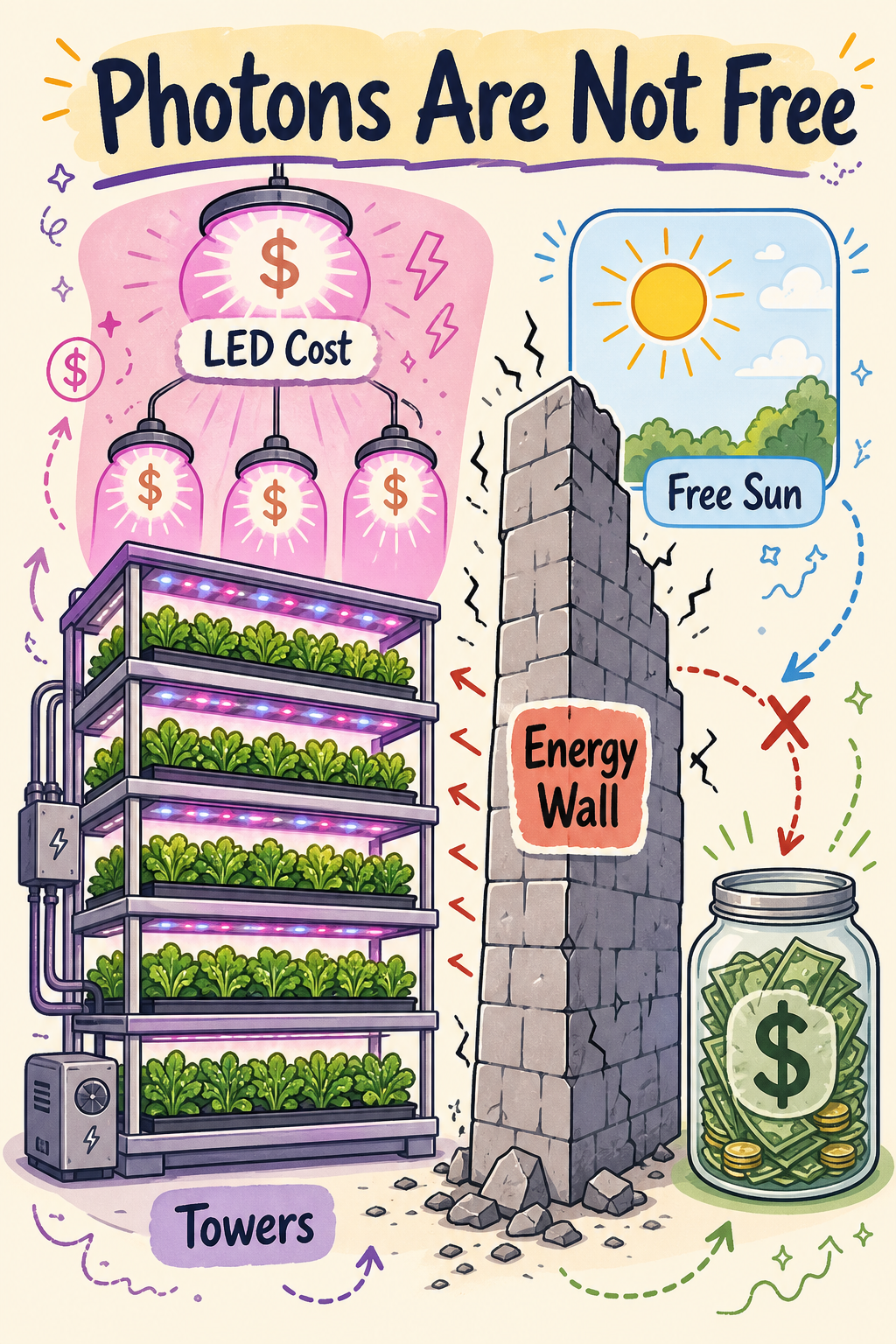
The trap: plants need photons. Outdoors, the sun is free. Indoors, you buy photons from the grid.
Unit economics: lighting is destiny
❓ Why do so many vertical farms fail financially?
Industry analyses and operator censuses repeatedly show energy — especially LED lighting, plus cooling/HVAC — dominating operating cost. Illustrative breakdowns from CEA census commentary put lighting on the order of ~50–65% of energy use, with cooling/ventilation another large share. When electricity is expensive, leafy greens grown under LEDs struggle to beat field-grown or greenhouse produce on price.
Capital expenditure is also high: racks, automation, sensors, clean facilities. Many early-2020s ventures scaled floor area before they scaled profit per kilogram.
The 2023–2025 reckoning and 2026 outlook
Reporting across the CEA sector described a brutal mid-decade correction: bankruptcies, down rounds, and a pivot from “growth at all costs” to unit economics first. One 2025 year-in-review style account tallied numerous closures and sharply lower funding while noting that demand for local leafy greens did not disappear — investor patience did.
By late 2025 / 2026, survivor narratives emphasize:
- automation to cut labor,
- smarter lighting recipes and dynamic dimming,
- renewable PPAs and heat integration,
- modular scale matched to offtake contracts,
- crop focus on high-value, fast-cycle greens and herbs rather than staple calories.
UK-specific warnings about 2026 electricity standing charge increases for high-capacity users illustrate a structural point: policy and grid tariffs can swing viability as much as LED efficiency can.
Trend classification — vertical farming viability:
Not a clean exponential success story. Better described as cyclical / hype-led then selection-driven logistic: a shakeout pruning weak models while LED efficiency and automation improve on longer curves.
Metric that matters: fully loaded cost per kg vs local wholesale price, at a stated crop and electricity price.
Mechanism of hope: LED µmol/J gains, cheaper robotics, AI climate control, co-location with cheap firm clean power.
Bottleneck: physics of replacing the sun; crop envelope; consumer willingness to pay.
What grows well (and what does not)
❓ Can vertical farms feed the world staple calories?
Today’s honest envelope: lettuce, leafy greens, herbs, some microgreens, limited berries/trials. These crops have short cycles, high water content, and retail prices that can absorb tech premiums.
Not economically viable at scale today: wheat, rice, maize, and other staple calories. The energy per calorie is the wrong shape. Anyone claiming vertical farms will “feed 10 billion people” without a radical energy breakthrough is conflating niche fresh produce with civilizational calorie supply.
Large showpiece farms (for example Dubai’s Bustanica-scale leafy production, opened earlier in the 2020s) demonstrate water and logistics advantages in desert climates — valuable regional tools, not universal calorie engines.
Convergence with other EmTechs
❓ Where does vertical farming sit in the OOM stack?
- Energy / solar / batteries: decide opex.
- Robots: transplanting, harvesting, cleaning.
- IoT / AI: closed-loop climate and yield optimization.
- Synthetic biology / breeding: cultivars optimized for indoor spectra, compact architecture, disease resistance in monoculture towers.
- Networks / logistics: the “local” premium is a last-mile story.
This is weak-to-moderate convergence today: each piece helps, but energy physics still gates the category.
Policy and food-system role
❓ When is a vertical farm the right tool?
Good fit: import-dependent city-states; deserts; military/remote bases; ultra-fresh premium retail; pharmaceutical/botanical crops; resilience buffers.
Poor fit: competing on commodity lettuce price in a sunny agricultural valley with cheap land and water.
Synbio’s food security story is stronger when vertical farming + alternative proteins + gene-edited climate-resilient field crops are treated as a portfolio, not when towers alone are asked to replace the Midwest.
Bottom line
Vertical farming is real engineering and real food for specific niches. It is also a graveyard of business models that ignored dollars per photon. The post-shakeout industry can still grow — especially beside cheap clean electricity — but it should be analyzed with the coldness of an energy balance sheet, not the warmth of a tech demo kitchen.