Last updated: 2026-09-25
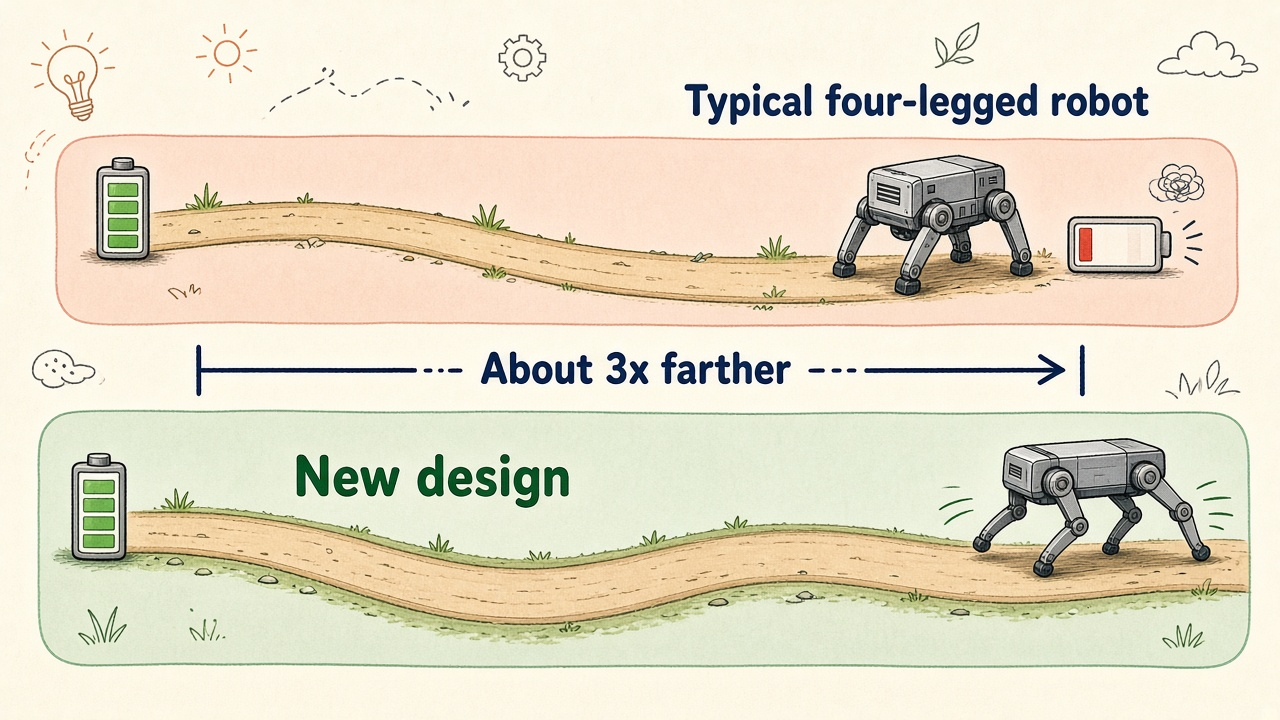
About three times farther
Against other four-legged robots
The researchers compared about a dozen four-legged robots by how far each can go for the size of its battery. This one goes more than three times farther than the trend line for the others. Many of the other robots' numbers are estimates from their makers' spec sheets, not side-by-side tests, so treat the comparison as a strong sign rather than a race result.
Against people
By the energy-per-kilogram-per-metre yardstick from chapter 02, the robot (0.25) did better than a typical walking person (about 0.37). Be careful with that headline. The robot's number counts electricity from a battery, and the person's counts food energy burned by the body. Those are different kinds of energy. Its finish time was a respectable jog, a little ahead of an average human marathon runner, not an elite one.
Against wheels
On smooth ground, wheels still win by a lot. A wheeled delivery robot or an electric car uses a small fraction of the energy per kilogram per metre. Legs are worth their extra cost only where wheels cannot go: steps, steep slopes, rough paths.
Against slow special walkers
A few very slow walking machines, built to swing their legs like pendulums on flat tracks, have gone even farther on one charge. This robot does it about four times faster, on hills, while still able to handle steps and slopes.
The gap between legs and wheels has narrowed enough that legs can now go the distance for long jobs.