Last updated: 2026-09-25
A whole marathon on one charge
In November 2024 a four-legged research robot lined up at an official road marathon in South Korea as a registered entrant. It crossed the finish line 42.195 km later, in 4 hours 19 minutes 52 seconds. It never stopped to recharge, and nobody swapped its battery.
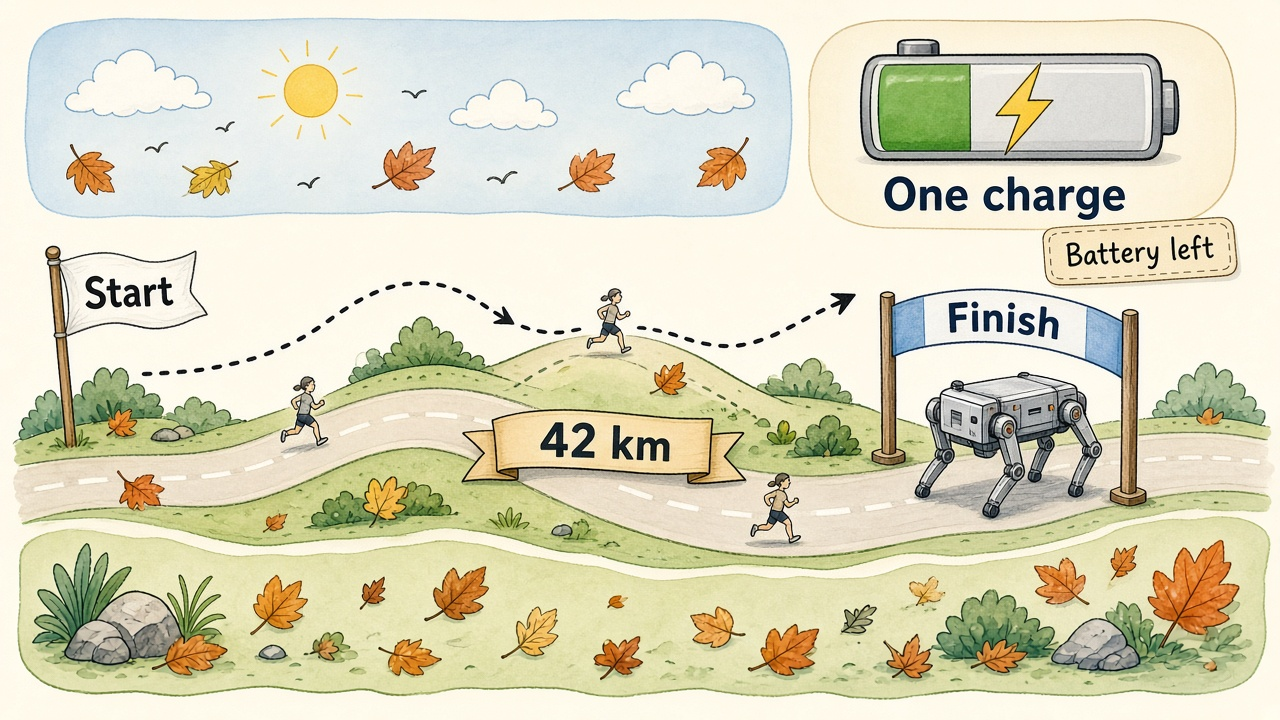
Real road, real hills
This was not a flat indoor track. The course ran out and back on public roads, next to human runners, with about 286 m of climbing and patches of slippery fallen leaves. Steep hills are where walking robots burn their batteries fastest.
A person was steering
The robot kept its own balance and chose its own footsteps. But a person steered it by remote control the whole way, and a team ran alongside. It was not finding its own way. Chapter 06 comes back to this.
Why it is news
Before this, four-legged robots managed somewhere between a few kilometres and about 20 km on a charge. This one went more than twice that, and its builders estimate it could reach about 65 km on a full charge. The detailed study was published by the research team in a peer-reviewed science journal in September 2026.
It took two tries
At a first race, two months earlier, the battery ran out at about 37 km. The robot had kept speeding up and slowing down to match the runners around it. The team reworked the robot and came back.
The one idea: a four-legged robot can now go a whole marathon on one charge because it wastes much less energy with every step. The next chapters show where that waste was hiding.