Last updated: 2026-09-25
Three fixes that work together
The team did not find one magic part. They went after every leak at once.
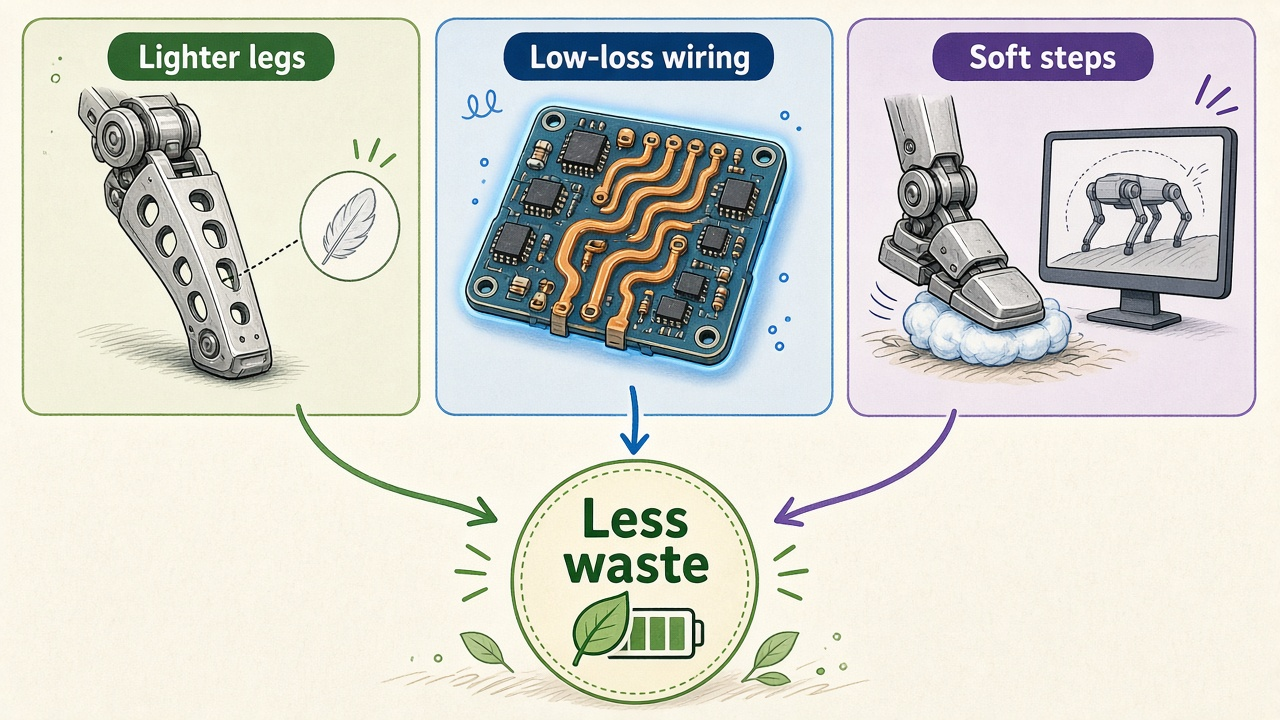
1. The body: lighter legs, stronger motors
A leg swings forward and stops thousands of times every kilometre. Every gram in it has to be sped up and slowed down again. The builders cut material from the legs wherever it was not needed, so each leg weighs about 1.1 kg without its motor. They also chose motors that give more push for the same current, so less of the battery turns into motor heat.
2. The wires: low-loss motor electronics
Every motor has a small circuit board that feeds it exactly the current it needs, thousands of times a second. Every switch and copper track on that board wastes a little energy. The team designed their own boards with thicker copper and carefully chosen parts, and measured each loss on a test bench.
3. The stride: a walking style learned in simulation
The software that turns "go forward" into leg movements was not written by hand. The robot practised millions of steps inside a computer simulation and learned by trial and error, getting points for good steps and penalties for bad ones. The penalties included:
- putting a foot down hard,
- letting a foot slip,
- asking the motors for more force than needed.
In a treadmill test, a version trained without the "put your feet down softly" rule wasted about 40% more energy.
Why they multiply
The fixes help each other. Lighter legs need less force, and less force means much less motor heat. Soft footsteps only work if the motors can react fast, which depends on the electronics. That is why the whole robot had to be designed together.