Last updated: 2026-07-29
Structured innovation methods: TRIZ, SIT, and SCAMPER
Executive abstract
Three widely taught “structured innovation” families solve the same human bottleneck — cognitive fixedness and fluent clichés — with different search policies. TRIZ (Theory of Inventive Problem Solving), begun by Genrich Altshuller in the Soviet Union from 1946, mines patent history for recurring inventive patterns and centers contradiction resolution (improve A without harming B) using tools such as the 40 Inventive Principles, contradiction matrices, Ideal Final Result, and ARIZ. Systematic Inventive Thinking (SIT), developed in Israel in the mid-1990s as a learnable descendant of TRIZ, keeps the pattern idea but replaces the heavy engineering stack with five templates — Subtraction, Division, Multiplication, Task Unification, Attribute Dependency — under a strict Closed World rule (“innovate inside the box” with nearby resources) and a Function Follows Form generation sequence. SCAMPER sits on a separate lineage: Alex Osborn’s idea-spurring checklists compressed by Bob Eberle (1971) into Substitute, Combine, Adapt, Modify, Put to another use, Eliminate, Reverse — a fast, open-world workshop mnemonic.
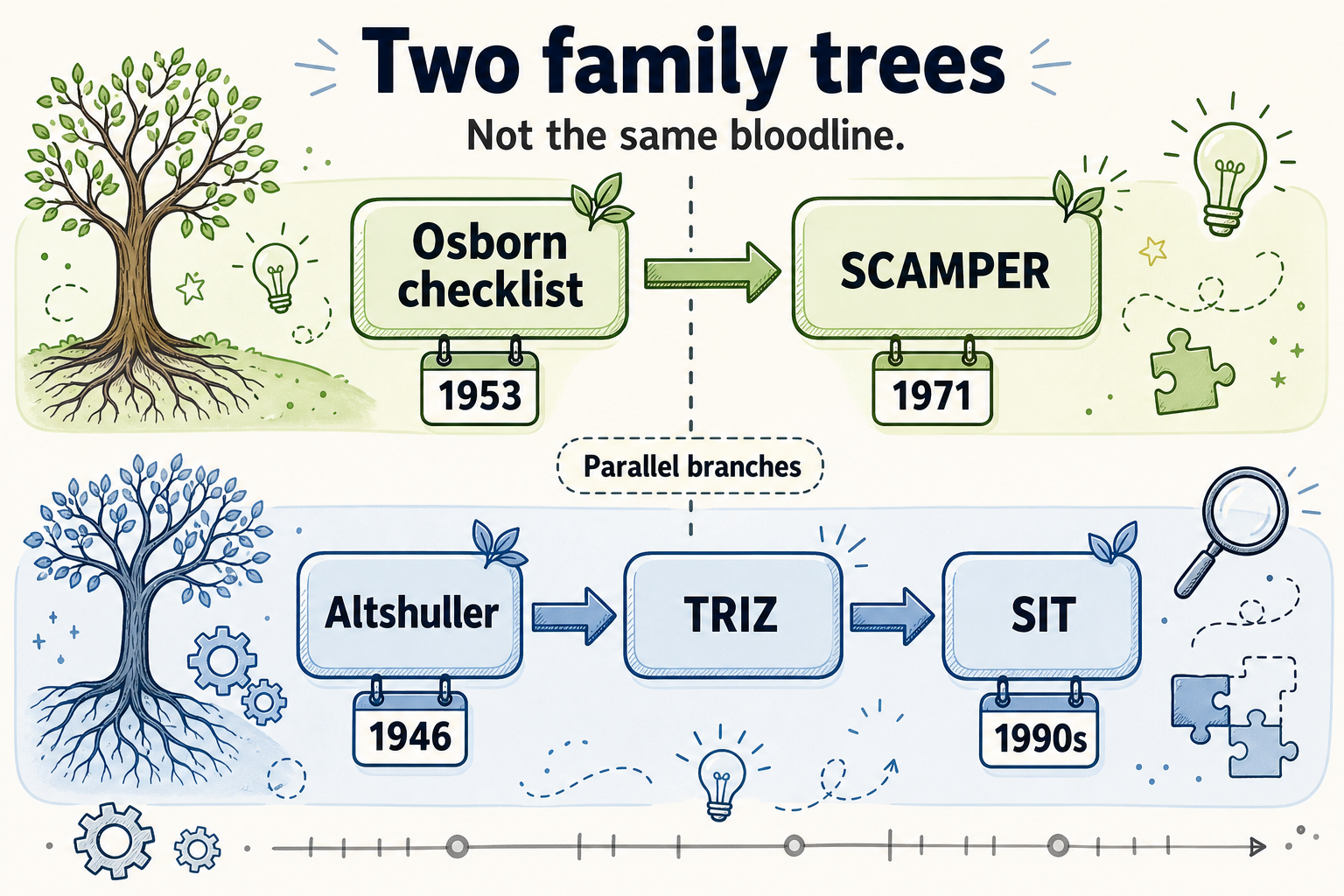
They are not interchangeable brands. SCAMPER maximizes inclusive breadth; SIT maximizes non-obvious reconfiguration of existing systems; TRIZ maximizes leverage on stubborn multi-parameter conflicts. Evidence quality is strongest for clear tool structure and teaching practice, medium for comparative efficacy, and mixed for vendor ROI stories. With generative AI, checklist and template methods become cheap to run at volume — which raises the value of human framing, Closed World audits, and empirical filters, not the value of raw idea count.
Core mechanism: replace hope-based ideation with a constrained search policy (prompts, templates, or contradiction operators) so search escapes high-fluency clichés without pretending creativity is random.
Table of contents
- TRIZ: Theory of Inventive Problem Solving
- SIT: Systematic Inventive Thinking
- SCAMPER
- Comparison and when to use which
- Mechanisms, limits, AI, and contrarian scan
- Question ledger
- References
- Illustrations index — 8 visuals (methods + tech-tree + fixedness + AI hybrid)
Short answers
| Question | Short answer |
|---|---|
| Is SIT “just TRIZ lite”? | Descendant, yes; identical, no — Closed World + five templates + broader non-engineering use. |
| Is SCAMPER from TRIZ? | No — Osborn/Eberle brainstorming lineage. |
| Which to teach first? | SCAMPER literacy → SIT as default product kit → TRIZ for hard contradictions. |
| Do they replace Design Thinking? | No — they strengthen the ideate engine inside broader discovery/build/test loops. |
| Does AI obsolete them? | No — AI accelerates operator execution; humans still own frames, constraints, and tests. |