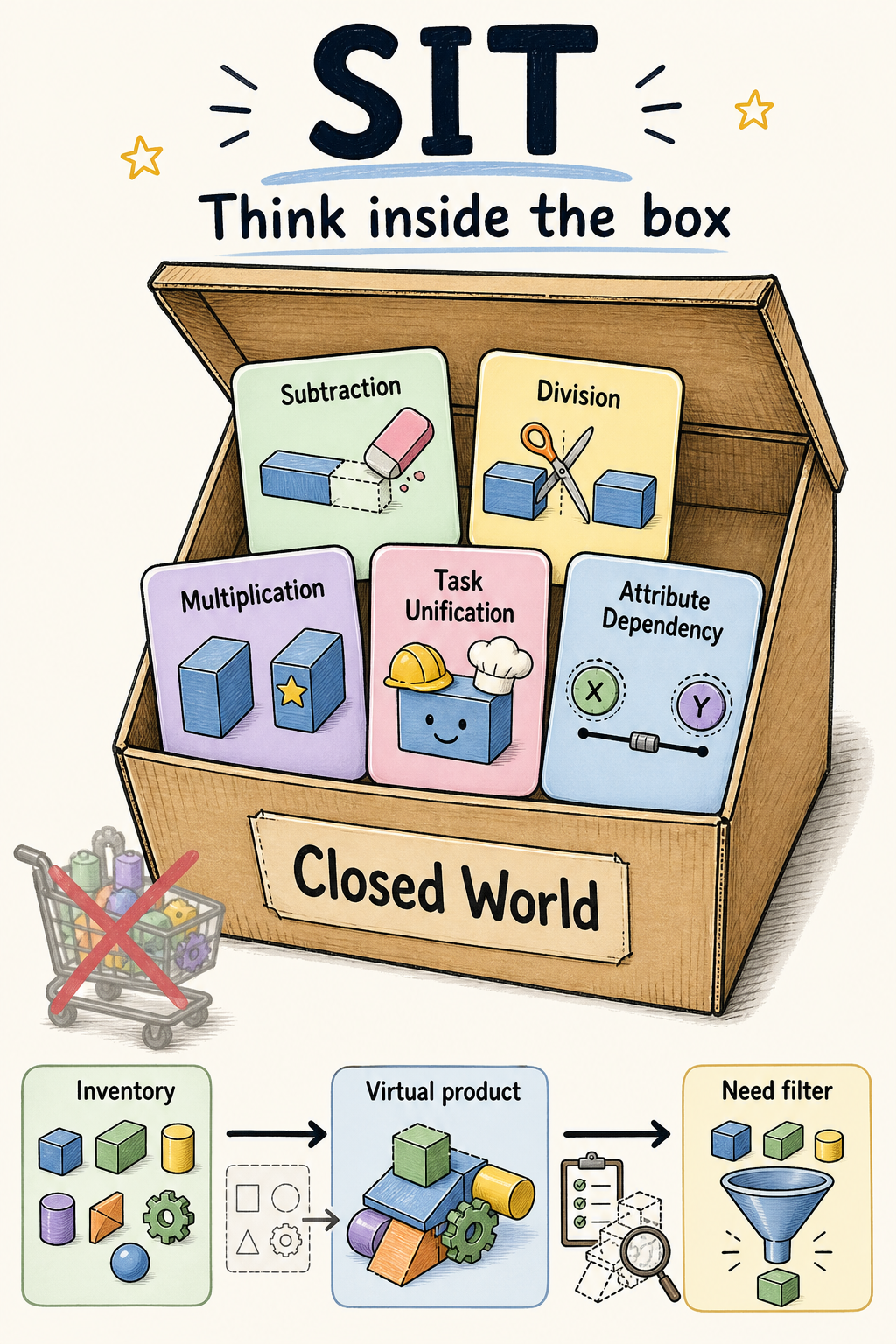
❓ What is SIT, and how does “thinking inside the box” actually generate non-obvious ideas?
SIT Closed World
Systematic Inventive Thinking (SIT) — also referred to in some materials as Systemic Inventive Thinking — is a structured creativity and innovation method developed in Israel in the mid-1990s. It descends from TRIZ but was deliberately redesigned to be easier to learn, less engineering-bound, and stricter about using only resources already in the problem world.
Key people associated with the formation path include TRIZ teacher Ginadi Filkovsky (who brought TRIZ knowledge into the Israeli setting) and researchers Jacob Goldenberg and Roni Horowitz, with additional founders and practitioners often named in secondary sources (including Amnon Levav, David Mazursky, and others linked to the commercial SIT practice and firm). The method’s public teaching face in English is strongly shaped by Drew Boyd and Goldenberg’s book Inside the Box (2013) and by earlier research such as the Harvard Business Review article “Finding Your Innovation Sweet Spot” (Goldenberg, Horowitz, Levav, Mazursky, 2003).
From TRIZ to SIT
❓ Why simplify a powerful Soviet engineering system into five tools?
Shared inheritance with TRIZ:
Inventive solutions share patterns.
Those patterns can become thinking tools.
Tools can be applied to generate new configurations, not only to wait for inspiration.
SIT’s redesign goals (as summarized in standard histories):
Fewer rules and tools → higher retention after training.
Less engineering specificity → usable in marketing, service, and general product work.
Stronger Closed World discipline → keep solvers inside real inventive constraints rather than importing unlimited external resources.
Where TRIZ often centers contradiction resolution with a large toolkit, SIT centers template-driven manipulation of an existing product/system under Closed World rules, then validates whether the new form serves a need.
TRIZ (Altshuller) → Israeli teaching/adaptation (Filkovsky et al.) → SIT five tools + Closed World (Goldenberg, Horowitz, collaborators) → commercial workshops / Inside the Box popularization.
The five thinking tools
❓ What exact mental operations does SIT run on a product or service?
SIT’s standard five patterns:
1. Subtraction
Remove a component that seems essential, then explore the remaining configuration (a virtual product) for new use or value. Example pattern class: products that became better by losing a “must-have” part (think of categories where a core piece was eliminated and the rest revalued).
2. Multiplication
Add one or more copies of an existing component, then change the copy along a parameter (“more” + “different”). Not mere duplication — the copy must be altered so the system gains a new behavior.
3. Division
Split a product or component in space, time, or scale, then rearrange the parts. Increases degrees of freedom: what was glued into one object can be redistributed across the use situation.
4. Task unification
Assign an additional job to an existing component or resource already in the Closed World. Affluent design cultures often add new parts; task unification forces multitasking of what is already paid for.
5. Attribute dependency
Create or break a dependency between variables (color, size, price, location, user type, time of day…). “As X changes, Y changes” becomes a designed relationship rather than an accident.
These are operators on structure and variables, not free-association prompts alone.
Closed World and related principles
❓ What does “inside the box” mean as a technical rule, not a slogan?
Closed World (Roni Horowitz)
When solving or inventing, prefer elements that already exist in the product/problem or its immediate environment. Do not freely import unbudgeted external magic. The claim is counterintuitive: novelty often comes from re-seeing nearby resources, not from distant analogies first.
Why it can work: unlimited search spaces invite cliché external borrowings (“add AI,” “add an app,” “add gamification”) that feel creative but are generic. Closed World collides with functional fixedness by forcing reassignment of roles among known parts.
Function Follows Form (FFF)
Drawing on cognitive work associated with Ronald Finke, SIT often manipulates form first (apply a tool → obtain a virtual product), then searches for function/market need. This reverses the common “start from customer need, then design form” order for the ideation phase — needs still matter, but they enter as a filter after structured transformation.
Path of Most Resistance
Prefer moves that feel slightly wrong or non-obvious to everyday thought. The method intentionally steers away from the mind’s default “most fluent” completions.
Qualitative change
Seek solutions that eliminate or reverse the problematic factor’s role, not merely dampen it.
Cognitive fixedness
SIT is explicitly a countermeasure to fixedness types such as functional fixedness (Duncker’s candle-problem lineage): the tendency to lock an object to one familiar function.
Why this is a good explanation (SIT core)
Definition: SIT is template-based inventive ideation under Closed World resource limits.
Explanation: Successful products often share a small number of structural transformation patterns. Training people to apply those patterns to a mapped inventory of components and attributes produces non-default configurations; Closed World keeps configurations implementable with nearby resources; FFF separates generation from premature market censorship.
Different from TRIZ: fewer tools, less contradiction-matrix machinery, Closed World as primary principle, broader non-engineering framing. Different from SCAMPER: tighter operator set, stronger Closed World and FFF process, more “virtual product then validate” than open checklist.
Hard-to-vary test: Remove Closed World and SIT collapses toward generic prompting; remove templates and it collapses toward constrained brainstorming without pattern leverage.
Refutability: Would fail if Closed World systematically blocked category-creating innovation more than it helped, in controlled comparisons — still under-tested at scale.
Reach: Applies to physical products, digital features, services, and processes whenever components and attributes can be listed.
Criticism note: Risk of incrementalism if the starting system is the wrong unit; commercial materials can sound promotional; Wikipedia’s SIT page itself carries promotional-tone warnings — prefer Boyd/Goldenberg process descriptions and academic template research over brochure language.
Worked micro-example (illustrative)
Take a standard hotel room key card:
Tool
Virtual move
Possible value hypothesis
Subtraction
Remove physical card
Phone credential / facial / room recognizes guest
Multiplication
Two cards with different rights
Guest + cleaner tiered access
Division
Split “unlock” from “identity” in time
Pre-auth offline code + later identity bind
Task unification
Door lock also meters energy
Access event sets climate profile
Attribute dependency
Floor / loyalty tier changes door UI or perks
Status-dependent experience
Each row is a form change first; market and security filters come next.
Organizational use
SIT is taught as a skill for innovation workshops, new product development, and marketing ideation, and is offered commercially by firms and trainers associated with the method (including sitsite.com materials). It pairs naturally with later validation stacks (experiments, business-model tests) because it is strongest at structured front-end novelty, not at replacing customer evidence.