❓ What is SCAMPER, and why does a seven-letter checklist still dominate classrooms and workshops?
SCAMPER seven prompts
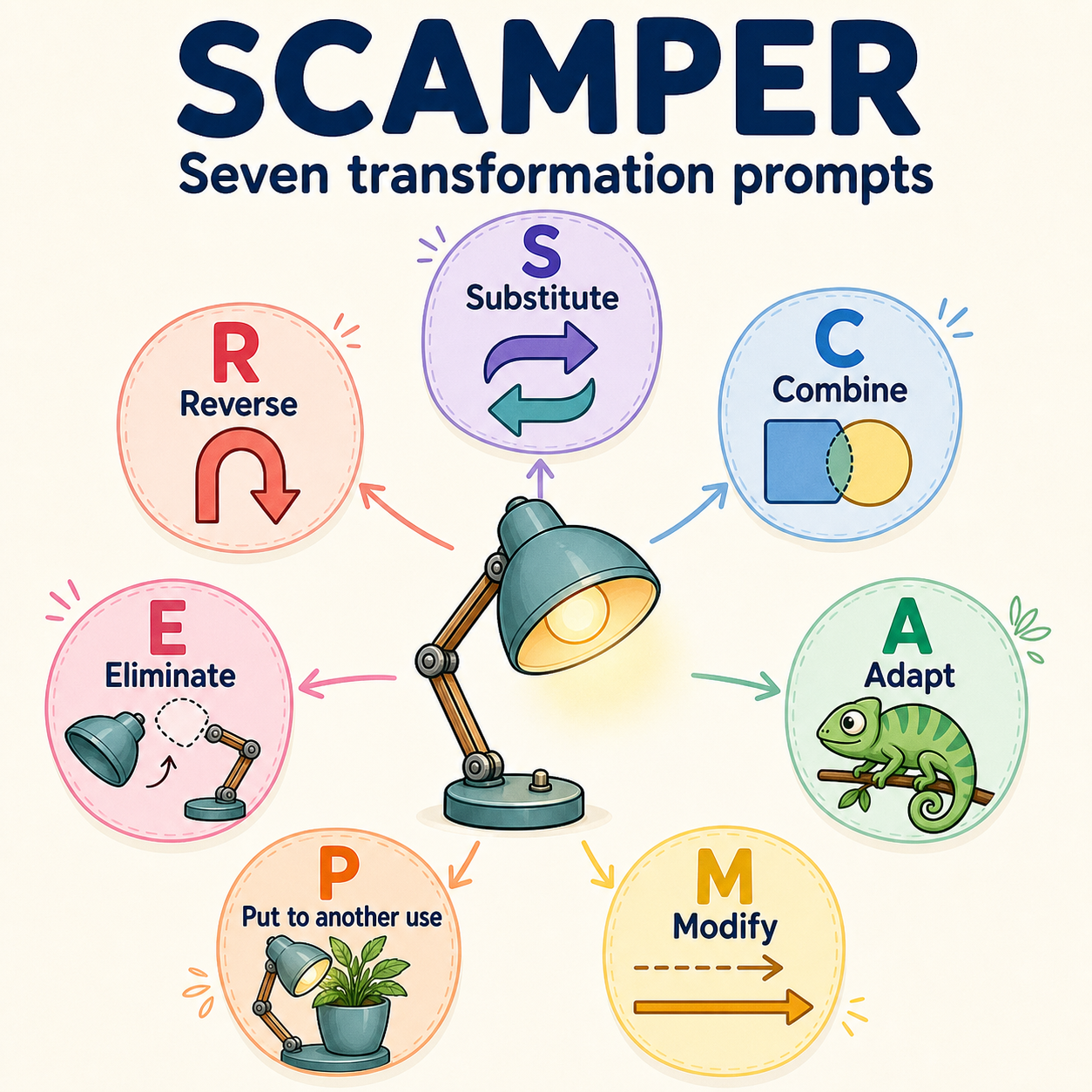
SCAMPER is a structured brainstorming checklist that prompts people to transform an existing idea, product, service, or process through seven operators. It is one of the most widely taught creativity techniques in education and business facilitation because it is memorable, fast to run, and low-training.
Lineage
❓ Where did SCAMPER come from if not from TRIZ?
SCAMPER is not a TRIZ descendant. It sits on a parallel Anglo-American creativity lineage:
Alex F. Osborn — advertising executive and popularizer of brainstorming — published extensive idea-spurring questions in Applied Imagination (1953 era checklist tradition).
Bob Eberle — educator — compressed that checklist culture into the SCAMPER mnemonic in SCAMPER: Games for Imagination Development (1971; later editions/reprints keep the method in circulation).
So: Osborn → Eberle mnemonic, not Altshuller → SIT.
This matters historically and practically. SCAMPER inherits brainstorming’s divergent, question-led spirit. TRIZ/SIT inherit patent-pattern and system-manipulation spirit. They can be combined, but they are not the same family tree.
The seven operators
❓ What does each letter force you to examine?
Letter
Operator
Guiding questions (typical)
S
Substitute
What materials, people, processes, or rules can be replaced?
C
Combine
What happens if we merge with another product, audience, or feature?
A
Adapt
What else is like this? What can we copy from another context?
M
Modify (also Magnify / Minify)
What can we emphasize, scale up/down, or change in attribute?
P
Put to another use
Who else could use this? What other job could it do?
E
Eliminate
What can we remove, simplify, or under-provide on purpose?
R
Reverse / Rearrange
What if we invert sequence, roles, or hierarchy?
Facilitators sometimes expand M into modify/magnify/minify and R into reverse/rearrange; the mnemonic stays stable even when sub-prompts multiply.
How a SCAMPER session actually runs
❓ What is the minimal process that makes SCAMPER more than shouting ideas?
Anchor — pick a specific starting object (product, journey step, policy, lesson plan).
Inventory — name components, users, and constraints lightly (optional but improves quality).
Walk the letters — force at least one serious attempt per operator; ban skipping “Eliminate” and “Reverse,” which people avoid.
Capture raw moves — quantity allowed here; SCAMPER is primarily generative.
Filter — feasibility, desirability, strategy fit (this step is not inside the acronym; teams that skip it drown in sticky notes).
Prototype or test the shortlist.
SCAMPER does not require Closed World. External substitutions and adaptations are welcome. That is a feature for exploration and a bug when resource discipline matters.
Worked micro-example: public library card
Operator
Idea seed
Substitute
Replace plastic card with phone wallet pass
Combine
Card + city mobility pass + museum access
Adapt
Borrow “holds queue” UX from streaming watchlists
Modify
Magnify teen design; minify bureaucracy for seniors
Put to another use
Card as local-business discount credential
Eliminate
Remove late fees (already a real library movement)
Reverse
Library delivers holds to you by default; you “return” by pickup point
Strengths
❓ When is SCAMPER the right instrument?
Onboarding non-specialists in minutes.
Workshop energy and inclusive participation.
Education settings (its original popularization context).
Marketing, content, service tweaks, and early divergent coverage of a design space.
Pairing with Design Thinking as an ideation-phase tool inside empathize/define/ideate/prototype/test loops.
Weaknesses
❓ Where does SCAMPER systematically under-deliver?
Superficiality: letters can produce obvious swaps without structural insight.
No contradiction model: multi-parameter engineering conflicts are underspecified.
Open-world drift: “Adapt/Combine” invite trendy external add-ons that ignore constraints.
False completeness: finishing seven letters feels like coverage even when the problem was misframed.
Evidence: teaching and practice literature is large; rigorous head-to-head proof of superior commercial outcomes versus other structured methods is thinner than the method’s popularity.
Relation to SIT and TRIZ (preview)
Overlaps exist at the operator level — Eliminate ≈ Subtraction, pieces of Modify/Combine touch Multiplication/Division/Task ideas — but SCAMPER lacks SIT’s Closed World + FFF discipline and TRIZ’s contradiction/IFR machinery. Think of SCAMPER as a wide shallow net, SIT as a narrow deeper template kit, TRIZ as a heavy professional system for conflict-heavy technical work.
Why this is a good explanation (SCAMPER core)
Definition: SCAMPER is a mnemonic checklist of seven transformational prompts applied to an existing anchor idea.
Mechanism: Human ideation is biased toward fluent, familiar completions. Externally paced prompts interrupt fluency and force attention onto under-sampled transformation axes (especially eliminate/reverse).
Hard-to-vary: If you drop the forced multi-axis walk and keep only free brainstorming, you lose the coverage mechanism that justifies the brand. If you add Closed World and contradiction tools, you are no longer “just SCAMPER.”
Refutability: Would be weakened if timed free brainstorming with equally good facilitation matched SCAMPER on diversity and novelty metrics consistently — some studies of structured vs unstructured ideation cut both ways depending on task and scoring.
Criticism note: Popularity is not proof. SCAMPER’s biggest risk is becoming a ritual of creativity theater.