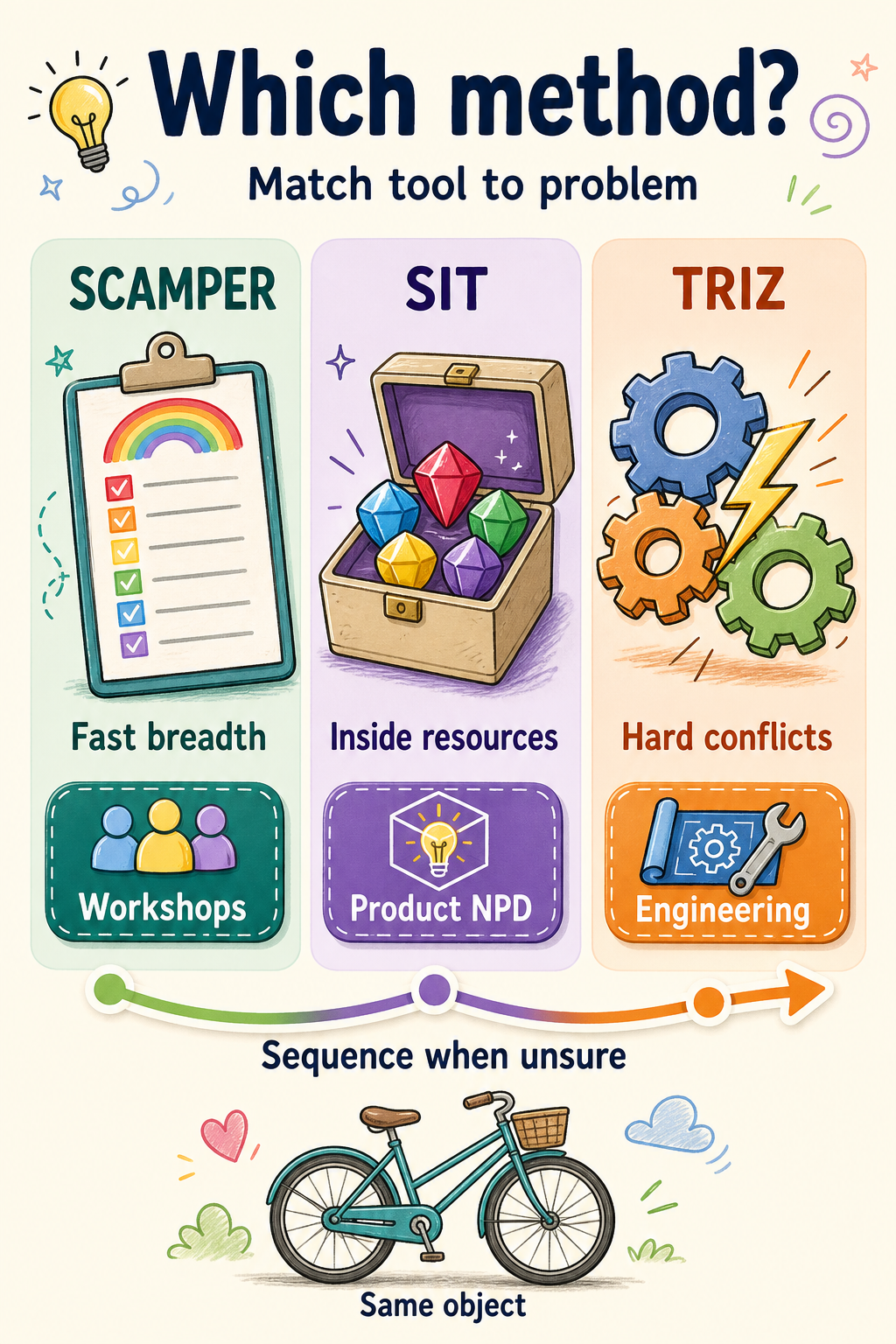
Non-obvious product/service concepts from nearby resources
Stubborn engineering / system conflicts
Failure mode
Shallow novelty theater
Incrementalism / wrong system boundary
Cargo-cult matrix lookup; tool overload
Facilitation need
Low–medium
Medium
Medium–high (expert helpful)
Decision rule (practical)
❓ Is there a simple chooser that is still honest?
Use this ordered test:
Is the pain a sharp technical contradiction (improving A clearly breaks B) in a complex engineered or socio-technical system?
→ Start TRIZ (or hire TRIZ-literate help). Light version: IFR + contradiction + a short principles pass before full ARIZ.
Do you already have a product/service system and need inventive variants without adding a junk drawer of new parts?
→ Run SIT (Closed World inventory → five tools → virtual products → need filter).
Do you need fast, inclusive coverage of transformation axes with mixed audiences?
→ Run SCAMPER, then ruthlessly filter.
Unsure / mixed team / education setting?
→ SCAMPER first hour, promote the best structural ideas into SIT tools for a second hour. Escalate residual hard conflicts to TRIZ.
Sequencing beats monogamy
❓ Must an organization pick a single religion of innovation?
No. A defensible pipeline:
Frame problem & success metric
        ↓
SCAMPER (breadth, inclusion)
        ↓
SIT Closed World pass (depth on shortlist systems)
        ↓
TRIZ contradiction pass (only where trade-offs block value)
        ↓
Evidence filters (users, tech, economics, risk)
        ↓
Experiments / prototypes
Design Thinking, Lean Startup, and stage-gate processes are containers; SCAMPER/SIT/TRIZ are ideation engines that plug into the ideate/build hypotheses stages. They do not replace empathy research or market tests.
Sibling methods (orientation only)
❓ What nearby names will appear in search results?
Name
Relation
ASIT
Another simplified inventive-thinking descendant of TRIZ; often compared with SIT
USIT
Unified Structured Inventive Thinking — structured engineering-oriented simplification related to the SIT/TRIZ family
Synectics / lateral thinking
Different creativity traditions; more associative than patent-pattern
Design Thinking
Human-centered process umbrella; weak native contradiction tools; often paired with SCAMPER
Liberating Structures “TRIZ”
Name collision; not classical TRIZ
Same object, three lenses (bicycle)
❓ How do the methods feel different on one familiar product?
SCAMPER: Substitute belt for chain; combine with cargo platform; adapt motorcycle lighting; modify wheel size; put frame to gym use; eliminate gears; reverse pedaling logic.
SIT:
- Subtraction — remove seat → standing / balance concepts.
- Task unification — wheels generate power for lights.
- Attribute dependency — assist level depends on heart rate or slope.
Closed World keeps solutions near bike + rider + road.
TRIZ: Contradiction — lighter frame vs strength/safety. Principles might suggest composite materials, segmentation, local quality (reinforce only high-stress zones), dynamization (geometry changes with load). IFR: protection and stiffness appear only when needed, mass otherwise vanishes.
The bicycle does not “prefer” a method; the problem type does.
Organizational chooser matrix
Situation
Prefer
School / intro workshop
SCAMPER
Marketing campaign refresh
SCAMPER → SIT
Physical or digital product NPD
SIT
Cost-down without killing function
SIT Subtraction + TRIZ ideality
Safety-critical mechanical conflict
TRIZ
Software latency vs feature richness
TRIZ-style contradiction (translated) + SIT task unification
Executive offsite “energy”
SCAMPER (with explicit filter time)
Patent-oriented R&D culture
TRIZ
AI-assisted ideation
All three as prompt scaffolds (see 05)
Metric: did the method help?
❓ How do you know it was not just sticky-note theater?
Track a small set:
Novelty to the team (blinded peer rating vs baseline brainstorm).
Closed-world compliance (for SIT): % of concepts using only listed resources.
Contradiction removal rate (for TRIZ): concepts that claim to dissolve A-vs-B, validated by engineering review.
Advance rate: concepts that enter experiment backlog within 30 days.
Kill rate with learning: discarded concepts that still changed the brief.
If none of these move versus a time-matched control workshop, the method is costume jewelry.