❓ When structured innovation methods work, why do they — and when should a skeptic walk away?
Why methods work
Cognitive mechanism (shared substrate)
❓ What psychological bottleneck are all three methods trying to bypass?
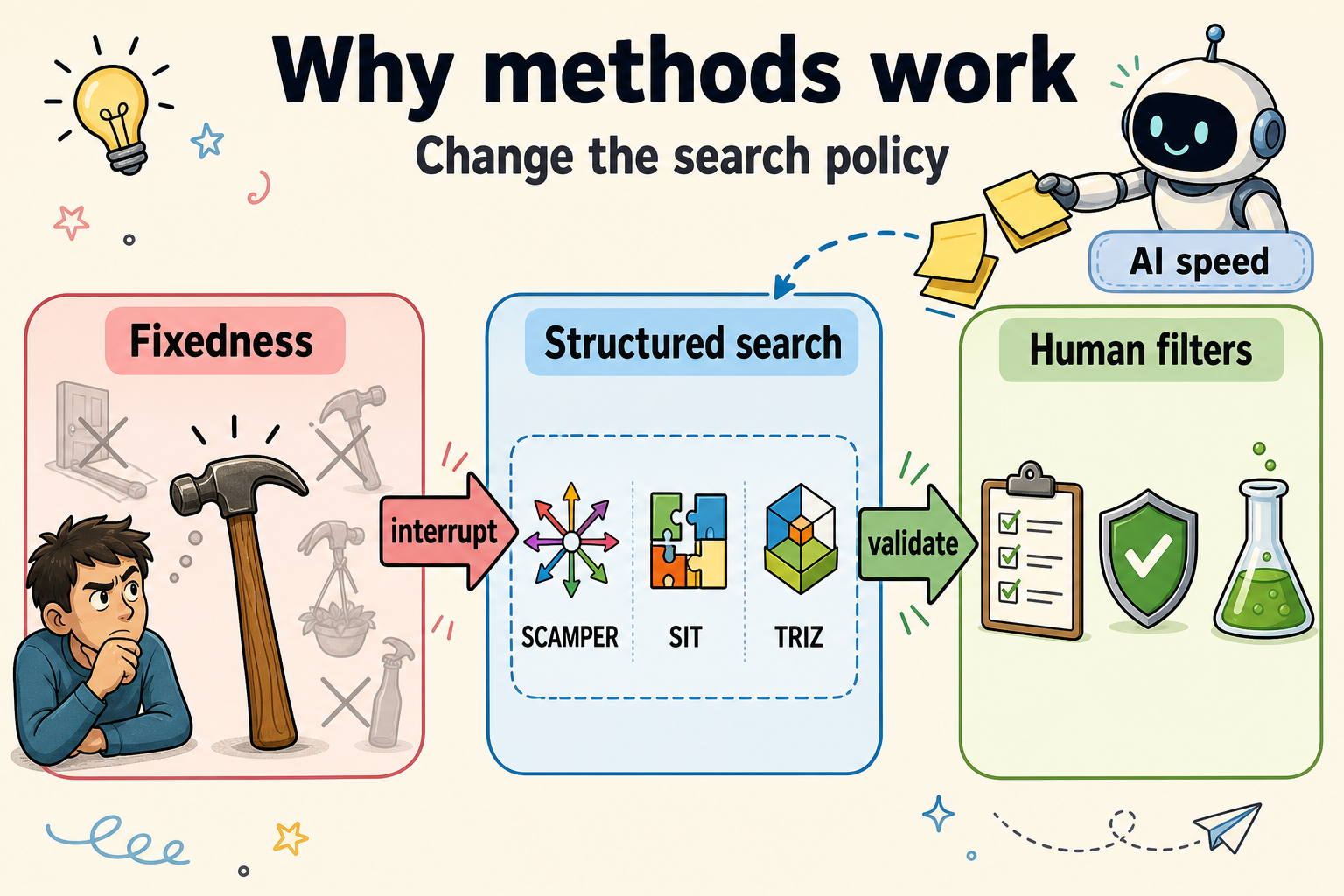
Humans exhibit cognitive fixedness: once a part has a familiar role, alternative roles become hard to see. Functional fixedness (Duncker) is the textbook case. Fluency biases push ideation toward high-probability, low-surprise completions. Quantity-first brainstorming can worsen this by flooding the room with ordinary ideas that anchor the group.
Structured methods interrupt that loop differently:
Method
Interrupt style
SCAMPER
External prompt schedule across transformation axes
Reframe as contradiction + retrieve non-local inventive operators
None magically create genius. They change the search policy over the idea space.
Contrarian scan (mandatory)
❓ What do critics and failure cases say?
Against TRIZ
Complexity tax: full TRIZ can consume training budgets that smaller firms never recover.
Matrix obsolescence risk: classical parameters map poorly onto pure software, data, and platform businesses without skilled abstraction.
Post-hoc storytelling: successful projects get labeled “TRIZ” after the fact.
School fragmentation: I-TRIZ, TOP-TRIZ, MATRIZ paths disagree on canonicity; buyers get confused.
Evidence mix: strong case lore; thinner independent multi-site experimental literature than marketing implies.
Against SIT
Closed World may block category creation when the right move is a new external platform or scientific effect (ironically something classical TRIZ sometimes imports via effects databases).
Template monotony: teams can overfit the five moves and miss problem redefinition.
Commercial halo: consulting packaging can outrun published critical evaluation.
Incremental pull: starting from today’s product privileges near-in innovation.
Against SCAMPER
Creativity theater: finishing the acronym feels like progress.
Shallow transforms: substitute/combine without system model.
Origin mismatch: a children’s imagination mnemonic stretched into enterprise strategy without filters.
Mixed experimental results versus other ideation treatments depending on task scoring.
Against the whole category
Methods cannot fix a wrong problem frame, toxic incentives, or missing domain expertise.
Facilitation skill often dominates method brand.
Organizations adopt methods as identity signals (“we are innovative”) rather than as measured search tools.
Strongest integrated counter-argument: Structured inventive methods improve average search behavior under fixedness; they do not guarantee breakthroughs, and heavy methods can destroy option value if they replace contact with users, physics, and economics.
Design Thinking boundary
❓ If we already “do Design Thinking,” do we need these?
Design Thinking is strong on empathy, framing, and iteration; it is often weak on systematic ideation mechanics, defaulting to brainstorming. Comparative teaching studies (including recent university design-method assessments) sometimes find TRIZ-like structured methods scoring higher on feasibility/transfer dimensions than pure intuitive DT for certain challenges — while DT can improve with participant experience. Practically: keep DT’s human loop; swap or augment the ideate step with SCAMPER/SIT/TRIZ rather than treating DT as a full substitute for inventive structure.
AI and EmTech interaction
❓ Do large language models make these methods obsolete, stronger, or more dangerous?
What AI changes
LLMs are fluent at executing checklists and templates. SCAMPER and SIT operators map cleanly to prompts (“Apply Subtraction to this system inventory…”). TRIZ principles can be retrieved and applied in bulk. That raises the floor of idea generation speed.
What AI does not remove
Problem ownership and real-world constraint truth.
Fixedness in the human approver who picks clichés from a polished list.
Validation — physics, regulation, customers, unit economics.
Contradiction honesty — models will happily “resolve” fake contradictions with word salad.
Defensible hybrid workflow
Human: define system inventory, contradictions, constraints, kill criteria
   ↓
AI: run SCAMPER + SIT five tools + TRIZ principle sweep at volume
   ↓
Human: Closed World audit, contradiction check, ethics/risk, strategy fit
   ↓
AI: stress-test and variant expansion on shortlist only
   ↓
Human+field: experiments
Trend classification (AI × structured ideation)
Trend: AI-assisted structured ideation adoption. Class:Stepwise / early logistic, not a measured exponential with a clean metric. Mechanism: software substitution of facilitation labor + falling inference cost. Bottleneck: evaluation quality and organizational absorption, not token generation. Reach: any white-collar domain that already runs workshops.
A team feeds a sacred legacy product into an LLM-SCAMPER loop, receives 200 sleek concepts in ten minutes, ships none — until a human SIT Closed World pass forces subtraction of the “untouchable” module and unlocks the only concept customers notice.
Significance for EmTech builders
❓ Why do pattern methods matter when the substrate (AI, robots, biotech) is itself exploding?
Emerging technologies raise option volume and coupling complexity. When capabilities jump, teams drown in “add the new thing” ideas (open-world clichés). Closed World SIT and TRIZ ideality push the harder question: what can be removed, unified, or contradiction-resolved so the new capability becomes a clean system, not a feature barnacle. SCAMPER remains the on-ramp that gets non-specialists generating before specialists deepen.
In OOM terms these methods are not EmTech themselves; they are cognitive tooling for shaping applications (LAC/PAC level) when EmTech capabilities become abundant.
Core mechanism (synthesis paragraph)
All three methods replace hope-based ideation with a constrained search policy: SCAMPER forces multi-axis prompts; SIT forces template edits inside a Closed World; TRIZ forces contradiction framing and retrieval of inventive operators distilled from prior invention. They work when fixedness and fluency would otherwise collapse search into clichés; they fail when the frame is wrong, evidence is skipped, or the method becomes ceremonial.
Practical recommendations
Teach SCAMPER universally as literacy.
Train product and process owners in SIT as the default inventive kit.
Keep TRIZ expertise for contradiction-heavy technical portfolios (internal specialists or partners).
Always budget filter and test time equal to generation time.
With AI, optimize for auditability (show which operator produced which idea) not for raw idea count.
Measure advance-to-experiment rates, not workshop happiness alone.