❓ What is TRIZ, and what hard-to-vary mechanism makes it more than a brainstorming brand?
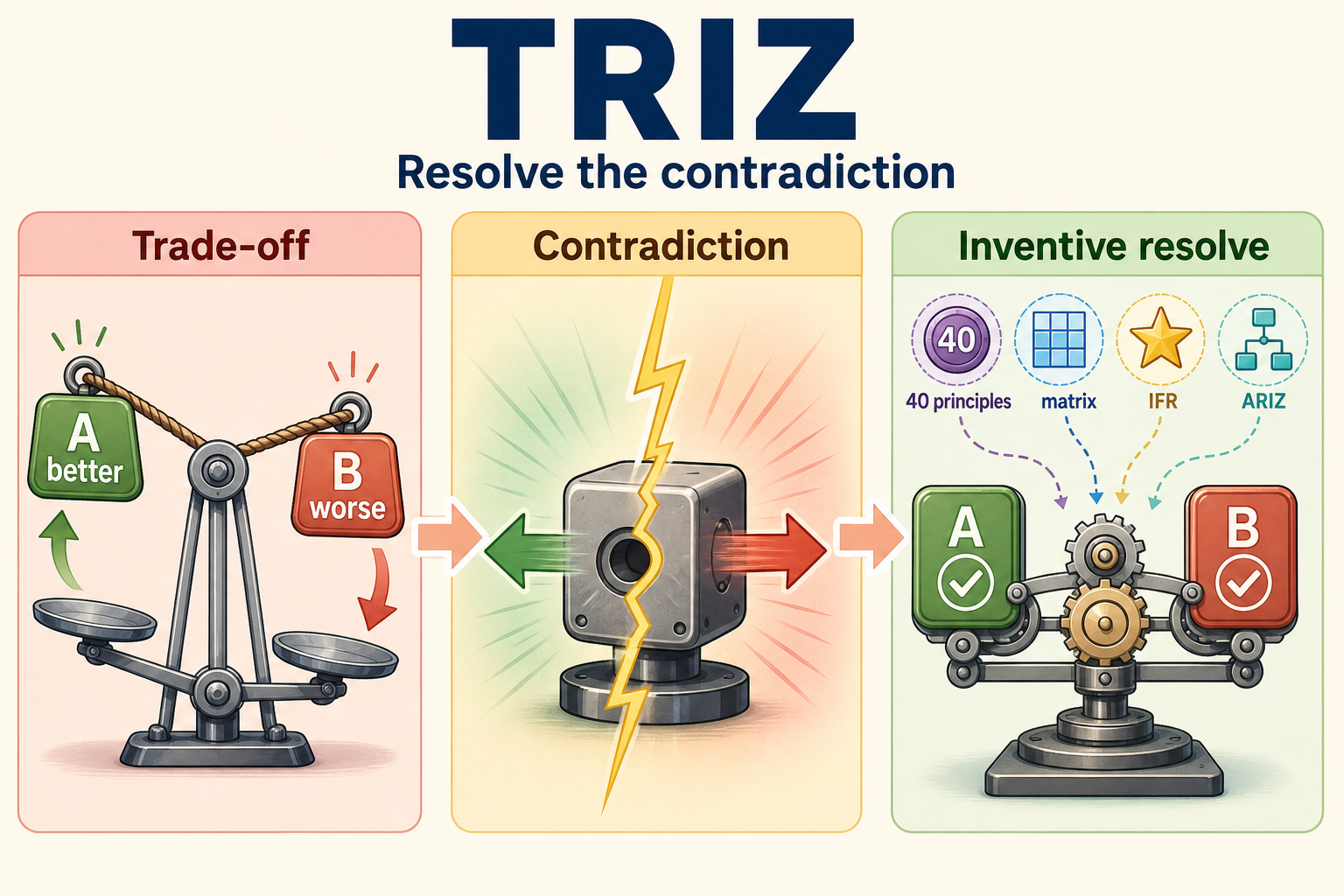
TRIZ contradiction resolve
TRIZ (Russian: теория решения изобретательских задач, teoriya resheniya izobretatelskikh zadach) is a structured methodology for inventive problem-solving built from patterns found in patent literature. In English it is usually called the Theory of Inventive Problem Solving. Development began in 1946 under Soviet inventor and science-fiction writer Genrich Altshuller, who worked in a navy inventions-inspection role evaluating proposals and patents. The method grew from the claim that inventive breakthroughs are not pure accidents of genius: they repeat as recognizable solution patterns across industries.
Core mechanism
❓ What is really happening when TRIZ “solves” a hard technical problem?
Definition: TRIZ treats many hard problems as contradictions: improving one parameter of a system worsens another. Routine engineering compromises (trade-offs). Inventive work, in Altshuller’s framing, removes or resolves the contradiction so both sides improve, or the conflict ceases to exist in that form.
Explanation: Altshuller and colleagues studied large numbers of patents (commonly cited figures range from tens of thousands in early work to claims of roughly 200,000 in later popular accounts — treat exact counts as source-variant). Three repeated findings structure the method:
Problems and solutions recur across industries and sciences.
Patterns of technical evolution also recur.
Scientific effects discovered in one field often solve problems in another.
From that base, TRIZ supplies reusable operators (especially the 40 Inventive Principles), indexing aids (the classical Contradiction Matrix over engineering parameters), and process frameworks (notably ARIZ, the algorithm for inventive problem solving), plus aspirational targets such as the Ideal Final Result (IFR) — the desired function achieved with minimal harmful side-effects and ideally “by itself,” with little system mass or cost.
Different from: Unstructured brainstorming aims to increase idea volume. Classical optimization aims to find the best trade-off on a Pareto front. TRIZ aims to restructure the problem so the trade-off is unnecessary or transformed.
Hard-to-vary test: You cannot replace “resolve the contradiction with a known inventive pattern” with “have more ideas” or “pick a clever metaphor” without losing what TRIZ claims to be. The mechanism is pattern transfer from prior inventive solutions to a newly formulated contradiction.
Refutability: TRIZ would be weakened if controlled studies showed that contradiction framing plus principle lists systematically underperform equally time-boxed structured alternatives on blinded idea quality and implementation success — or if most “TRIZ wins” turn out to be post-hoc labeling of solutions found another way.
Reach example: The same contradiction logic used for a mechanical seal can be applied, carefully, to a software performance vs. security tension or a service-capacity vs. personalization tension — if parameters are reformulated honestly.
Criticism note: The classical matrix is rooted in mid-20th-century engineering parameters; software, services, and AI systems often need translation layers. Training cost is high. Vendor and enthusiast literature sometimes overclaims ROI.
Altshuller’s research was interrupted in 1950 by arrest and a long sentence to the Vorkuta Gulag after he and Refael Shapiro criticized Soviet invention policy in letters to leadership. Released in the post-Stalin thaw, he returned to developing the method. The first academic paper linked to the line of work, On the psychology of inventive creation, appeared in 1956.
Main tools (practical inventory)
❓ Which TRIZ instruments does a practitioner actually reach for?
Tool
Role
Technical contradiction
Parameter A improves, parameter B worsens
Physical contradiction
Same object must have opposite properties (e.g., hot and cold, large and small)
Suggests which principles historically helped for pairs of conflicting parameters
Ideal Final Result (IFR)
Forces extreme usefulness / minimal harm framing before designing mechanisms
ARIZ
Heavy multi-step algorithm when lighter tools stall
Su-Field (substance-field) models
Abstract problem as interacting substances and fields; apply standard transformations
Laws / trends of technical system evolution
Forecasting and directed improvement (ideality, dynamization, transition to super-system, etc.)
Levels of invention
Rough typology from routine parameter change to discovery-level breakthrough
Not every engagement uses every tool. Many industrial programs teach a reduced “practical TRIZ” stack: contradiction + principles + IFR + a few standards.
Why this is a good explanation (TRIZ core)
The TRIZ claim is not “creativity is systematic” as a slogan. It is a specific causal chain:
Inventive history is compressible into recurring operators.
Hard problems often hide parameter conflicts.
Mapping a live conflict onto prior operators transfers non-local solution structure into the current domain.
That chain is hard to vary: drop patent-derived operators and you have ordinary facilitation; drop contradiction framing and you have a principle buffet without a problem model; drop ideality and you optimize local patches. It has depth (inner structure of inventive moves) and reach (cross-industry analogy). It remains fallible: matrix quality, facilitator skill, and domain translation all modulate outcomes.
Industrial footprint and evidence quality
❓ Who uses TRIZ, and how seriously should ROI stories be taken?
Public secondary sources associate TRIZ practice with firms such as Samsung, GE, Intel, Boeing, NASA, Procter & Gamble, automakers, and others. Case narratives include packaging, manufacturing, and semiconductor productivity claims. Treat company-reported ROI (for example, large multi-month Intel deployment figures circulating in TRIZ literature) as directional case evidence, not as independently audited science, unless finance verification is primary and detailed.
Evidence quality bar for this package: strong on history and tool structure from encyclopedic and specialist summaries; medium on comparative efficacy; weak-to-medium on universal ROI.
Name collisions and schools
❓ Why does “TRIZ” mean different things in different rooms?
Classical / MATRIZ-linked TRIZ — engineering inventive problem solving.
Commercial variants — e.g., Ideation’s I-TRIZ, practitioner systems such as TOP-TRIZ — extensions and repackagings; not identical.
Liberating Structures “TRIZ” — a workshop game about stopping counterproductive practices; only loosely inspired, not Altshuller’s method.
When someone says “we did TRIZ,” ask which stack they mean.
Trend note (method adoption, not EmTech curve)
Trend classification:Too data-poor to classify as exponential for “TRIZ capability.” Adoption appears stepwise and institutional (waves after Soviet emigration; corporate programs; periodic academic interest). Digitization and AI prompting may create a new stepwise wave, but that is a hypothesis, not a measured doubling curve.
Metric candidates if studied later: certified practitioners, patents acknowledging TRIZ, controlled experiment counts, software-tool usage. None are standardized enough here to claim a compounding rate.