A long-form essay
The Door They Meant, and the Door They Wrote
OpenAI, Navier–Stokes, and Clay’s four doors — 8 September 2026.
Last updated: 2026-09-16
On Sunday, 6 September 2026, Tristan Buckmaster sat on a call without his coauthor. Sébastien Bubeck of OpenAI was on the line. Buckmaster, a Courant Institute mathematician who had spent a year on a quiet route through fluid equations, was told that an internal model had produced a proof of finite-time blowup for the forced Navier–Stokes equations — about a hundred pages, on ordinary space and on the torus. The route, he later wrote, was “the one Levent and I had quietly chosen,” a route “almost nobody else I know of was working on.”
Two days later OpenAI published. The byline was the company. The prize, they said, they did not intend to claim.
That is not how the last Millennium problem was closed.
In 2010, Grigori Perelman refused a million dollars. Clay had awarded him the prize for the Poincaré conjecture, the only one of seven problems named in Paris in 2000 that anyone had solved. He told Interfax the decision was unjust: Richard Hamilton’s contribution was no smaller than his. He had already declined a Fields Medal. He lived with his mother in St. Petersburg and did not want to be looked at like an animal in a zoo.
OpenAI’s refusal is a different species. Perelman refused credit he thought was mis-split. OpenAI refused a cheque it had not waited to be offered, on a proof the field had not yet digested, produced by a model it would not name.
The two refusals rhyme. They do not mean the same thing.
A law for water that is not water
The Navier–Stokes equations are Newton’s second law written for a fluid treated as a continuous medium, not a swarm of molecules. At every point you keep a velocity and a pressure. Density is taken as constant — that is what incompressible means here — so volume is conserved. Viscosity is internal friction. An outside force, gravity for example, may push.
Claude-Louis Navier and George Gabriel Stokes wrote the skeleton in the nineteenth century. Engineers discretize it every day: wings, pipes, blood, weather. That daily use is not the prize.
The prize asks whether a perfectly smooth three-dimensional incompressible flow, with viscosity, must stay smooth forever, or whether the continuum description can produce infinite speed in finite time. Mathematicians call that finite-time infinity a blowup. A real fluid cannot move infinitely fast. If the equations do, the description has left the regime where it is valid.
Richard Feynman put a cousin of this discomfort in the first volume of his lectures: we cannot analyze, from first principles, wet water running through a pipe. He called circulating, turbulent fluids a physical problem common to many fields, very old, and unsolved. Blowup is not turbulence. Turbulence is typical disorder at finite speed. Blowup is a single solution becoming unbounded. They live in the same stretching. They are not the same question.
In two dimensions the optimistic theorem has long been known. Olga Ladyzhenskaya proved global unique solvability for the two-dimensional viscous equations. Three dimensions are different. A 3D flow can elongate rotation the way you stretch dough. That stretching has no 2D analogue. Energy, the one bound everyone has, does not control it.
The equations are supercritical relative to that bound. You can know the total kinetic energy and still not know whether motion is piling into a smaller and smaller region until derivatives explode.
Four doors in a PDF
On 24 May 2000, at the Collège de France, the Clay Mathematics Institute named seven problems and put a million dollars on each. Charles Fefferman wrote the Navier–Stokes statement. To give solvers leeway without losing the heart of the question, he asked for a proof of one of four statements.
(A) and (B): every allowed smooth initial velocity, with zero outside force, has a global smooth finite-energy solution — on all of space, or on a periodic box.
(C) and (D): there exist a smooth initial velocity and a smooth force, obeying the stated decay or periodicity, for which no such global solution exists.
(A) and (B) are the conversational problem. (C) and (D) are the written counterexample doors. Force is identically zero in the first pair. Force is allowed, but must remain smooth, in the second.
That split is not a loophole invented in 2026. It is page 2 of Fefferman’s official PDF.
Jean Leray, in 1934, had already shown that solutions exist in a weaker sense: they satisfy an integrated form of the equations and an energy inequality, but they need not be classically smooth. He called them turbulent solutions. He could not prove uniqueness. He could not prove they stayed regular for all time. During the war he was interned at Oflag XVII-A in Austria and, rather than work on fluids the Germans might use, built spectral sequences and sheaves in a prison-camp university. The 1934 paper remained the load-bearing wall. Clay put a million dollars on finishing the wall.
A weak solution is a solution that obeys the equations after you integrate against a test function and throw derivatives onto the test function. It can exist even when the classical velocity is not twice differentiable. Leray constructed such objects globally. Smoothness of those objects is the regularity question.
What the swarm actually built
OpenAI’s Theorem 1.1, in a manuscript authored as “OpenAI,” says this: for every positive viscosity there is a smooth force, compactly supported in space and time, and a flow that starts from rest, stays compactly supported, keeps uniformly bounded kinetic energy, and has velocity that becomes unbounded as time approaches 1. Compact support yields the periodic analogue. The authors identify these with Fefferman (C) and (D).
It is a forced blowup from rest. It is not (A). It is not (B). It is not unforced Navier–Stokes.
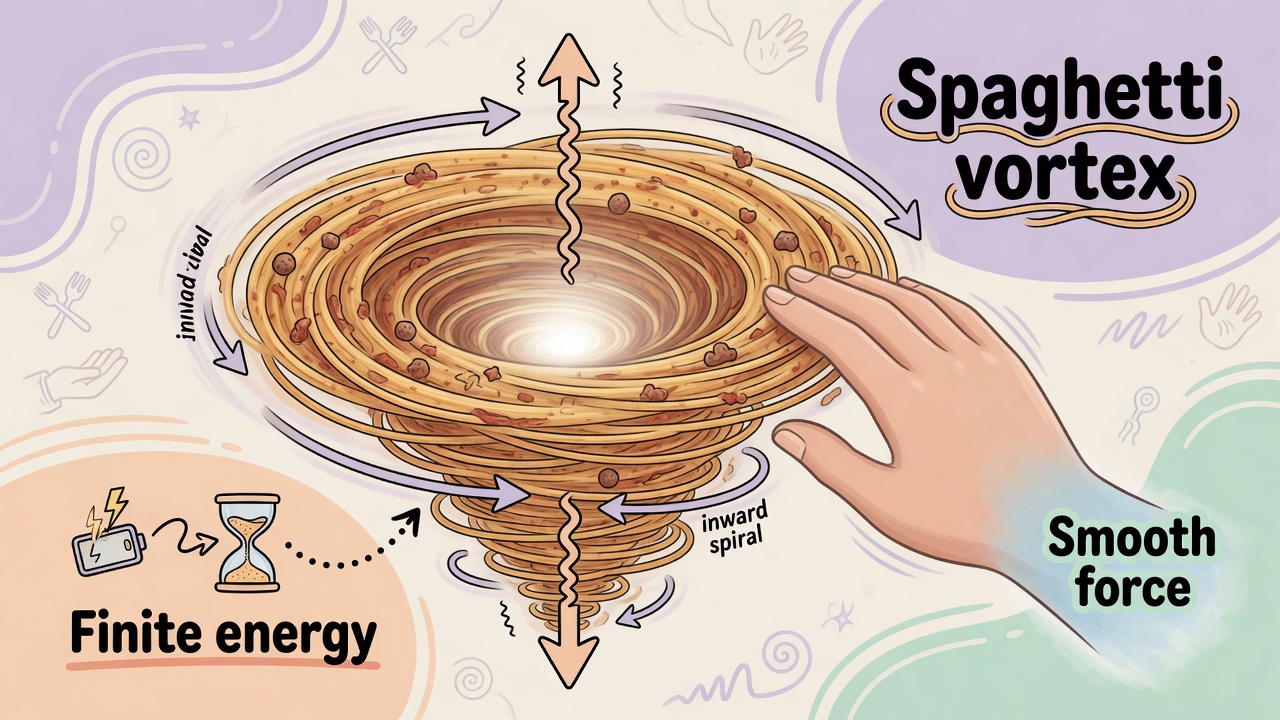
The constructed object is a vortex that spirals inward and elongates, “like spaghetti.” Radial width shrinks faster than axial length. Speeds rise. Volume falls fast enough that energy stays finite. Pressure drops toward the axis. Fluid goes up and down on opposite sides of a dividing layer.
If you define the outside force to be whatever leftover the momentum equation needs, every invented field “solves” Navier–Stokes. That is cheating. The constraint that makes (C) and (D) a real problem is that the leftover must stay smooth through the singular time. Individual terms — acceleration, inertia, pressure, viscosity — may diverge. Their sum and all its derivatives must extend smoothly.
The inner vortex alone leaves an imbalance in an annular matching region. Oscillatory pulses are placed there so their nonlinear fluxes cancel the singular part of that imbalance. Further corrections mop up remaining errors.
Remove the cancellation requirement and the problem collapses to “write down a blowing-up field.” Keep it, and the pulses and the self-similar core are the theorem.
OpenAI also claims a separate result: unforced incompressible Euler — viscosity set to zero — on ordinary space, compactly supported smooth initial data, velocity becoming unbounded. Euler is not on Clay’s list. It is the standard stepping stone.
Eighty-eight hours
The search model is not named. OpenAI says only that it is significantly more capable than GPT-6 Astra, a public generation announced days earlier, and that training of the internal model had been running since 28 August.
On Tuesday 1 September, after rumors that two Millennium problems had been resolved, the lab launched coordinating agents at the remaining prize problems. Agents could read a cached internet and run code. They were grouped. The Navier–Stokes group was of order ten thousand concurrent instances. Separate groups received variants A, B, C, and D.
A cousin problem — Euler, viscosity off — fell first: nearly a hundred agents, about fifty hours, unforced. Resources then shifted onto Navier–Stokes. Codex harvested useful lemmas across groups. A further-trained checkpoint was swapped in.
The Navier–Stokes resolution is dated Saturday 5 September, about eighty-eight hours after launch. Conversion into Lean — a proof assistant whose kernel checks each inference — took about seventeen more hours via GPT-6 Astra. On Navier–Stokes specifically: about 2.7 million messages and 130 billion output tokens. Across all attempted problems that week: about 300 billion output tokens. Press-conference dollar figures disagree: millions, about fifteen million if a customer ran the same job, twenty-two and a half million at Astra rates. The order of magnitude is millions. There is no audited invoice in public.
Lean is not the discovery. Lean is the critic that does not get tired. Without it you have an unread 165-page claim. With it you have a certificate other people can, in principle, typecheck.
The certificate is public. It is not yet socially verified. That is the ordinary state of a day-old proof, amplified by length and by a corporate byline.
The other clock
The same Tuesday, Buckmaster and Levent Alpöge posted finite-time blowup with smooth forcing for incompressible porous media, Boussinesq, and three-dimensional Euler, following Diego Córdoba and Luis Martínez-Zoroa, with heavy help from language models, Lean on the released pieces. They did not claim full Navier–Stokes. Terence Tao called the work remarkable and wrote that nothing in principle blocked extension all the way to Navier–Stokes given enough compute and AI.
That sentence reads as prophecy after OpenAI’s post.
OpenAI dates its effort to 1 September from a rumor later connected to Alpöge and Buckmaster. After Lean verification on the 6th, believing the rumor was Navier–Stokes, it says it reached out to offer a concurrent release. It then learned they had forced Euler, not Navier–Stokes. It recognizes their priority on forced Euler. It says researchers and agents did not see the pair’s work until public release, and that no specific user data was accessed. It cannot rule out that de-identified product data helped improve models. The Euler theorems, it notes, differ: forced versus unforced.
Buckmaster asked on the Sunday calls whether the model had been trained on Codex sessions containing their drafts. He was told the model did not look up user data. He did not get an answer on training. He alleges pressure to drop Alpöge because Alpöge works at Anthropic.
Those are allegations, specific and dated. They are not findings.
Córdoba, told of the Navier–Stokes claim, said he was a little in shock. If it was done, it would be a big surprise.
Keep the theorem and the process in separate columns. A correct proof can have an ugly priority story. An ugly priority story does not put a sorry in Lean. If unpublished drafts cannot safely live inside a lab’s coding agent, the labs that own the best agents become unavoidable coauthors of the fields they serve. That is a trust problem orthogonal to the kernel. What the contracts actually guarantee is the follow-on: enterprise “no training” is a real default on named SKUs; Zero Data Retention is a narrower storage control; consumer Codex is not Copilot.
What does not move
David Silvester told New Scientist, of the stepping-stone results, that a working Millennium theorem is unlikely to deliver practical benefit. Computational fluid dynamics already displaced most wind-tunnel use. “Nothing will change in the applications.” “A mathematical nicety.”
On a one-year engineering horizon he is right. Aircraft will not be redesigned from Theorem 1.1. Climate codes will not be rewritten in Lean. Blood is not a perfect Newtonian incompressible fluid filling all of space.
The reason to care anyway is the warranty those codes quietly assume: that the continuum PDE is a faithful model down to the grid. A certified blowup is a license to treat “the PDE failed” as a theorem rather than a superstition. Hybrid models that switch to particles near extreme concentration have a sharper existence proof of the regime they are built for.
That is not next quarter’s drag reduction. It is a boundary marker on a theory.
Clay has not spoken. Its rules require a qualifying outlet, two years, and general acceptance. Martin Bridson, Clay’s president, told New Scientist the evaluation is deliberately unhurried. Wikipedia’s same-day “disproved” language is premature. A lab PDF and a GitHub repo are not a prize.
Unforced three-dimensional Navier–Stokes — doors (A) and (B) — remains open even in OpenAI’s own frame. If you came asking whether the equations we fly planes with can spontaneously explode with no outside push, the answer as of 8 September 2026 is still: nobody has a Clay-grade yes or no.
Answers without understanding
Five days before the fluids burst, Tao had already used Navier–Stokes as a worked example of how an AI-generated solution could damage a field. After the announcement he told New Scientist there had been, this year alone, a strange decoupling between getting answers and getting understanding. Results arrive faster than the slow conversation that makes a theorem into knowledge.
Lean checks local logical steps. It does not check that the theorem is the theorem you cared about, or that a graduate student can rebuild the idea. Those are social.
If the field reads, rebuilds, and teaches the vortex cancellation in a year, the damage scenario weakens. If the proof remains an unread oracle, it strengthens.
The Commander’s Intent of the week is narrower than the headlines. OpenAI closed, if the certificate holds, a door Fefferman wrote. Many specialists still live in a different house: unforced smoothness, no extra hand. Both houses are real. Only one of them is the PDF.
Do not change a wing design on this news. Do change what you think a weekend of agents plus a kernel can finish, and what you are willing to store in a lab’s coding tool while you finish it.
The last person to close a Millennium door walked away from the money because credit was, in his view, unjust. This time the money was declined in advance, the author is a company, and the argument is a vortex that looks like spaghetti, checked by a machine, published before the field has had time to look.
The door they wrote may now be shut. The door they meant is still open. The new instrument is the swarm. Whether mathematics can still understand what it can now obtain is the problem that replaces the one that just fell.
References
Research appendix (this site)
- Research appendix home
- Research index
- What the prize asks
- Why mathematics
- Physical world
- What was proved
- How they did it
- What it unlocks
- Credit
- What the contracts actually guarantee
- Contrarian scan
- Outlook
- Question ledger
- External primary sources
Primary sources
- OpenAI announcement
- Fefferman / Clay PDF
- Lean formalization
What the contracts actually guarantee
Enterprise no-training, Zero Data Retention, and why the All-In leak story is mostly consumer Codex — not Copilot.
Full dossier
Nine research chapters, sources, illustrations, napkins, and the question ledger behind the essay.
Pick a real place. Use what this essay made possible. You lead.