Research · Supercritical PDE
Why mathematics
Last updated: 2026-08-12
A flagship supercritical equation
❓ Why has this particular PDE sat on a pedestal for a century?
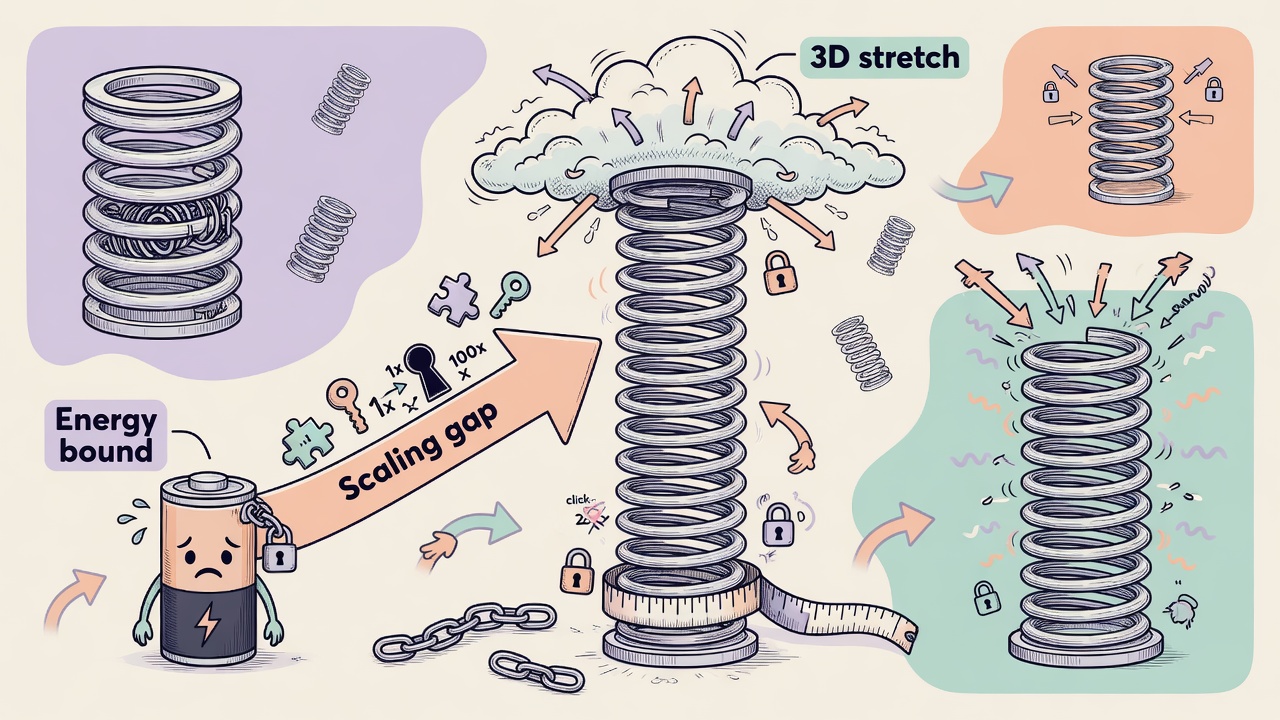
The three-dimensional incompressible Navier–Stokes system is a supercritical nonlinear PDE. The one estimate everyone has — conservation or dissipation of kinetic energy — controls a norm that is too weak to control the scaling-critical regularity. In slogan form: you can bound the total energy, but you cannot, from that bound alone, stop the flow from piling its motion into a smaller and smaller region until derivatives explode.
Definition: A PDE problem is supercritical (relative to its natural a priori estimate) when the controlled quantity sits below the scaling that would lock down smoothness.
Explanation: If you zoom into a small region and rescale, the nonlinear stretching can look stronger than the viscous smoothing. Energy does not forbid that zoom. That is why two-dimensional theory, small-data theory, and short-time theory all exist, and why the large-data, long-time, three-dimensional problem does not follow from the same estimates.
Different from: This is different from a calculation that is merely long. Length is not the obstruction. The obstruction is a scaling gap.
Hard-to-vary test: If energy did control the critical norm, the Millennium problem would already have fallen to textbook perturbation theory.
Refutability: A new coercive estimate that closed the scaling gap would refute “supercriticality is why it is open.”
Reach example: The same supercritical diagnosis appears in other unsolved regularity problems. Navier–Stokes is the public face of that class.
Criticism note: “Supercritical” is a precise scaling statement, not a mood. It does not by itself predict blowup. It predicts that known estimates do not decide.
Fefferman’s closing remark in the official statement is the mathematical motive in one paragraph: fluids are important and hard; we do not even know whether the solutions we talk about exist in the classical sense; standard PDE methods appear inadequate; new ideas are probably required.
What a resolution does to the field
❓ What changes in mathematics if one of the four doors closes?
A positive proof of (A) or (B) would mean the continuum 3D viscous incompressible model is globally well-posed in the smooth class for the allowed data. That would be a foundational well-posedness theorem, the kind the field uses as a load-bearing wall.
A proof of (C) or (D) would mean the opposite wall: there exist admissible smooth data (and, in those doors, a smooth force) for which smoothness cannot be continued forever with bounded energy. The model can fail while still obeying every smoothness condition Clay put on the inputs.
Either way, the result is not a new numerical method. It is a theorem about the object that numerical methods discretise.
Partial results already shape the landscape:
- Leray (1934): global weak solutions.
- Caffarelli–Kohn–Nirenberg (1982), simplified by Lin (1998): the singular set of a suitable weak solution is small in a parabolic Hausdorff sense — small enough to forbid a spacetime curve of singularities, not small enough to forbid isolated ones.
- Escauriaza–Seregin–Šverák: a scale-invariant boundedness criterion for the unforced problem.
- Tao: finite-time blowup for an averaged Navier–Stokes equation that keeps energy cancellation — a warning that nearby equations do blow up.
- Buckmaster–Vicol: nonuniqueness among finite-energy weak solutions via convex integration.
- Albritton–Brué–Colombo: distinct suitable Leray–Hopf solutions from rest with the same force, the force being rough at the initial time.
None of those is Fefferman (A)–(D). They are the mountain path. A Clay-door theorem would be a summit of a particular kind.
Among the seven problems
❓ How does Navier–Stokes sit next to Poincaré, Riemann, and P vs NP?
The seven Millennium problems were chosen as deep, long-open, central questions. As of early 2026 only Poincaré had been solved, by Grigori Perelman, with the Clay prize later declined. Navier–Stokes is the analysis/PDE representative. Riemann is arithmetic. P vs NP is computation. Yang–Mills is quantum field theory in a mathematical cloak.
A Navier–Stokes resolution is therefore not “the hardest problem” in some universal ranking. It is the fluids-and-PDE community’s public unsolved problem, and one of the last classical-physics equations whose basic well-posedness was still open.
If OpenAI’s (C)/(D) claim survives, it would be the second Millennium problem with a serious claimed solution — and the first whose writeup is authored as “OpenAI” and machine-checked in Lean at the moment of announcement. That is a sociological fact about mathematics, not a substitute for refereeing.
Turbulence is nearby, not identical
❓ Is the Millennium problem the same as “solving turbulence”?
No. Richard Feynman called turbulence a great unsolved problem of classical physics. Kolmogorov’s 1941 theory gives statistical predictions for energy cascades. Deriving that statistical picture from the PDE, with theorems, is a different project from proving or disproving global smoothness of individual solutions.
A blowup is a single solution becoming unbounded. Turbulence is typical, persistent, multi-scale disorder at finite speed. You can have (and do have) turbulence in flows that every engineer treats as smooth at continuum scales.
The link is this: both difficulties live in the same nonlinear stretching. A constructed singularity is a certificate that stretching can overwhelm viscosity in the PDE. It is not a theory of chaotic cascade statistics.