Research · Four doors
What the prize asks
Last updated: 2026-08-12
A continuum law for fluids
❓ What do the Navier–Stokes equations say is happening in a fluid?
The Navier–Stokes equations are Newton’s second law written for a fluid that is treated as a continuous medium rather than a swarm of molecules. At every point you keep a velocity vector \(u(x,t)\) and a pressure \(p(x,t)\). The fluid is assumed incompressible: density is constant, and volume is conserved, which is written \(\nabla \cdot u = 0\). Viscosity \(\nu > 0\) is internal friction. An optional external force \(f(x,t)\) (gravity is the usual example) may push the fluid.
Definition: A continuum description means the fluid is a field — a value at every point — not a list of particles.
Explanation: Each tiny parcel accelerates because pressure differences push it, neighbouring parcels drag it through viscosity, it is carried by the flow it is already in (the nonlinear term \((u \cdot \nabla)u\)), and an outside force may act. The nonlinearity is the source of almost all of the mathematical difficulty: the fluid advects its own velocity.
Different from: This is different from a molecular simulation, which tracks collisions, and different from an engineering CFD run, which replaces derivatives by numbers on a grid.
Hard-to-vary test: You cannot drop the nonlinear term and still be talking about real fluid inertia. You cannot set viscosity to zero and still be talking about Navier–Stokes rather than Euler.
Refutability: If a real fluid’s motion, in a regime where the continuum hypotheses hold, systematically refused to match solutions of these equations, the model would be the wrong physics.
Reach example: The same skeleton describes air over a wing, water in a pipe, and, with extra physics, large-scale atmosphere. The Millennium problem is about the idealised incompressible 3D case, not every variant.
Criticism note: Real air is compressible; real blood is not a perfect Newtonian fluid. The prize isolates a clean mathematical object.
The equations were written in the nineteenth century by Claude-Louis Navier and George Gabriel Stokes. They are used, in discretised form, for aircraft, weather, blood flow, and combustion. That daily use is not the prize. The prize is about whether the continuum PDE is globally well behaved.
Existence, smoothness, blowup
❓ What would it mean for these equations to “break”?
Jean Leray proved in 1934 that solutions exist in a weak sense: they satisfy an integrated form of the equations and an energy inequality, but they need not be classically smooth. The remaining question is whether a solution that starts smooth stays smooth for all future time, or whether it can develop a singularity in finite time — velocity becoming unbounded as t approaches some finite T.
Mathematicians call that finite-time singularity a blowup. Because a physical fluid cannot have infinite speed, a blowup would mean the continuum model has left the regime where it is a valid description. One would then have to descend toward molecular tracking, or another finer theory, near the singular event.
In two space dimensions, global smoothness has been known for a long time (Ladyzhenskaya). Three dimensions are different. Vortex stretching — the way a 3D flow can elongate and intensify rotation — has no 2D analogue. Local-in-time smooth solutions exist. Small initial data stay smooth. For large data, there is a maximal time T, and the question is whether T can be finite.
The four official doors
❓ What, exactly, did Clay ask someone to prove?
In 2000 the Clay Mathematics Institute named seven Millennium Prize Problems and attached one million dollars to each. Charles L. Fefferman wrote the Navier–Stokes statement. To “give reasonable leeway to solvers while retaining the heart of the problem,” he asked for a proof of one of four statements.
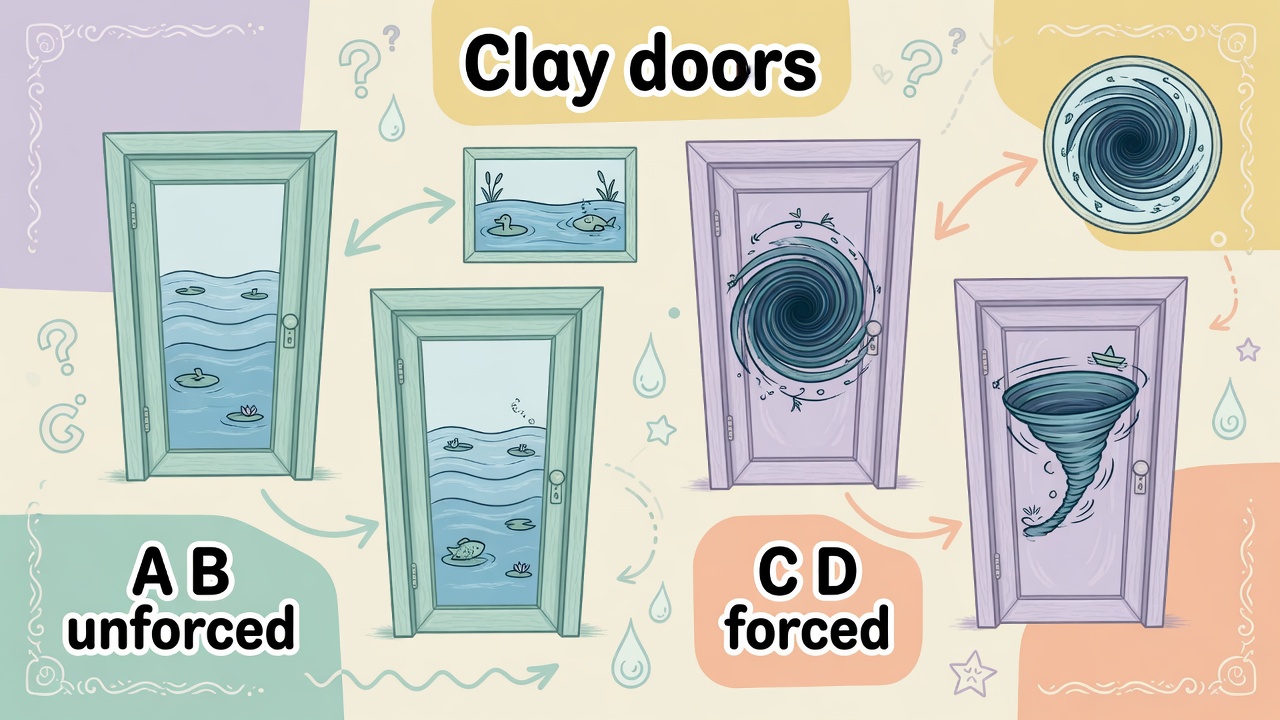
(A) On all of three-dimensional space, with zero external force: every smooth, rapidly decaying, divergence-free initial velocity has a global smooth finite-energy solution.
(B) The same on the periodic box \(\mathbb{R}^3/\mathbb{Z}^3\), again with zero force.
(C) Breakdown on \(\mathbb{R}^3\): there exist a smooth initial velocity and a smooth force, obeying the stated decay, for which no global smooth finite-energy solution exists.
(D) Breakdown on the torus, with a smooth periodic force.
(A) and (B) are the optimistic global-regularity theorems. (C) and (D) are admissible counterexamples. Force is identically zero in (A) and (B). Force is allowed, but must remain smooth and satisfy decay or periodicity, in (C) and (D). That is not a rumour. It is page 2 of Fefferman’s official PDF.
Definition: Physically reasonable, in Fefferman’s text, means the velocity and pressure stay smooth, and (on \(\mathbb{R}^3\)) kinetic energy stays bounded.
Explanation: Clay did not require a solver to prove both “always smooth” and “sometimes breaks.” One complete alternative is enough. A forced breakdown is an official alternative, not a consolation prize hidden in a footnote.
Different from: This is different from the sentence many scientists say in conversation — “do the equations always stay smooth with no extra pushing?” That conversational problem is (A)/(B). The written problem includes (C)/(D).
Hard-to-vary test: If you delete (C) and (D) from Fefferman, OpenAI’s claimed theorem would not match the prize statement. If you keep them, a smooth-force blowup is in scope.
Refutability: The mapping is refuted if Clay later states that this construction is not a complete solution to the official description.
Reach example: The same four-door structure is why a lab can say “we solved the Millennium problem” while specialists say “you did not solve the problem we teach.” Both sentences can be using different doors.
Criticism note: The gap between the written doors and the community’s favourite door is the main source of confusion in 8 September 2026 coverage.
Fefferman also notes that the same questions are open and important for the Euler equations (viscosity zero), but Euler is not on Clay’s prize list.
Why this explanation is a good explanation
The four-door account is hard to vary: the force is zero in (A)/(B) and allowed in (C)/(D) because Fefferman wrote it that way, not because a commentator prefers it. It has depth: it distinguishes continuum PDE, weak solutions, and engineering discretisations. It has reach: the same distinction applies to every later claim in this package. It is testable: open the PDF. It is fallible: Clay, not this package, is the last word on completeness.