Research · Spaghetti vortex
What was proved
Last updated: 2026-08-12
The theorem in one paragraph
❓ What is the precise claim, without headline inflation?
OpenAI’s manuscript Finite Time Blowup for Navier–Stokes, authored as “OpenAI,” states Theorem 1.1: for every viscosity \(\nu > 0\) there exist a smooth force, compactly supported in space and time, and smooth velocity and pressure on \(\mathbb{R}^3 \times [0,1)\) solving incompressible Navier–Stokes, starting from rest, remaining compactly supported in a fixed spatial set, with kinetic energy uniformly bounded, such that the velocity becomes unbounded as \(t \to 1\). Consequently there is no global smooth finite-energy continuation. Compact support yields the periodic analogue (Corollary 10.6). The authors identify these with Fefferman (C) and (D).
That is a forced blowup from rest. It is not (A) or (B). It is not unforced Navier–Stokes. OpenAI’s accompanying Euler paper is a different theorem: unforced incompressible Euler on \(\mathbb{R}^3\) with compactly supported smooth initial data, \(C^1\) velocity unbounded, and the Beale–Kato–Majda integral of vorticity diverging.
Confirmed (8 September 2026): the public artifacts exist — company post, PDF, GitHub Lean project openai/NavierStokesAndEuler.
Credible but unconfirmed: that the Lean build is complete and faithful to Fefferman, and that the 165-page analysis has no gap. The community has had hours.
Weak / rumor: any claim that Clay has accepted a solution, or that unforced 3D Navier–Stokes is settled.
The spaghetti vortex
❓ What does the constructed fluid actually do?
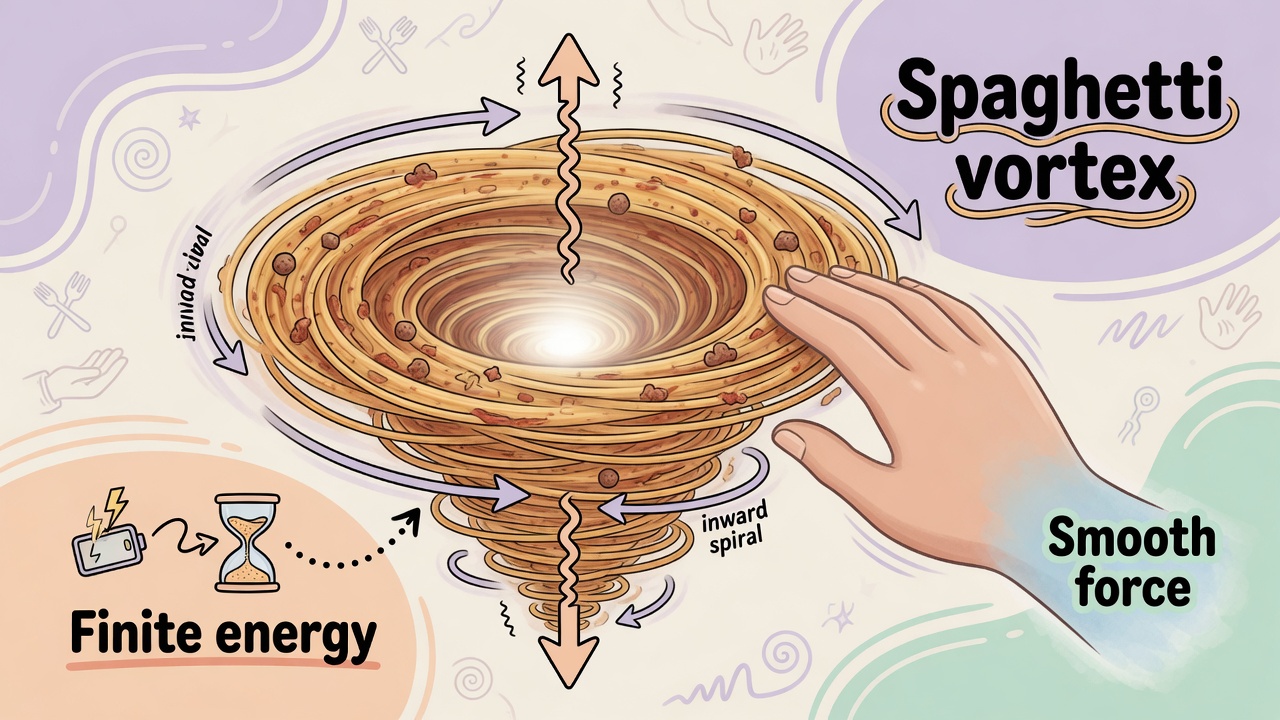
The solution is described as a vortex that spirals inward and elongates, “like spaghetti.” The core’s radial width shrinks faster than its axial length. Speeds rise; volume falls fast enough that energy stays finite. In cylindrical coordinates the leading inner flow is axisymmetric: inward spiral, axial outflow on opposite sides of a dividing layer near \(z = 0\), pressure dropping toward the axis so that centripetal force is supplied.
To leading order the core is self-similar. Writing \(\tau = 1-t\) for time remaining, both lengths tend to zero, the core becomes a thinning column, and characteristic speeds grow. OpenAI’s physical section claims the angular Reynolds number diverges (many turns per radial diffusion time) while the radial Reynolds number stays bounded (viscosity still competes with inflow). Kinetic energy of the core is argued to vanish even as peak speed diverges, because volume shrinks faster than speed squared grows.
A slightly broken reflection symmetry is used so that needed shear near the midplane does not vanish.
Why the force is the whole game
❓ If you can choose the force, isn’t blowup trivial?
If you define f to be whatever residual the momentum equation needs, every invented field “solves” Navier–Stokes. That is cheating, and everyone knows it. The constraint that makes (C)/(D) a real problem is that f must be smooth (and rapidly decaying or periodic) through the singular time. Individual terms in the residual — acceleration, inertia, pressure, viscosity — may diverge. Their combination must cancel so that the leftover force and all its derivatives extend smoothly.
Definition: The momentum residual is the failure of a candidate field to satisfy Navier–Stokes; when you call that residual “the force,” smoothness of the residual is the theorem.
Explanation: The inner vortex alone leaves an imbalance in an annular matching region. Oscillatory pulses are placed there so that their nonlinear fluxes cancel the singular part of that imbalance. Further corrections mop up remaining errors. The published proof outline runs through constructing a leading flow, correcting it to every order, separating oscillatory supports, realizing residual stress, compactly supported mean corrections, and finally compact forcing on the whole space.
Different from: Albritton–Brué–Colombo’s force, which is not smooth at the initial time. Clay (C)/(D) demand smoothness of f.
Hard-to-vary test: Remove the cancellation requirement and the problem collapses to “write down a blowing-up field.” Keep it, and the pulses and the self-similar core are load-bearing.
Refutability: A demonstration that the residual fails to be \(C^\infty\) through \(t=1\), or fails Clay’s decay, would kill the prize mapping.
Reach example: The same “big terms, smooth sum” pattern is how one builds many weak or distributional solutions. Here it is pushed all the way to a classical force.
Criticism note: Smooth forcing is exactly what some experts “did not mean.” Scientific American recorded that split: the Clay problem as written versus the Clay problem as imagined. This package treats both as real.
Historical placement inside the manuscript
❓ What prior work does the construction sit on?
The paper’s own genealogy includes Leray; Caffarelli–Kohn–Nirenberg; Escauriaza–Seregin–Šverák; Tao’s averaged blowup; Buckmaster–Vicol convex integration; Albritton–Brué–Colombo; Lifschitz–Hameiri and Friedlander–Vishik wave dynamics; Billant–Gallaire centrifugal instability; Singh–Sridhar viscous shearing waves; Daneri–Székelyhidi oscillatory stress for Euler.
That list is the authors’ citation frame. It does not include, in the announcement essay, a full accounting of the Córdoba–Martínez-Zoroa → Buckmaster–Alpöge forcing program. The concurrent-work paragraph of the blog post does name Alpöge and Buckmaster and concedes priority on forced Euler. The mathematical route-overlap is the controversy in 07.